


Microsoft CEO Satya Nadella announced on October 7 that Windows is entering the era of “Hybrid Intelligence”: bringing AI compute without quota limits to every desk and every home, making every PC a place where AI agents can safely work on behalf of users. On the same day, at a launch event in San Francisco, Microsoft unveiled a local flagship model, a Copilot architecture overhaul, secure containers for agents, and a new generation of Surface hardware co-engineered with NVIDIA.
137B-Parameter Coding Model Runs on a PC; 3-Bit Quantization Compresses It by Nearly 80%
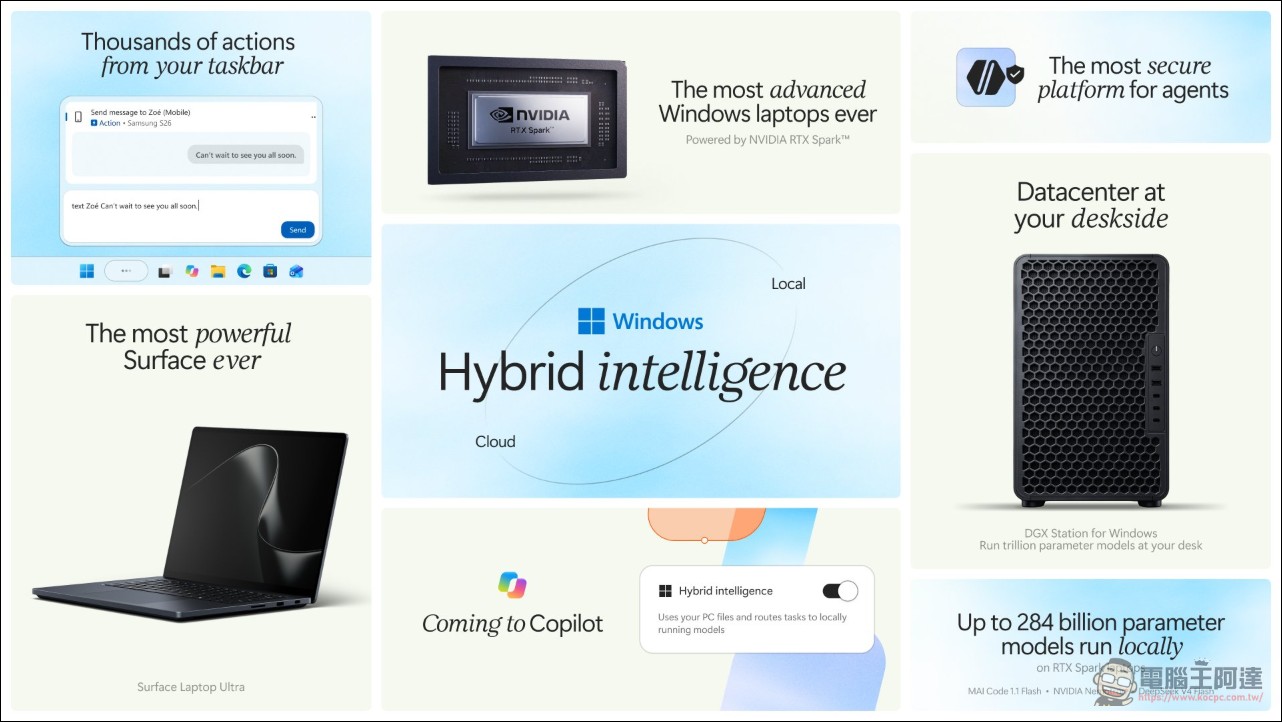
Microsoft has officially brought MAI-Code-1.1 Flash, announced at this year’s Build conference, to the device side. It is a code model with 137B total parameters and 6.8B active parameters, supporting a 256K context window; through 3-bit precision, it compresses the model size by nearly 80% while preserving coding quality, allowing it to run locally on ordinary PCs. Microsoft also introduced third-party open-weight models: NVIDIA’s upcoming Nemotron series has over 70B parameters and, after 2-bit quantization, uses only about 20GB of memory; DeepSeek V4 Flash reaches 284B parameters and also runs locally on RTX Spark. NVIDIA added that RTX Spark can run Qwen 3.8 Flash Next, a 125B model, with intelligence that can rival many cloud models, and data does not need to be sent to the cloud.
Copilot Takes Over Local Work: “Your PC Turns Into an Infinite Software Factory”
In Nadella’s rundown, GitHub Copilot will now dispatch work to local models like MAI-Code-1.1 Flash, dramatically reducing project costs without compromising quality. The mechanism behind this is GitHub’s HydraFusion intelligent routing: it originally assigned tasks only to suitable cloud models, but now extends to local models on nearby devices, making every token count; this feature will arrive in the GitHub Copilot app, CLI, and Visual Studio Code as an experimental preview in late October.
Today marks a new chapter for Windows, as we bring unmetered intelligence to every desk and every home, and make every PC a place where agents can work securely on your behalf. Some highlights of what we announced: • MAI-Code-1.1 Flash: 137B parameter coding model w/ 256K context window, which is now optimized to run on your PC! • GitHub Copilot now hands off work to local models like MAI-Code-1.1 Flash, helping projects cost a lot less without sacrificing quality. • With Hybrid Intelligence, Copilot can now take action directly on the PC and keep sensitive work on your device. • And with Code in Copilot, you can essentially build any software you need on your desktop, without any cloud token spend, and it’s just super at it. You’re no longer limited to what’s in an app store! Your PC becomes an infinite software factory. • Security is foundational to all this, which is why we are also bringing together Windows and Agent 365 so agents can work within secure boundaries on-device, including MXC a local sandbox for agent execution. Windows becomes your secure agent box! • All this comes to life on a new generation of devices, like Surface Laptop Ultra, powered by NVIDIA RTX Spark. Can’t wait to see what you build with all this.
— Satya Nadella (@satyanadella) October 7, 2026
Copilot itself also gains three local capabilities on Copilot+ PCs: after obtaining user authorization, it can read files and recent activity on the PC as local context; act directly on the user’s behalf on Windows (organizing files, diagnosing devices, troubleshooting, and coding); and invoke local models on the PC. Nadella specifically called out “Code in Copilot”: users can build any software they need on the desktop, with no cloud token costs at all, “no longer limited by what’s in the app store; your PC becomes an infinite software factory.” At the runtime level, Microsoft announced that Windows ML will support llama.cpp, enabling developers to try emerging open-source models faster.
MXC Container Officially Launches, Turning Windows into a “Secure Proxy Box”
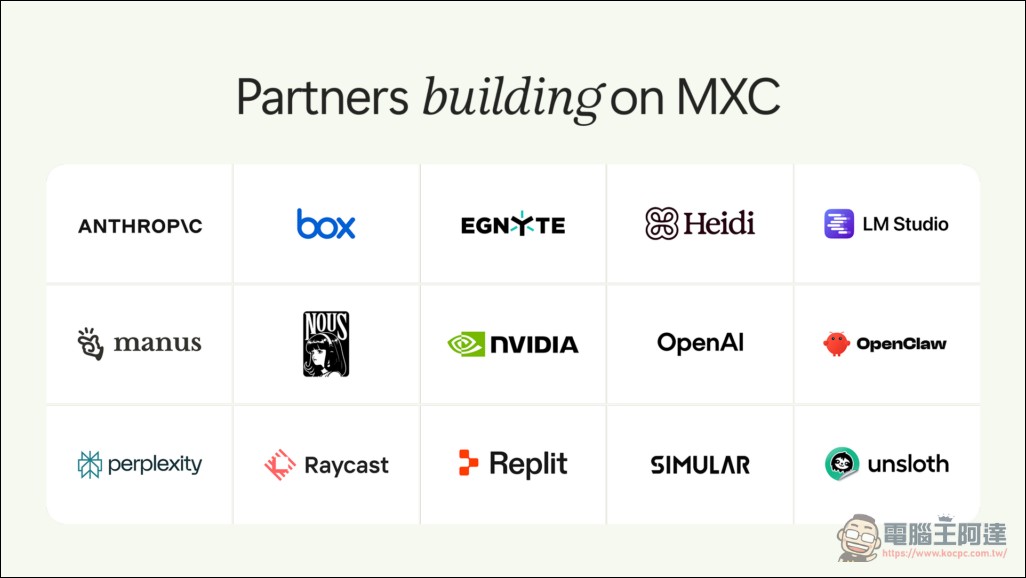
Agents run around the clock, write code, and access files; traditional sandbox designs can’t keep up. Microsoft has made Microsoft Execution Containers (MXC) generally available (GA) on Windows 11: organizations can define which files and networks agents can access, policies are enforced at runtime, and isolation options range from process and session isolation, WSLc, and virtual machines to Windows 365 for Agents. MXC integrates with Microsoft Agent 365 and Intune, enabling enterprises to set policies, monitor risks, govern agents at scale, and distinguish “which agent did what” from the user’s own activity. Nadella says this makes “Windows your secure agent box.”
Agents already supporting MXC include OpenAI Codex, GitHub Copilot, Replit, LM Studio, NVIDIA OpenShell, and Unsloth AI; Anthropic Claude Code, Nous Research’s Hermes Agent, Manus, Perplexity, Raycast, and others are also scheduled to follow, and Meta’s personal AI agent Muse for Windows is also coming soon.
Surface Laptop Ultra opens for pre-order; RTX Spark laptop ships October 16.
On the hardware side, the Surface Laptop Ultra equipped with NVIDIA RTX Spark is available for preorder at $2,599 (about NT$83,000), with up to 128GB unified memory and 1 petaflop of FP4 AI compute, and “can run models that traditional machines can’t fit,” said Pavan Davuluri, head of Microsoft’s Windows and Devices division. RTX Spark combines a Blackwell-generation RTX GPU (up to 6,144 cores) with a Grace CPU with up to 20 cores, linked at 600GB/s. RTX Spark laptops ship on October 16, and small desktop models go on sale in November, with corresponding designs from Acer, ASUS, Dell, HP, Lenovo, MSI, and Gigabyte; for enterprises, there is also DGX Station for Windows, bringing GB300-class AI infrastructure to the office desk.
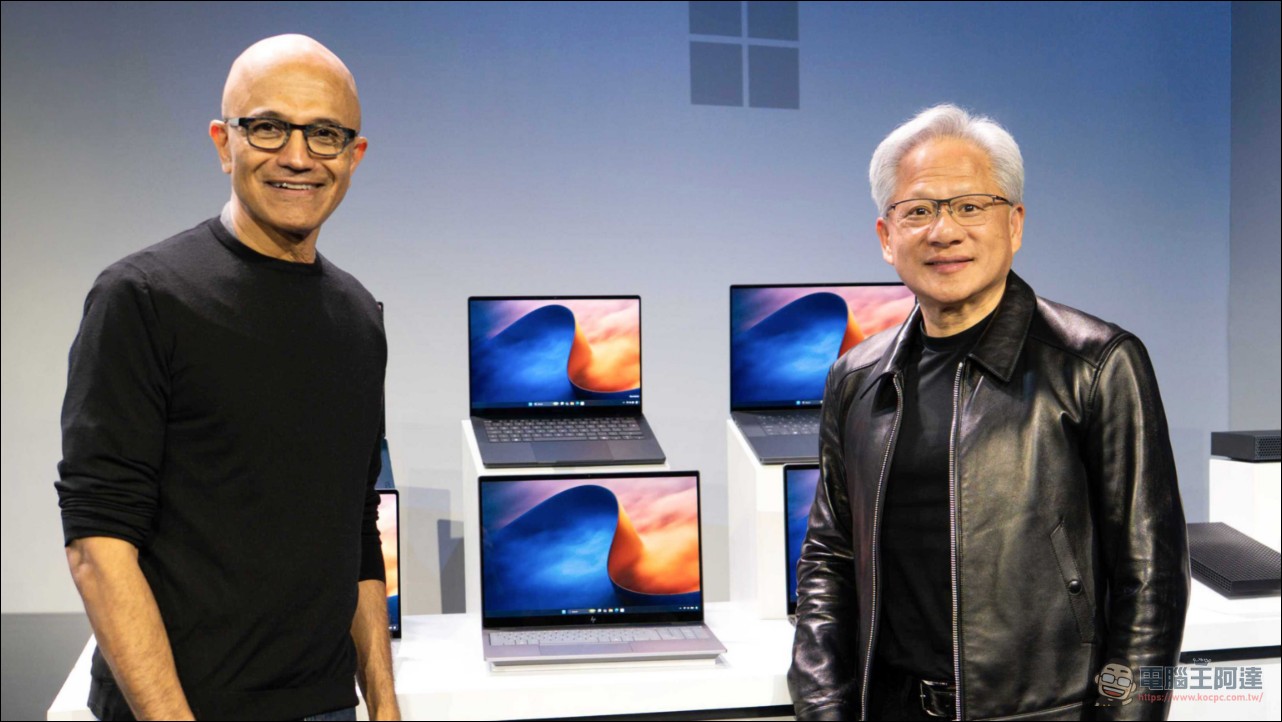
The press conference closed with a conversation between NVIDIA CEO Jensen Huang and Nadella. Huang traced NVIDIA’s ties to Windows: “Without Windows, there would be no GeForce.” He framed the agent era as a shift in the PC’s role: “When an agent is on your computer, it is your personal assistant.” Nadella laid out the strategic core of the announcement: “We need to make the desktop the safest place for agents to run.” From models, routing, and secure containers to silicon, Microsoft turned “keeping AI local” from a hobbyist DIY setup into a platform-level first-class citizen.
Source:Windows Blogs
Source: KOCPC Chinese