


This may be the biggest open-source news recently: ArtCraft has released the Craft series software, an AI remake of Adobe’s seven-piece suite, and it’s free and open source! Everyone knows Adobe is an everyday essential tool for most people in creative work, but the company will stop at nothing to make money—it often raises subscription fees without warning, users who want to cancel must go through tedious, lengthy steps, and Adobe even uses contract traps to hit users with fines. But Adobe’s UI and workflows have already built muscle memory in many users, making the cost of switching platforms very high; it could be said that “the world has long suffered under Adobe.” But this situation may be about to change. Recently, Adobe’s most widely used “seven-piece suite” software was remade from scratch by an open-source team in Rust, and it was all open-sourced.

ArtCraft releases an AI-rebuilt seven-piece Adobe suite, open source and free to download.
From September 30 to October 1, the GitHub organization “storytold” (website name ArtCraft) launched seven projects in succession, corresponding to Photoshop, Illustrator, Premiere Pro, Lightroom, Acrobat, After Effects, and InDesign. All were written in Rust and dual-licensed under MIT/Apache-2.0, so anyone can download, modify, and redistribute them for free. On Reddit, the author said he used Anthropic’s AI model Claude Opus 5.5 to help build these seven pieces of software. Within a week, the Photoshop-like PhotoCraft had accumulated more than 5,700 stars, and nearly all of the other six projects had surpassed 1,000.
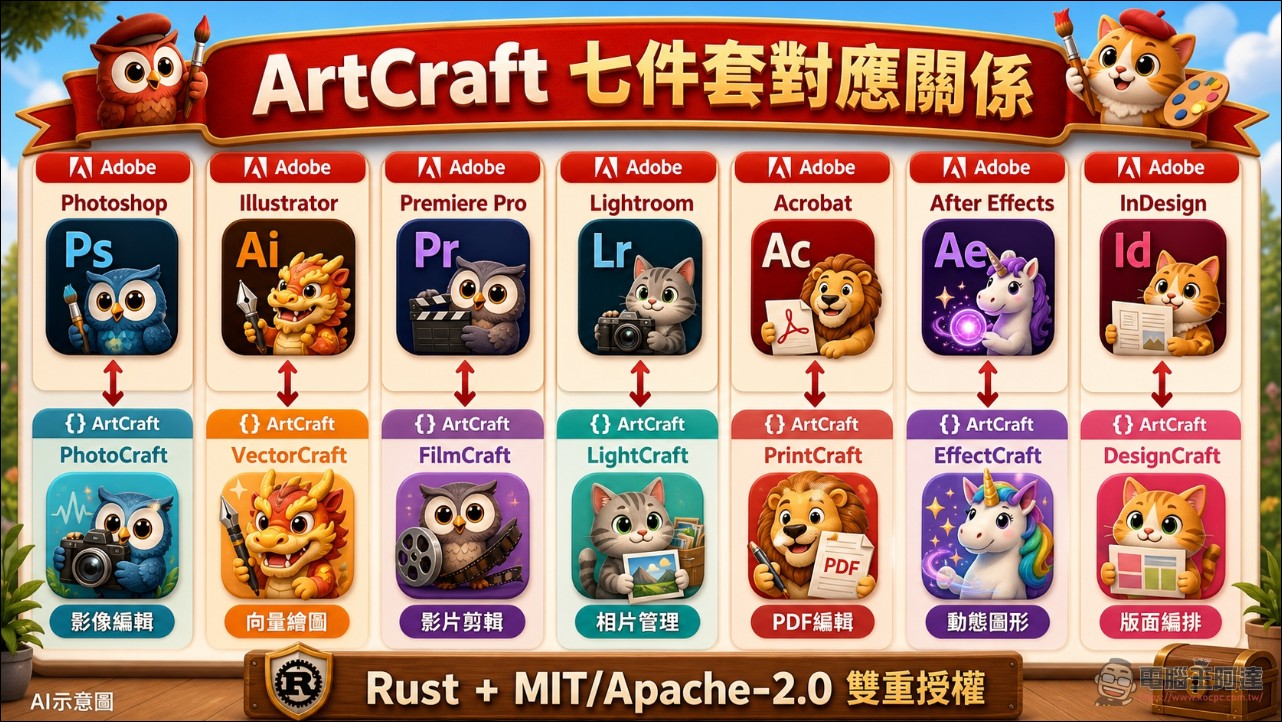
What does a seven-piece set look like?
Seven projects each have a name: PhotoCraft corresponds to Photoshop (image editing), VectorCraft to Illustrator (vector drawing), FilmCraft to Premiere Pro (video editing and color grading), LightCraft to Lightroom (photo management and RAW development), PrintCraft to Acrobat (PDF reading and protection), EffectCraft to After Effects (motion graphics), and DesignCraft to InDesign (page layout). All seven share the same set of rules: pure Rust, clean-room reimplementation, native execution on macOS/Windows/Linux, no Electron and no embedded web shell; six of them can also be compiled to WebAssembly and run directly in a browser tab.
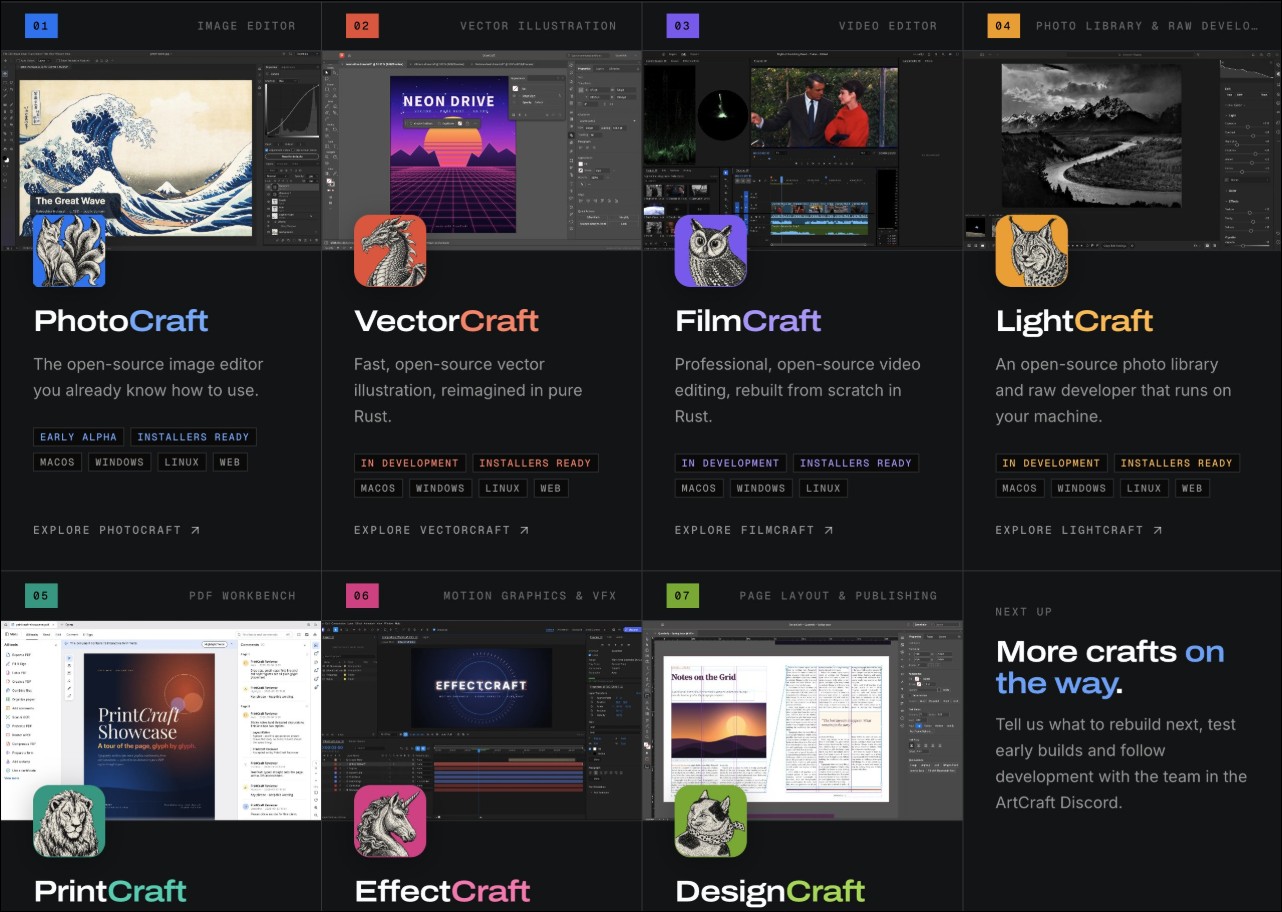
The most mature one at present, PhotoCraft, is labeled early alpha. It already offers installers for the three major platforms and a web version, supports layers, masks, adjustment layers, text, and brushes, and can also read and write real PSD files. This part is an independent module written according to Adobe’s public format specification and then tested against a large number of real files.
GitHub – ArtCraft
Rule number one: don’t touch Adobe’s code.
In the VectorCraft repository, an Illustrator clone, there is a set of working guidelines for AI agents called AGENTS.md. The first item on the “non-negotiable” list is clean-room: do not read, decompile, or copy anything from the Illustrator installation files; you may only look at file names and listings. Behavioral specifications for the software may only come from public documentation and from observing Illustrator in actual use with self-made test files. Observation screenshots are stored in a dedicated directory and never committed to the repository. Adobe icons, images, presets, color swatches, and brushes are all prohibited, and even copying open-source code licensed under GPL/AGPL (such as Inkscape’s geometry library) is forbidden. The project even states “does not handle .ai proprietary data” as out of scope, to sidestep format details of unknown origin.
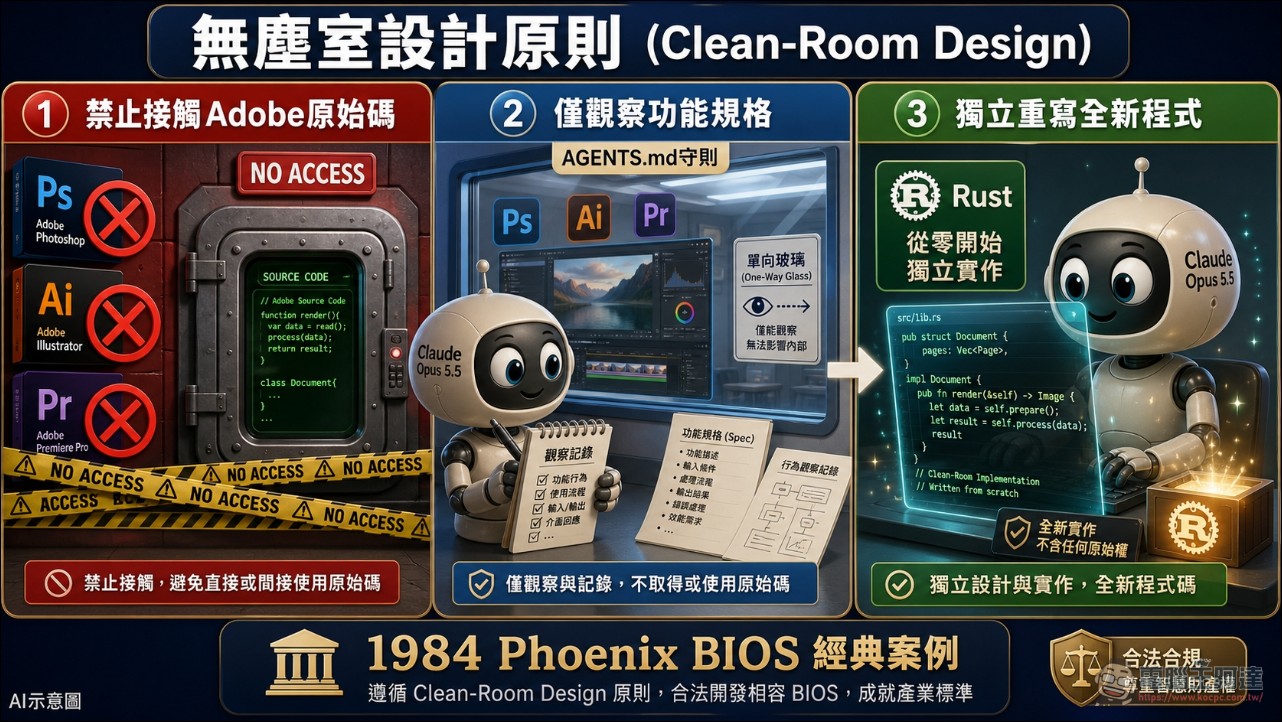
In other words, the developers do not have Adobe’s source code, and the AI is not allowed to look at it either; every feature is the product of a three-step process: observe the finished product, organize the specifications, and rewrite according to the specifications. This also answers the licensing question: the reason they dare to release it under MIT/Apache-2.0 is precisely that every line is claimed to have been written independently.
Already played this trick back in 1984: Phoenix BIOS
Cleanroom Design (clean-room designThe classic textbook case occurred in 1984. That year, Phoenix Technologies wanted to clone the BIOS of the IBM PC—the low-level firmware responsible for initializing hardware at boot. The approach was to keep two teams separate: one group of engineers studied IBM’s BIOS (about 8KB of code) and wrote only functional specifications, without referencing the original source code at all; the other group, engineers who had never seen IBM’s code, rewrote it according to the specifications, leaving evidence of independent development. In July 1984, Phoenix licensed this BIOS to computer manufacturers, and American Megatrends followed the same approach, eventually taking over the PC-compatible market. More than forty years later, this open-source project replaced the second group of engineers with AI.
AI as the main workhorse: 33,000 lines in a day, self-rated only 75%
The speed of AI development is truly astonishing. Take Photoshop’s PhotoCraft: on September 30, the day its repository was created, it committed about 33,000 lines of Rust code in a single commit; by October 6, it had accumulated more than 200 commits, and it has now passed 300. VectorCraft’s progress document ROADMAP.md even directly uses “hours of continuous work by a Claude Opus 5.5 agent” to estimate the remaining workload, writing the work required for feature parity as 210 to 330 hours for a single agent and 55 to 95 hours with 4 to 6 agents working in parallel.
However, the score the project gave itself is quite conservative. VectorCraft’s October 5 “Honest assessmentIt says: the breadth of menus, tools, and panels is about 90%, and functionality is about 75% (an honest self-assessed range of 69 to 75%); but to achieve “veterans can’t tell the difference when using it,” counting operating feel and stability together, it’s only 40 to 55%; interaction feel details are only 30 to 40%, because “it hasn’t yet been compared side by side with the real Illustrator”; 3D and material features are at zero, and advanced layout, raster filters, and scripting interfaces are all empty as well. The document also states: these scores were self-assessed by the AI agent that built the features, not produced by comparing against Illustrator, “so they should only be viewed as an upper bound.” The author claimed on Reddit that they would achieve 100% alignment within a month; against this self-assessment, that sounds quite difficult.
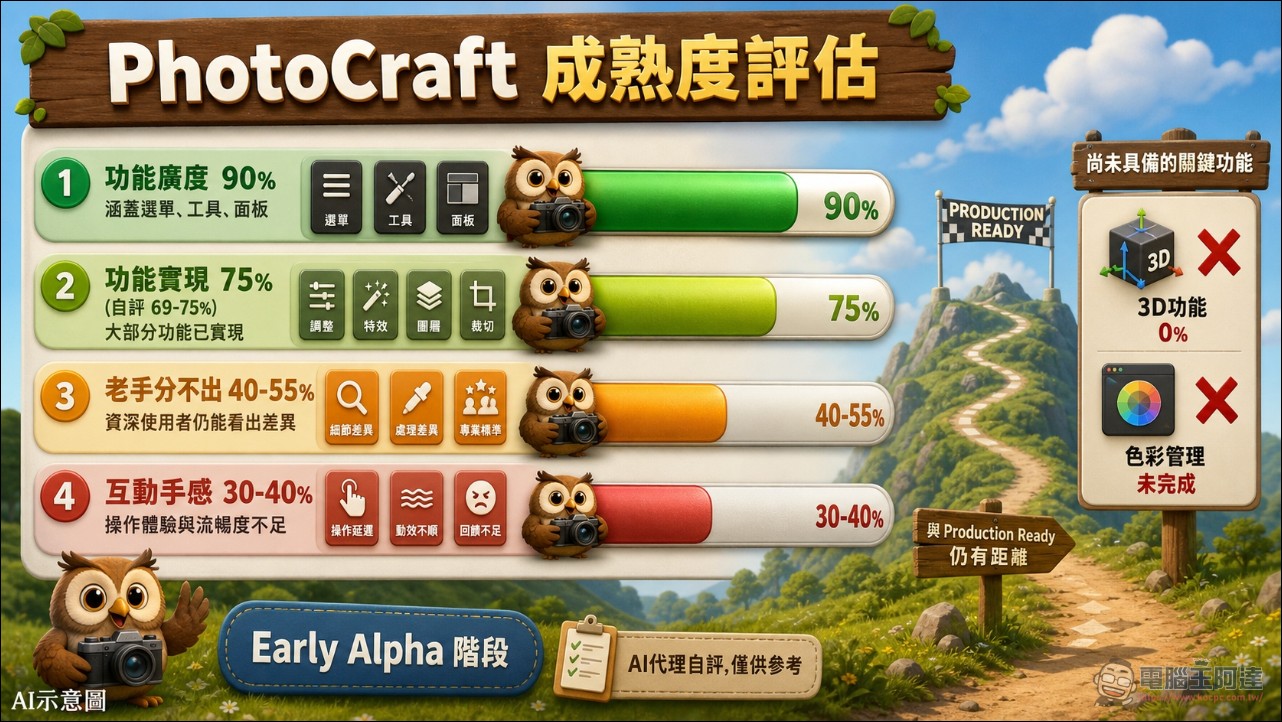
Veterans know where the difficulty lies. On the Hacker News forum, a user relayed that another AI-built Photoshop clone had been tweaked for nearly a year, and the hardest nut to crack was color management—that is, making the same image’s colors as consistent as possible across monitors, printers, and phones. How well PhotoCraft handles color management will be the hurdle determining whether professionals can adopt it into their workflows.
Why Rust?
Choosing Rust for all seven components is tied to both security and cost. Older software is mostly written in C or C++, and it runs fast, but engineers have to manage memory themselves; a single mistake can cause a crash or leave a vulnerability. According to statistics released by Microsoft security engineer Matt Miller at the 2019 BlueHat conference, over the past 12 years, about 70% of the vulnerabilities Microsoft patched and assigned public CVE numbers to each year were memory safety issues. Rust blocks these kinds of errors by default at compile time, with performance on par with C++. Its downside is that it is difficult to write, and rewriting an entire codebase in it used to be very labor-intensive; that cost is now being rapidly driven down by AI.

DHH, the creator of Ruby on Rails, is the latest example. On September 28, he posted that he had gotten the Rust-rewritten beta of his own chat app Campfire running that day: “The conversion was almost free*, and I never directly looked at that Rust code myself,” though he called the code “ugly as hell and six times as verbose.” He later used the same approach to make Elixir and Go versions. A bigger undertaking is on GitHub: on September 16, the official blog announced that Copilot’s agent execution environment had been fully rewritten from TypeScript/Node.js into 832,378 lines of Rust. AI agents wrote most of the code, in a gradual replacement across 128 PRs over about fourteen and a half weeks, and it was mainly completed by one developer within a few months; in official tests, memory usage for a single session dropped from 1,383MB to 126MB.
Conclusion
The seven-piece suite is still a work in progress: PhotoCraft is still tagged early alpha, VectorCraft admits it is still halfway from being indistinguishable to veterans, and 3D, color management, and interaction feel are all tough battles. But this project proved two paths can work: clean-room design gives legally safe imitation an AI-assisted, low-cost approach, and rewriting in Rust has gone from prohibitively expensive engineering to a few weeks of agent hours. People who want to save on Adobe subscription fees can download and install PhotoCraft to try it; its online reviews are currently very high. But don’t expect it to completely replace your workflow in the short term. Still, I believe that with the help of the open-source community and AI, it will only get better. As for Adobe, if it still doesn’t seriously think about improving its products and instead spends all its time messing with users through contracts and subscription mechanisms, it’s really only a matter of time before it is replaced.
Source: KOCPC Chinese