


“If you can think it, you can play it.” Google has officially launched Playground: a browser-based game platform where you can generate a playable game just by describing your idea, with no coding required. Players take on the role of director, typing commands to tweak physics, change rules, swap characters, and overhaul scenes, then send a link straight to friends or publish it to the Explore community gallery. The first rollout is limited to the US, ages 18 and up, and requires a Google account; it’s playable that same day.
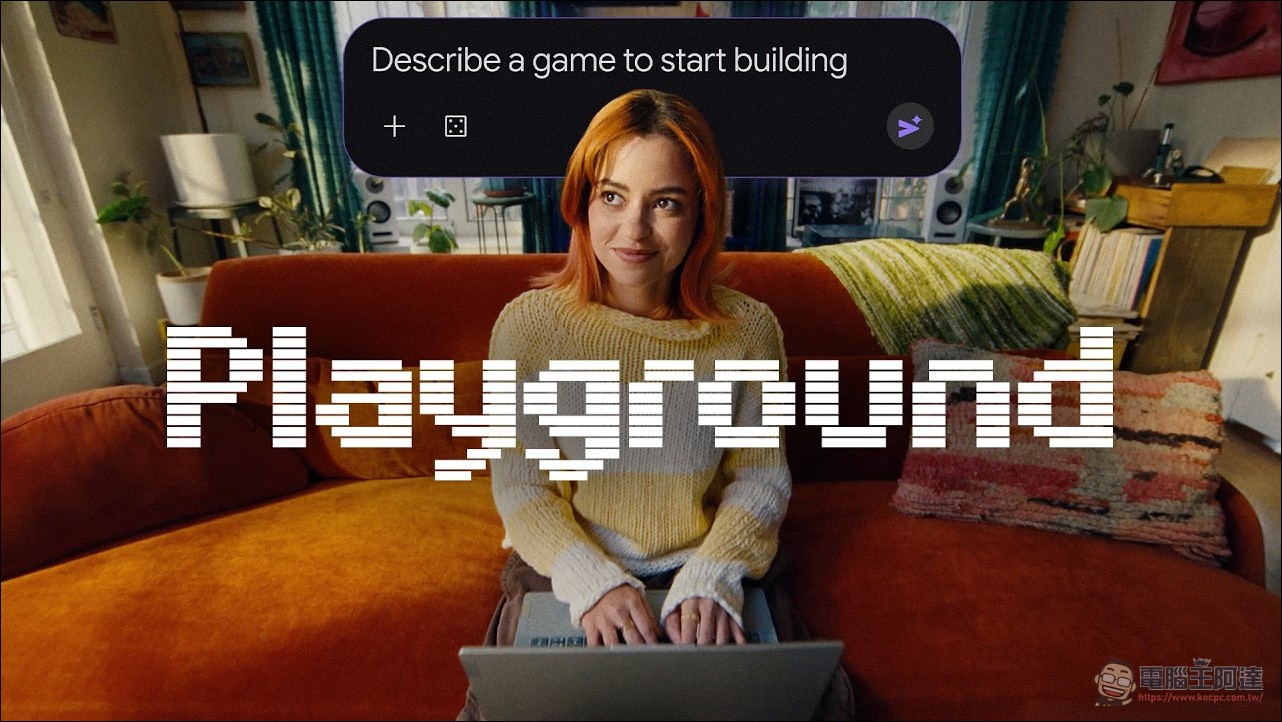
Generate games just by typing, and play them right in your browser.
The process is simpler than you’d think. Open playground.google, sign in, enter your concept, and the system will ask follow-up questions to clarify or give you beginner starter templates to mix and match. Choose 2D or 3D, choose single-player or multiplayer for specific genres, describe the gameplay, art, and rules, hit submit, and the game appears. Then the conversation continues: “Make the character double jump,” “turn up the elasticity a bit,” “turn the enemies into giant cats.” The AI edits in real time, and you can playtest immediately after each edit. When you’re satisfied, publish it. Under the hood, Gemini handles text logic, Nano Banana generates art assets, Lyria generates sound effects, plus Google’s own custom-tuned harness, trained by repeatedly working with games made internally. Games run in the browser and are playable on phones and laptops. Certain genres support leaderboards and multiplayer, and you can link your Play Games account to keep score.
Play for free, but there’s a quota system. Free users have a limited number of tokens per week, while Google One subscribers get higher quotas based on their plan. Publishing goes through safety checks that scan for compliance with community guidelines, and users can report violations. The gallery is ranked by ratings and play popularity, surfacing fresh, creative, and fun works.
Unity Spark as an advanced plug-in, closed beta at the end of the year.
There’s also a big gift from Unity at the same event:Unity SparkAn AI game-making tool that looks like a professional engine, the way you use it still starts with typing, but it can generate professional-grade gameplay mechanics, high-quality 3D, and a full Unity runtime, and even let you collaborate with others on the same game at the same time, connecting directly to the Unity Asset Store to pull in thousands of art assets. Spark is exclusive to the Playground ecosystem, and finished games can also be shared on Playground, using Google’s leaderboards, matchmaking, and social tools. The closed beta kicks off at the end of the year, with the waitlist opening today. Unity CEO Matthew Bromberg is preemptively setting expectations: “Getting an AI to spit out a game that already exists won’t make you the next Hideo Kojima, just as retyping the first paragraph of War and Peace won’t make you Tolstoy.” The point is that Spark is about original creation, not copying.
This move makes a lot of sense for Unity. The engine maker has gone all-in on AI in recent years, and Playground amounts to a ready-made distribution channel; for Google, it fills in the professional-grade piece of the puzzle: Playground lowers the barrier to attract novices, while Spark retains creators who want to get serious, completing a two-tier funnel in one go.
Born under Labs, with Genie blood running through his veins.
Playground is under Google Labs, not Google Play, and that origin determines its fate. Labs is where Google puts experiments: if they succeed, they get promoted; if not, no one would be surprised if they’re shut down. Stadia was a full-fledged first-party product back then. Its technical pedigree, though, is the real deal: DeepMind’s Genie world model can generate real-time explorable 3D worlds from a single sentence, Project Genie is already in Labs for people to play with, and the SIMA agent can even complete tasks in worlds generated by Genie. Playground essentially packages this world-generation research into a mass-market toy; it works on the same principles, just turning papers into games. The official page also says right at the start: you can directly pick popular genres like quiz, tower defense, and racing, or start from scratch and create your own, setting your own rules.
From Casual Doodles to the Leaderboard: An Amateur’s Complete Journey
The company has made its target users very clear: amateurs full of ideas who can’t code, and players curious about AI. The chat interface is key, and what it lowers is the psychological barrier: no need to learn an engine or read documentation, just type whenever an idea strikes. But the free quota is a ceiling: once your weekly tokens run out, you have to wait. Google One subscribers get more depending on their plan, making it clear the company intends to move to subscriptions. Leaderboards and multiplayer are only enabled for specific genres, which amounts to the company demonstrating by example what games are worth making: only games that retain players and can support competition get traffic; everything else is left to fend for itself in the gallery.
After the amateur revelry, review hell awaits.
The flip side of zero barriers is a content tsunami. Roblox is a cautionary tale: player-made games have long been plagued by harmful content, from porn to Nazi role-playing, and academics even specifically study how harmful user-made games get conceived. Roblox relies on AI moderation to block it, but developers on forums complain daily about false positives, with games taken down even when they haven’t violated any rules. Playground will sooner or later face the same problem: safety scans can hold off the first wave, but when a million amateurs upload at once, the moderation team’s nightmare is only just beginning. Google now only says there is scanning and reporting; it doesn’t say what to do about false positives.
Three-Way Battle: Meta and Roblox Are Both on the Same Path
Playground isn’t alone on this path. Meta recently announced that Horizon can also be used to make games with AI, on both mobile and web, and once made, they can be recommended to Facebook and Instagram, the traffic Playground currently lacks. Roblox did it earlier, launching its mobile Build feature in July; text-to-game is already in public testing in some countries, and it also plans to use AI to help creators playtest and view data. Industry sentiment is clear too: this year’s GDC survey found that 52% of game industry professionals consider generative AI a negative influence on the industry, so Roblox had to promise its recommendation system only looks at retention. AI games no one plays will naturally sink, and the quality of the homepage won’t change. Playground ranks by ratings plus popularity, and the logic is the same: let players vote to decide what a good game is.
Source:Google
Source: KOCPC Chinese