


The Meta Muse team, currently all the rage overseas, is making big moves again, Meta Chief AI Officer Alexandr Wang Announce Muse Gadgets’ debut on X.Meta has open-sourced the relevant source code for Muse Gadgets, plus the ESP32 firmware and Linux SDK, so anyone can build any creative hardware that works with Muse. It also unveiled its own device, Muse Home Link, which lets Muse connect to smart home devices such as TVs and speakers.
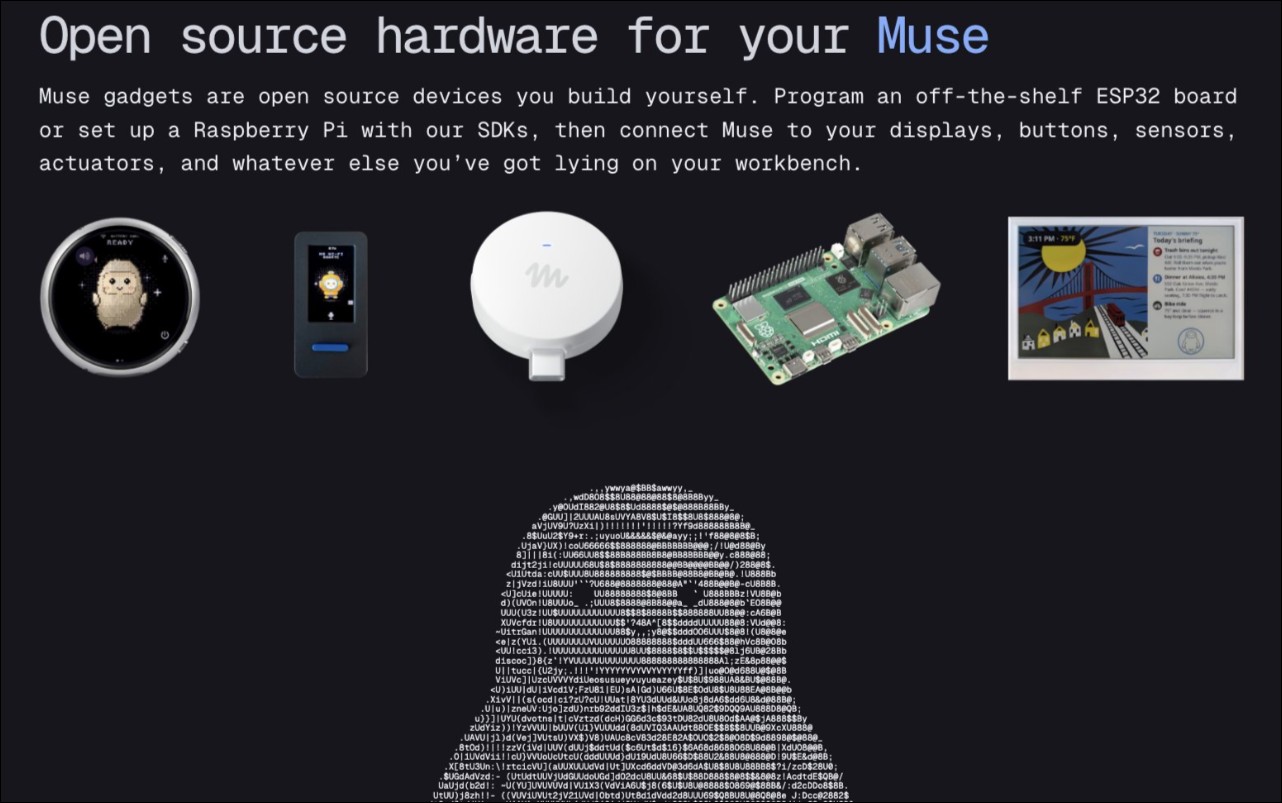
A side-project-level open-source project.
The person actually running the show is Meta Superintelligence Labs product lead Nat Friedman, who posted twice on the same day. The first post read: “Side project alert. Introducing Muse Gadgets, open-source ESP32 firmware and a Linux SDK, so everyone can build hardware devices that work with Muse. Go grab an API token, point your favorite coding agent at the GitHub repo, and build your own Muse peripherals.”
🚨 side project alert 🚨
Announcing Muse Gadgets, an open source ESP32 firmware and Linux sdk so that you can make hardware devices that work with Muse.
Grab an API token from https://t.co/g2yJeQRJH7 and point your favorite coding agent at the github repo to build your own… pic.twitter.com/wM1YsjsS7s
— Nat Friedman (@natfriedman) October 2, 2026
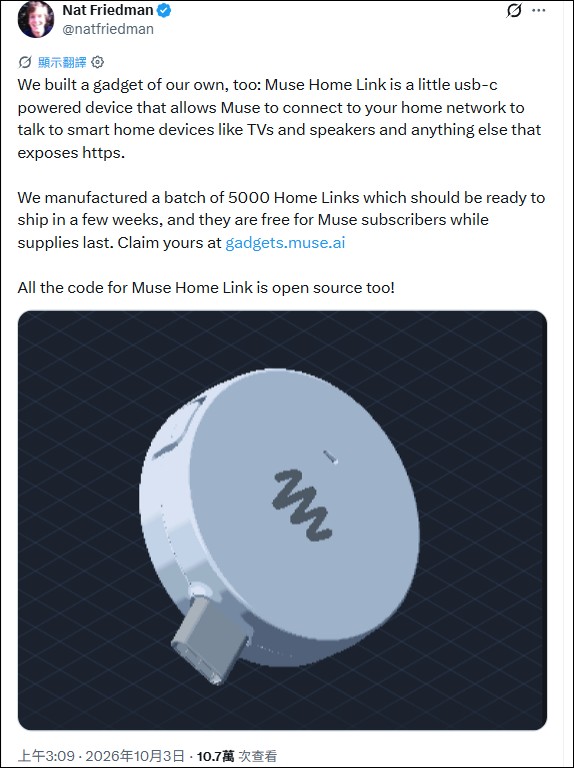
The second post introduces their own device: “We made one ourselves too: Muse Home Link is a small USB-C powered device that connects Muse to your home network and lets it talk to smart home devices like TVs and speakers, as long as they have https enabled. We made 5,000 units, shipping in a few weeks, free for Muse subscribers, first come, first served.” The official page adds that Home Link’s code is also open source.
Friedman’s credentials make this more than a side project. He’s a Xamarin co-founder, served as GitHub CEO from 2018 to 2021, and has spent his entire career building developer tools. This time he’s bringing the same playbook to AI hardware: the official website says right up front that this is something hackers made for hackers, purely for fun, with possible side effects including bricking, voiding your warranty, and frying boards—if you break it, you’re on your own. The GitHub repository is under facebookincubator, every directory has a README, and the getting-started docs even include an AGENTS.md for coding agents. The message is clear: take your go-to coding agent and hack hardware.
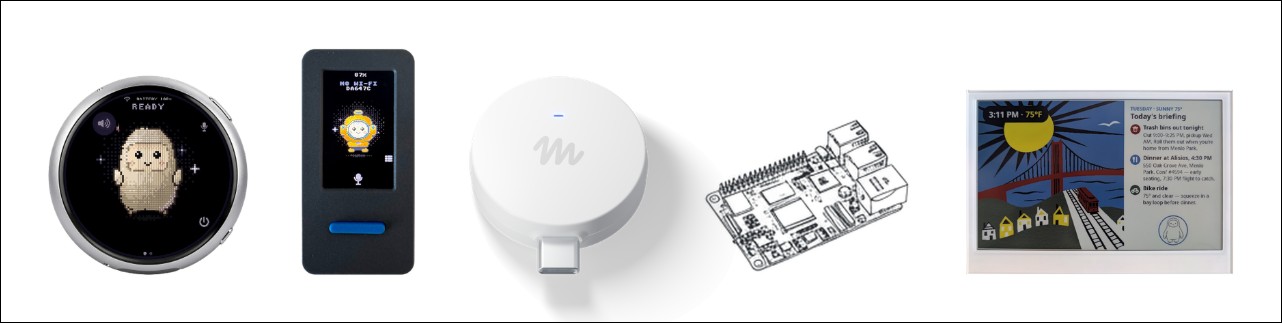
Muse Gadgets – GitHub
The ESP32 Device SDK handles the microcontroller side: connect an off-the-shelf ESP32 development board to Muse, add a screen to display images, add a microphone and speaker for voice input/output, or connect various sensors. The Linux Device SDK turns an idle Raspberry Pi or Linux host into a Muse device, letting you add custom commands for Muse to manage system chores, or connect it to Home Assistant. For both device types, you first need to get an SDK token from the official website, one per device. To pair, open the Muse App on iOS or Android, go to Settings, enable developer mode under Devices, and scan for peripherals whose names start with MuseGadget to complete pairing.
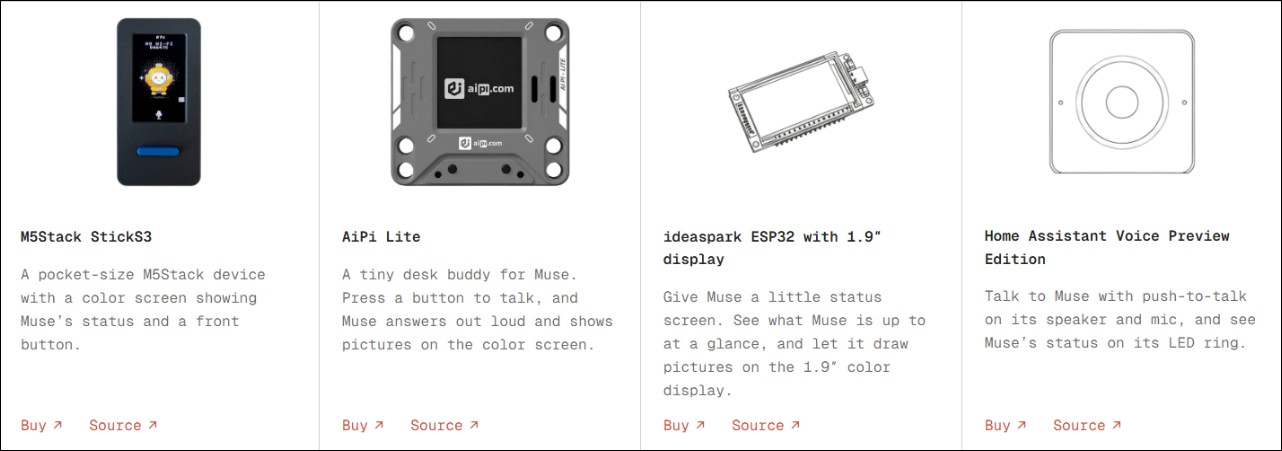
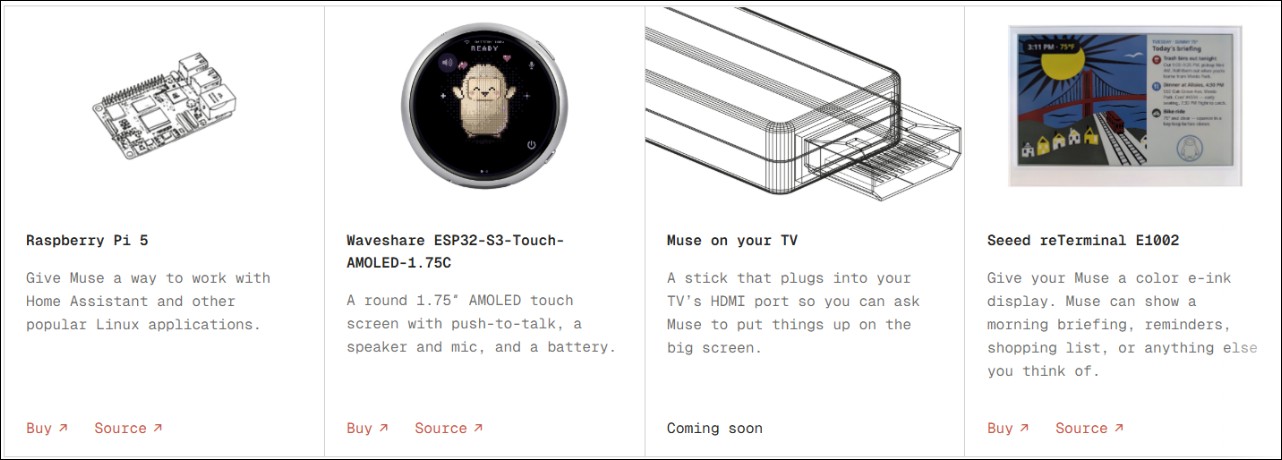
The official team released 8 reference designs in one go: a Waveshare board with a round 1.75-inch AMOLED touchscreen, a push-to-talk button, speaker, microphone, and battery; a TV stick that plugs into a TV HDMI port to throw the display onto the big screen; Seeed reTerminal as a color e-paper morning report machine; the pocket-sized M5Stack StickS3 status screen; the desktop companion AiPi Lite; the ideaspark board with a 1.9-inch small status screen; and the Home Assistant Voice Preview Edition’s push-to-talk plus light ring. Each one comes with a purchase link and a corresponding firmware configuration file. The community Discord is already open, with 18 people online right now, and from day one people have been posting their own custom boards on it.
Home Link is the official demo, with 5000 free applications.
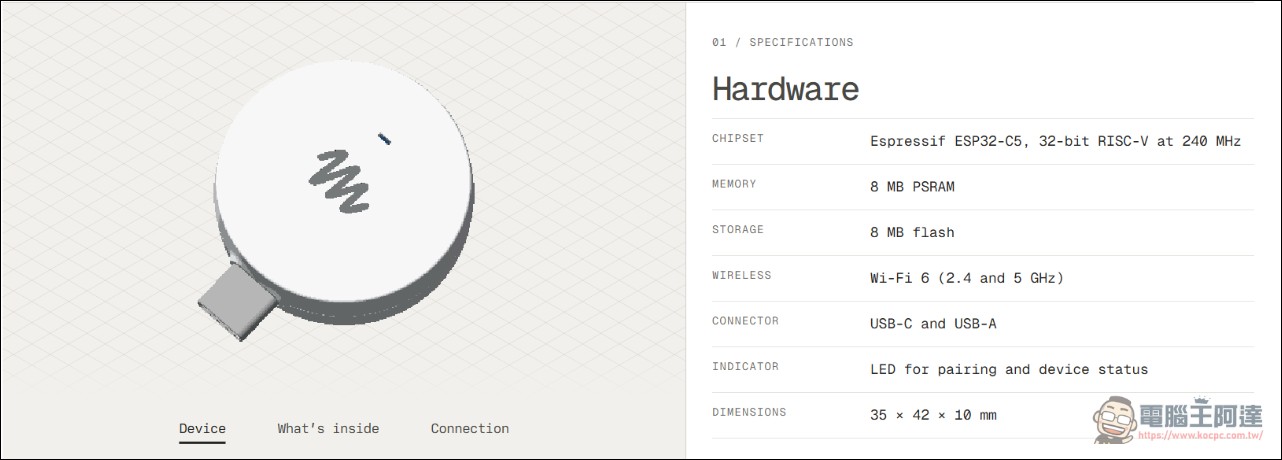
The in-house device Home Link is the example built with this SDK. The hardware is an Espressif ESP32-C5, a 32-bit RISC-V running at 240 MHz, with 8MB PSRAM plus 8MB flash, dual-band Wi-Fi 6, USB-C and USB-A dual connectors, in a small 35 × 42 × 10 mm block. The firmware is based on the open-source ESP32 Device SDK, so anyone can understand how it works, but the Home Link itself only runs official firmware and can’t be reflashed yourself. The usage flow has four steps: plug it in and place it next to the router, pair over Bluetooth in the app and choose Wi-Fi, speak to Muse, and go to GitHub to install community skills. The support list calls out Philips Hue, Sonos, Apple TV, Google Nest speakers, and Samsung TVs, using community skills to connect to devices already in your home, or anything with a local HTTP API: turn on lights, control the TV, send documents to the printer.
Free but with limits: US Muse subscribers only, one per person, ships in October, first come, first served. Registering on the official website only puts you in a queue, not an order, and it’s while supplies last for 5000 units. TechCrunch estimates that Friedman’s Home Link post drew nearly 30,000 views within hours, so the free slots have probably already been claimed. The company also set expectations upfront: community skills may be revised or break at any time, so don’t use them for safety-critical tasks.
Open-source code, but the connection has to get past Meta.
This is the clause most worth reading closely in this whole matter. The device SDK and firmware are open source under Apache 2.0, except for a few files such as the Jollybot avatar; under the license, they could originally be modified and distributed. But connecting to Muse depends on another key: the SDK token, whose terms are independent of the software license. The token is limited to personal, non-commercial use, and one token can be bound to at most 50 devices. Embedding it and selling it, listing it with public advertising, or giving it away as part of a promotion are all prohibited. If you want to mass-produce and sell, you must obtain another one separately. Written permission from MetaSDK and token are not officially supported products either. The official documentation states that they may be changed, discontinued, or revoked at any time without notice. In other words, the program on the board is yours, but the line to Muse is Meta’s.
The same logic applies to security responsibility. The terms require makers to take full responsibility for what they build; they may not use a token to access someone else’s Muse account or collect someone else’s data, and before handing a device to someone else for pairing, they must first disclose how it will handle information. The restrictions let developers customize what goes on the board while leaving control over connectivity in Meta’s hands. Anyone planning to make devices for others must first accept a reality: the Apache license governs software distribution, but whether the connection can keep being used is Meta’s call. The official documentation does not make clear whether tokens outside the US can be used; at this stage, those who want to mass-produce and sell in Japan or Taiwan can only wait for official clarification.
It’s only been one day since it was open-sourced, and someone has already handed in their homework.
The online community has responded very enthusiastically to Muse Gadgets, with many people already showing off their creations on X. Norwegian creator NFTart used the SDK to build an XCOPY art frame; when told “Show me XCOPY,” the frame switches the artwork, announces the piece’s title, and reports its collection, with 1,088 works pinned to the device. Muse is currently only available in the US, so he’s using another agent to handle calls for now and will switch over once Europe opens; the post ends with “Muse-ready” and a Norwegian flag.
“Show me XCOPY.” The frame swaps the piece, names it, and reports the archive. 1,088 works pinned on the device.
Built on Meta’s Muse Gadget SDK. Muse is US-only, so another agent makes the calls until Europe opens.
Muse-ready. Waiting 🇳🇴@natfriedman @alexandr_wang pic.twitter.com/vtKArFORlY
— NFTart (@NFTart) October 3, 2026
Indian developer Mohit Garg didn’t get Muse access, so he built a round-screen little companion himself: press and hold a button to ask a question, get a voice answer in about 2 seconds, the backend runs on his own server, and you can freely switch between OpenAI, Claude, Grok, and Gemini. It’s open source too.
Since, I didnt had access to Muse.
Built a tiny AI friend that lives on a round screen 🌱
Hold the button, ask anything, and it answers out loud in about 2 seconds, running on my own server with whichever AI I pick: OpenAI, Claude, Grok, Gemini…
Open source, built on Meta’s… pic.twitter.com/v38WA3h1SA
— Mohit Garg (@mohitt_garg) October 3, 2026
Others have already made smart accessories for glasses and all sorts of novel little gadgets. It’s been less than a day since it went open source, and I’m sure more incredible creations from brilliant minds will appear next.
I turn any dumb eyeglasses into AI Glasses with this little device. Now with @Muse Gadget SDK things are pretty easy. @alexandr_wang @natfriedman
It has directional speakers, microphones, Bluetooth & Wi-Fi.
Who wants to turn your glasses to Muse Glasses? pic.twitter.com/Y1g9pfSgMH
— Jesik Min (@jesikmin) October 2, 2026
スタックチャンにMuse Gadgetsのキャラを表示できた!
ぷにぷにしててかわいい! pic.twitter.com/GWzvNEl1yd— あいろぐ (@AILogDev) October 3, 2026
Muse on M5Stack Stopwatch
Just landed a first-class Stopwatch support to Muse Gadgets! pic.twitter.com/KYTa05oEND
— chan (@chantastic) October 3, 2026
I’ve integrated Google TTS for the responses, so it can now speak aloud; however, the results aren’t ideal—the voice sounds robotic and there is significant latency. I hope the official voice output feature is released soon. pic.twitter.com/5PAXPyDYeV
— 清风 (@qing_feng___) October 3, 2026
The company also officially brought out its pocket device Muse Charm as a comparison point: announced at Connect on September 23, about the size of an AirPods case, with a roughly 2-inch touchscreen and built-in 5G, going on sale in December, priced in the smartwatch range. Charm is the ready-to-use version, while Gadgets is the DIY version—the two tracks run in parallel.
This Muse Charm is something I can’t wait to get my hands on 😍
Looks super interesting. pic.twitter.com/PGAMgXwKDE— Mukul Sharma (@stufflistings) September 25, 2026
Muse doesn’t just want to stay in the chat window.
Muse launched in the U.S. on September 8, focused on helping people book travel, fill out forms, and shop on their behalf. In the U.S., it has even ranked higher than ChatGPT on mobile (which is why OpenAI quickly rolled out dots). The following week, it launched an SMB version, free but rate-limited, integrated with Shopify, Dropbox, and Slack, and set up a Meta Enterprise Platform business unit focused on enterprise customers. Gadgets is the third shot in the same campaign: from consumer app to enterprise tools, and then to the hacker’s workbench, Muse wants to grow a body beyond the chat window. TechCrunch’s conclusion is blunt: Gadgets may not have a broad audience, but it fits perfectly with Meta’s strategy of making Muse everything beyond a standalone chatbot.
Source: KOCPC Chinese