


While Taiwan is still dragging its feet over FSD and the government and various agencies have made no progress, self-driving company Waymo announced on September 14 that it has signed agreements with Tokyo’s largest taxi operator Nihon Kotsu and ride-hailing platform GO, preparing to launch Japan’s first commercial fully autonomous taxi service in Tokyo in 2027. This is part of Waymo’s move beyond the United States to expand into international markets, and Japan’s autonomous taxis are also moving from testing into commercial operation.
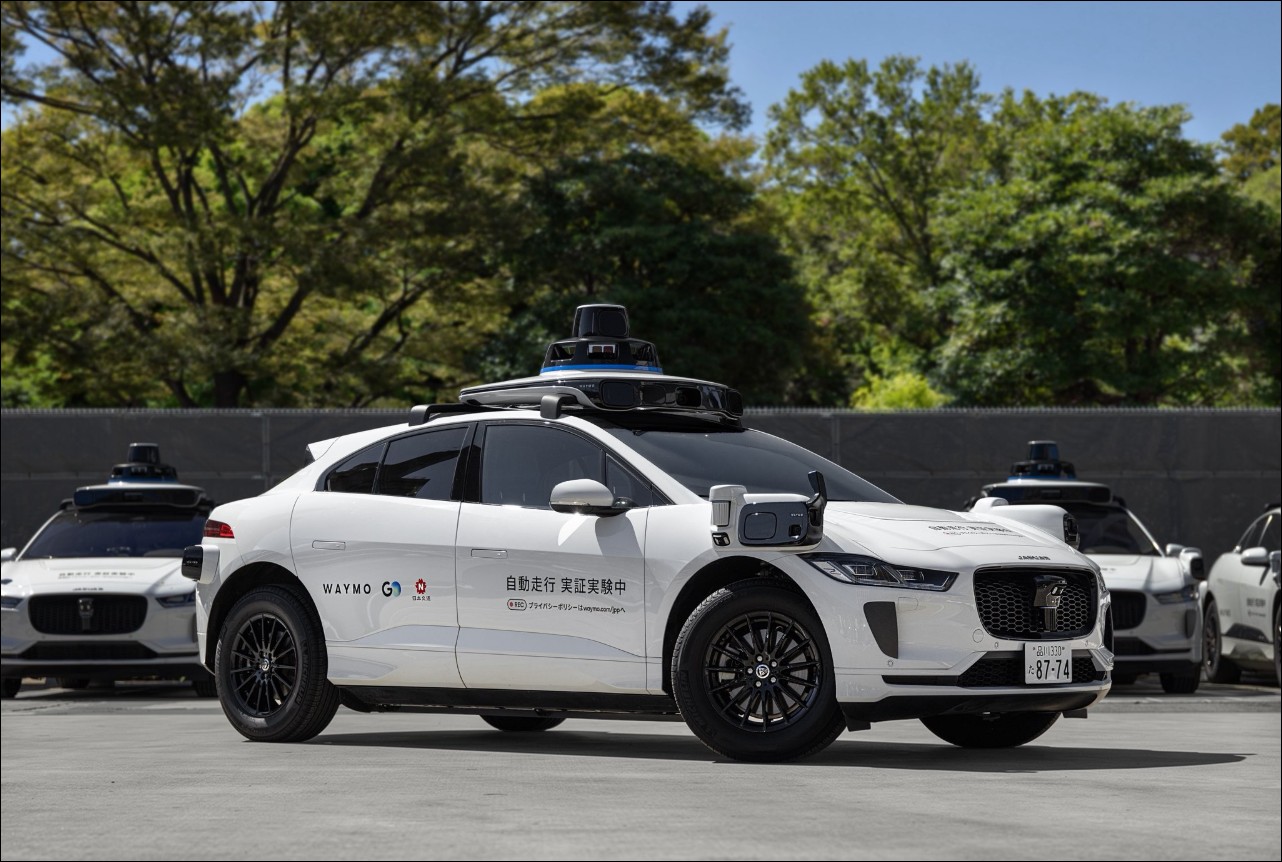
Three-way division of labor: technology, platform, and ground operations each in position.
This division of responsibilities in the partnership reflects Japanese transportation regulations requiring that passenger services be operated by licensed taxi companies. Nihon Kotsu, Tokyo’s largest taxi company, is responsible for ground operations management and depot dispatch; Waymo provides the autonomous driving system, operations platform, and fleet management software, and helps partners scale; GO is responsible for coordination with taxi operators and for the overall design of how Waymo’s technology is integrated into Japan’s taxi industry.
Passengers will be able to hail rides through two channels, the GO App and the Waymo App, booking both traditional taxis and Waymo autonomous trips within the same app. This is Waymo’s first commitment to dual-platform distribution outside the United States. GO Chairman Hiroshi Nakajima said that to provide this entirely new mobility experience, the company will launch it as a full commercial service.
Two and a half years of road testing in Tokyo, from manual mapping to supervised autonomous driving.
The three-party partnership can be traced back to December 2024, when Waymo called Tokyo its “first international road-testing trip.” In early 2025, Waymo’s Jaguar I-Pace vehicles arrived in Tokyo, and Nihon Kotsu drivers began manually mapping high-definition maps of seven core wards: Minato, Shinjuku, Shibuya, Chiyoda, Chuo, Shinagawa, and Koto. In the first phase, the autonomous driving system was completely disabled, and drivers drove with their hands on the steering wheel like ordinary drivers.
A March 2026 media briefing confirmed that the vehicles had entered an autonomous driving phase supervised in-car by trained Nihon Kotsu personnel. At the briefing, Waymo Chief Product Officer Saswat Panigrahi said a fully driverless service was “not years away,” and that work was advancing on a timeline measured in “months.” Now this week’s announcement clearly sets the target at 2027, shifting the tone from “within months” to “next year,” mainly because the pace of regulatory approval remains unsettled; there has been no technical regression. This week, Waymo said its vehicles have been driving autonomously under supervision “for the past year,” “confidently navigating narrow neighborhood roads and safely maneuvering through dense crowds.” Nihon Kotsu President Yasuharu Wakabayashi said its trained drivers “spared no effort in helping the Waymo Driver adapt to Tokyo’s roads.”
Why does Japan need self-driving taxis?
Mai Niizoe, a senior researcher at Sompo Institute Plus at the University of Tokyo, pointed out in January this year that if Japan is to catch up with international progress in autonomous driving, 2026 is a critical year (Taiwan says:). The Japanese taxi industry’s workforce has shrunk sharply since the pandemic, the median age of drivers has exceeded 60, the overtime-hour cap introduced in 2024 has further tightened supply, and the government continues to push to expand the scope of autonomous driving. Nihon Kotsu has consistently positioned autonomous taxis as a complement to, not a replacement for, human drivers—a stance the taxi industry must maintain if it is to move forward smoothly and avoid internal backlash. Koji Wakabayashi believes this partnership with Waymo and GO “represents a critical opportunity to help solve future driver shortages while coexisting with human-driven taxis, and to pass on safer, higher-quality transportation infrastructure to the next generation.”
Timeline, Regulation, and International Footprint
If it launches in early 2027, Tokyo’s road-testing period will be about 21 months; if it launches at the end of the year, about 33 months. Waymo emphasizes that the 2027 timeline depends on obtaining regulatory approval from central and local authorities and completing validation of the technology and joint operations, and the company has not given a specific month in 2027. Japan allows driverless Level 4 autonomous driving operations, but approvals are granted on a case-by-case basis for specific operating plans and are not a nationwide blanket clearance for any operator; currently, everything operating in Japan consists of low-speed shuttles and campus loops, and there is not yet an urban taxi fleet spanning multiple administrative districts.
Tokyo is Waymo’s first market outside the United States. It currently has three named international target cities, but has not yet carried a paying passenger without a human driver in any of them. London’s timeline is earlier and its road-test mileage is shorter; in October 2025, Waymo announced it would launch commercial service there in 2026 as its European debut. Munich was announced on August 25, with a target launch by the end of 2027. Waymo no longer has the Tokyo market to itself: Nissan conducted free test rides in Yokohama with five Serena vans from late November 2025 to late January, aiming for commercialization in 2027; Nuro’s vehicles drive autonomously in Japan with safety personnel supervising from inside the vehicle; and Honda has also been exploring autonomous taxi services since General Motors shut down Cruise in December 2024.
Conclusion
Waymo currently operates fully autonomous driving services in 15 US cities, with more than 500,000 trips per week and tens of millions of commercial trips completed cumulatively. Co-CEO Tekedra Mawakana calls it “proven to be more than 15 times safer than human drivers.” Tokyo will be the first commercialization test for this American company as it transplants mature technology into a left-hand-traffic, high-density market with case-by-case regulatory approval. For GO and Nihon Kotsu, this also means plugging autonomous rides into their existing ride-hailing and taxi networks, letting passengers freely choose between traditional taxis and driverless cars in the same app. For Japan, autonomous taxis are meant to address aging and driver shortages, but when that will materialize still depends on regulators’ approvals and validation results. As for Taiwan, with likely opposition from yellow taxi drivers and fleets alone, plus its reputation as a “ban-first country,” it will probably be very difficult to achieve even by 2030. I hope my prediction is wrong; otherwise, Taiwan is actually like Japan in that autonomous driving would be very helpful for solving the problem of elderly people in some remote areas having no one to transport them.
Source: KOCPC Chinese