


Google On August 27, US time, Gemini was released. Omni 1.1 Flash, this is a major update to its multimodal video generation model, Omni Flash. The new version adds scene extension, first/last frame interpolation, 360p quick preview, 4K upscaling, and video reference, among other features, shifting its positioning from an “experimental tool” to a “production-ready” developer platform. Google DeepMind product managers Anish Nangia and Alisa Fortin wrote on the official blog that Omni 1.1 makes generative video “more controllable, faster to iterate, and suitable for real-world deployment.” Logan Kilpatrick, who leads the Gemini API, also X announced the update details, emphasizing that this is a new version of the “anything in, anything out” world model.
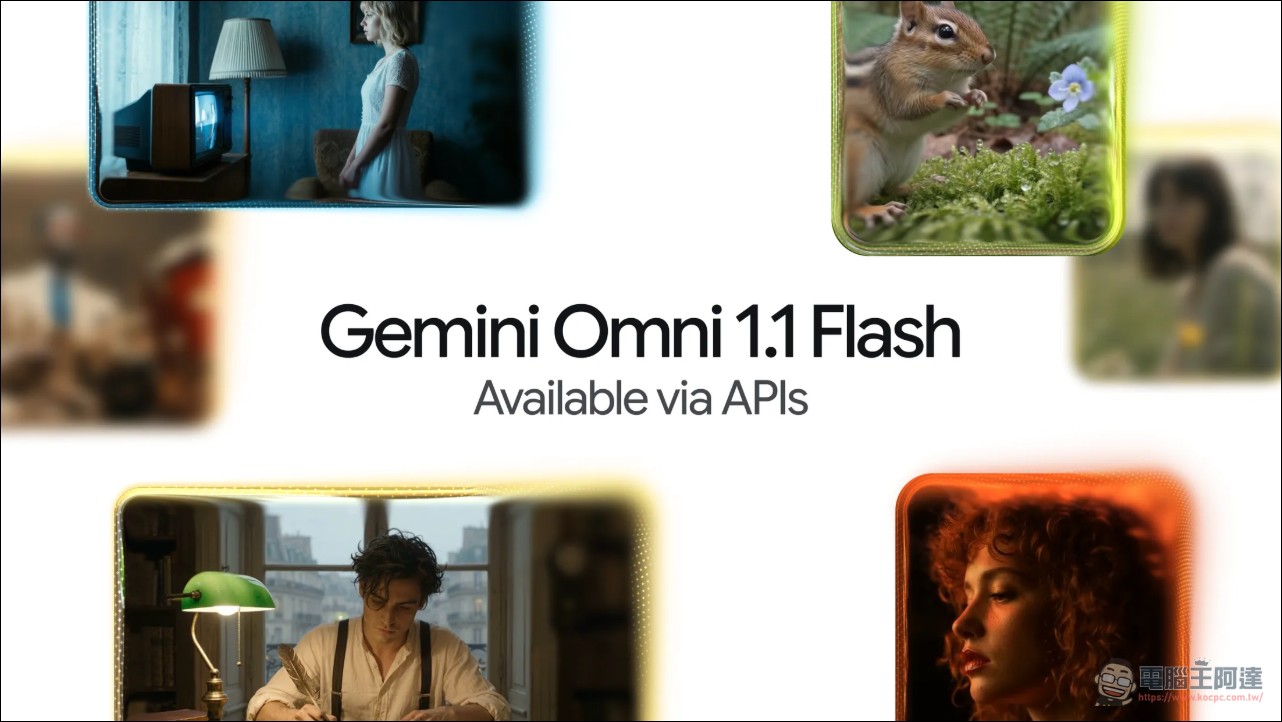
Google Gemini Omni 1.1 Flash Announced: Scene Extension, 4K Output, First/Last Frame Control
Scene extension: up to 40 seconds, context extended from 1 second to 10 seconds
Omni 1.1’s core new capability is Scene Extension. Developers can generate continuations from the end of an existing video, extending it in 10-second increments up to a maximum of 40 seconds. The model can analyze up to 10 seconds of preceding context, a significant improvement over the previous generation’s 1-second reference window, resulting in noticeably better visual consistency and narrative coherence.
This feature allows developers to start from a short clip and progressively extend it into longer video content. The official demo includes dramatic camera movement scenarios, such as dolly-zoom, 360-degree orbital rotation, and other complex camera controls, all achieved through sequential scene extension commands. However, each scene extension consumes a full set of video output tokens, so accumulating 40 seconds of long-form video can become quite costly—which is why the 360p draft mode exists.
First/Last Frame Specification: Precisely Control Camera Movement and Transitions
Another important feature is First and Last Frame interpolation. Developers can specify the start and end frames of a shot, and Omni 1.1 will generate continuous video between the two, making it suitable for creating tracking shots, zoom transitions, or seamless looping segments.
This feature addresses a long-standing pain point in generative video: the difficulty of precisely controlling camera movement. Previously, developers could only use text prompts to describe the desired shots, and the actual generated results often fell short of expectations. Specifying the first and last frames makes precise shot composition possible. Developers can prepare the start and end keyframes in advance, and the model automatically fills in the transition animation in between, greatly reducing the time spent repeatedly adjusting prompts.
360p quick preview: 60% faster speed, two-thirds lower cost
Omni 1.1 adds a draft mode at 360p resolution, generating up to 60% faster than standard 720p at just one-third of the cost. This is especially useful for creative workflows that require repeated trial and error—developers can use 360p to quickly generate multiple versions for comparison, then switch to higher resolution to output the final result once the direction is confirmed.
The official showcased the “Draft Room” concept app: displaying 3 to 4 360p drafts side by side on the same screen, adjusting only one variable at a time, making it easy for creators to compare the effects of different settings.
4K Upscaling and Video Reference
Regarding output quality, Omni 1.1 supports upscaling generated results to 1080p or 4K resolution, reaching a standard that can be used directly for professional production.
Additionally, the new version introduces a Video Reference feature, which allows developers to input up to 3 seconds of reference video during generation, enabling the model to maintain visual context and character consistency based on the reference content. This feature is particularly useful in scenarios where multiple shots need to maintain a unified style.
The partner has been deployed to the production environment.
In its published article, Google announced practical application cases from multiple partners:
- Adobe FireflyGemini Omni Flash has been integrated into the Firefly platform for video generation and editing.
- Figma WeaveCreative Director Itay Schiff stated that Omni Flash is “one of the most powerful video models” on the Weave platform, and that scene extension, richer material references, and 4K resolution have allowed the team to “evolve from generating videos to directing videos.”
- RunwayChief Creative Officer Jamie Umpherson pointed out that Omni Flash naturally fits with Runway’s existing workflow of “starting from prompts, images, or videos, and then generating or editing.”
- GMI Cloud: : Marketing Vice President Louisa Guo stated that Omni Flash’s “accuracy has proven itself under scrutiny,” and for creators of educational and explanatory content, this reliability matters more than any single feature.
Pricing and How to Obtain
Omni 1.1 Flash API pricing is the same as the previous generation: $1.50 per million tokens for input (text, image, video, audio), and $17.50 per million tokens for video output. For 720p video, that works out to roughly $0.10 per second (about NT$3.25). The 360p draft consumes fewer tokens, at 1,931 tokens per second (compared to 5,792 for 720p).
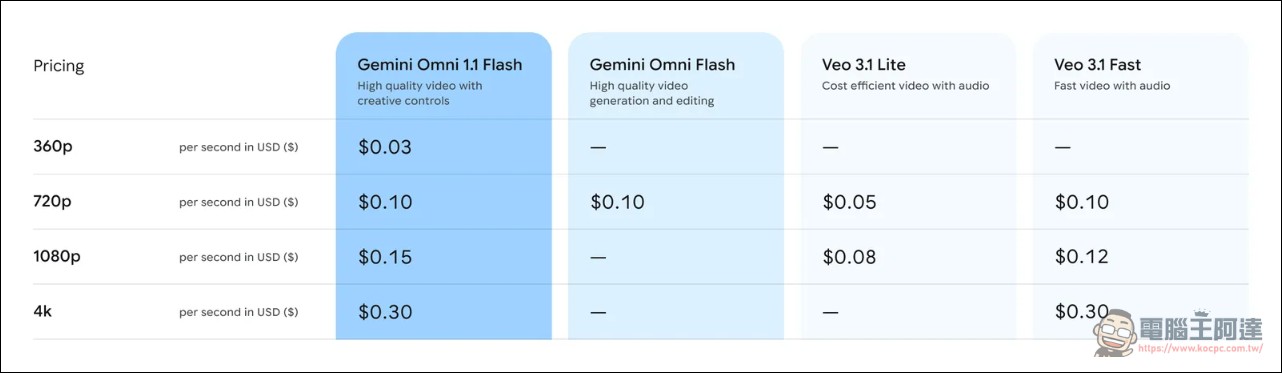
In terms of access channels, developers can use it directly through Google AI Studio, while enterprise customers can access it via the Gemini Enterprise Agent Platform API. For general users, Google AI Plus, Pro, and Ultra subscribers can now use Omni 1.1 in Google Flow, and the scene extension feature is also available in the Gemini app.
From a pricing structure perspective, Google has maintained the same rates as the previous generation, without raising prices for feature upgrades. This indicates that Google’s strategy is to attract the developer ecosystem with stable pricing rather than increasing unit prices when models are updated. In contrast, competitors such as Runway and Pika typically charge for video generation services through subscriptions, making it harder to estimate the marginal cost of each generation. Omni 1.1’s pay-as-you-go model offers more flexibility for developers who need to run large volumes of generation tests.
Conclusion
The direction of Gemini Omni 1.1 Flash’s update is clear: Google wants to move AI video generation from “showcase” to “production-ready.” Extended scenes solve the length limitation, first and last frame control addresses precision, the 360p draft lowers iteration costs, and 4K upscaling completes the final piece of the output quality puzzle. Combined with real adoption by partners like Adobe, Figma, and Runway, Omni Flash is shifting from a tech demo to the foundation of a creative toolchain.
For developers, the most practical change is the improvement in workflow efficiency. In the past, generating a usable video often required repeatedly adjusting prompts, generating multiple times, and then picking the best result. 360p draft mode significantly reduces the cost and time of this trial-and-error process, while specifying the first and last frames makes precise control feasible. When video generation tools evolve from “leaving it to luck” into a “controllable creative workflow,” they stand a chance of being integrated into professional content production pipelines.