


NVIDIA is turning the $6 billion deal finalized last week into a weapon for building the world’s most powerful open-source AI model. According to the Wall Street Journal, citing people familiar with the matter, NVIDIA plans to use its licensing agreement with AI startup Poolside to develop a top-tier open-weights AI model, taking aim at heavyweight Chinese rivals such as DeepSeek and Kimi K3. NVIDIA chose to bring Poolside’s technology and talent into its own Nemotron development system through a combination of technology licensing fees and team integration, rather than pursuing a direct acquisition. People familiar with the matter said NVIDIA’s goal is to bring Nemotron to a level comparable to frontier models within a year.
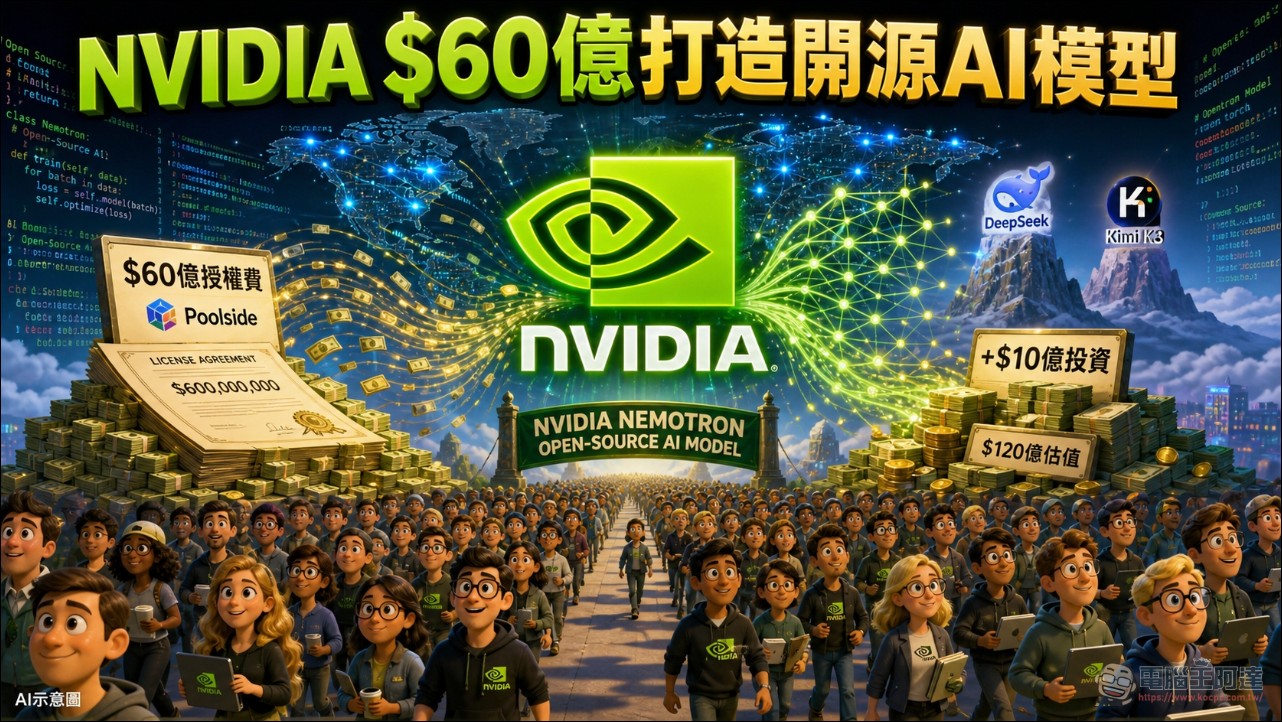
NVIDIA pumps $6 billion into Poolside, teaming up to build top-tier open-source AI models that can rival China.
Who is Poolside?
Founded in 2023 and headquartered in San Francisco, Poolside focuses on developing AI-driven software development tools. Unlike products such as GitHub Copilot, Poolside’s technology places greater emphasis on understanding and refactoring large codebases rather than simple code completion. Its models are trained on large amounts of high-quality software projects, enabling them to handle complex development tasks across files and modules, giving it considerable competitiveness in enterprise-level applications.
NVIDIA is specifically drawn to this capability. When Nemotron needs to be trained from scratch or fine-tuned, the Poolside team’s experience in data processing, model architecture design, and training optimization will come into direct play. The wholesale transfer of over 100 engineers means NVIDIA gains a complete AI model R&D team in one stroke.
Poolside deal breakdown: $6 billion licensing fee plus $1 billion investment
The deal was first reported by Bloomberg on August 20. NVIDIA paid AI startup Poolside a $6 billion technology licensing fee and invested an additional $1 billion at a $12 billion valuation, bringing the total transaction value to roughly $7 billion. As part of the partnership, more than 100 Poolside employees will join NVIDIA to work on developing the Nemotron family of open-weight models. These engineers come from Poolside’s core R&D team, covering key areas such as large language model training, code generation, and model compression. In effect, the deal amounts to NVIDIA using capital to acquire an AI research team with hands-on experience.
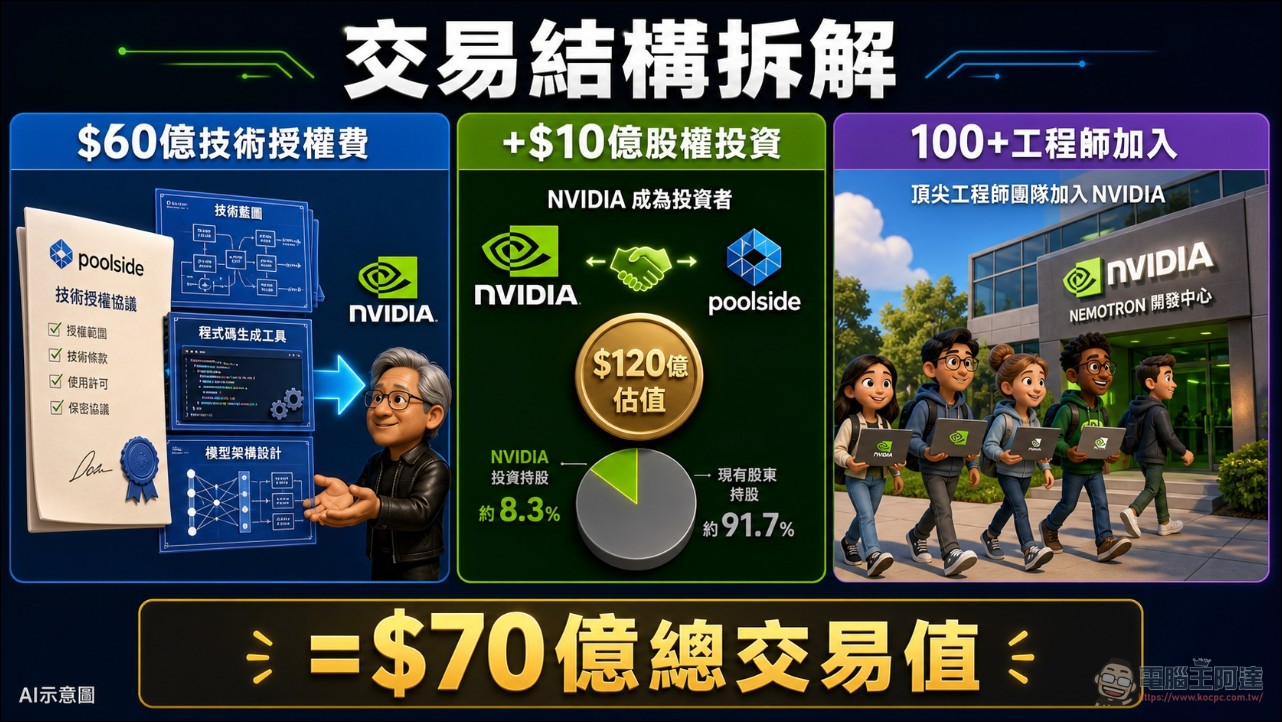
Poolside is a startup focused on AI-assisted software development, co-founded by former GitHub and AWS executives. Its technology has built a solid reputation in code generation and development efficiency, and it has received backing from multiple venture capital firms. NVIDIA chose to collaborate through a model of “technology licensing fees plus team integration,” which differs from a typical direct acquisition, reflecting its greater emphasis on Poolside’s technical expertise and existing talent rather than purely its products or brand assets.
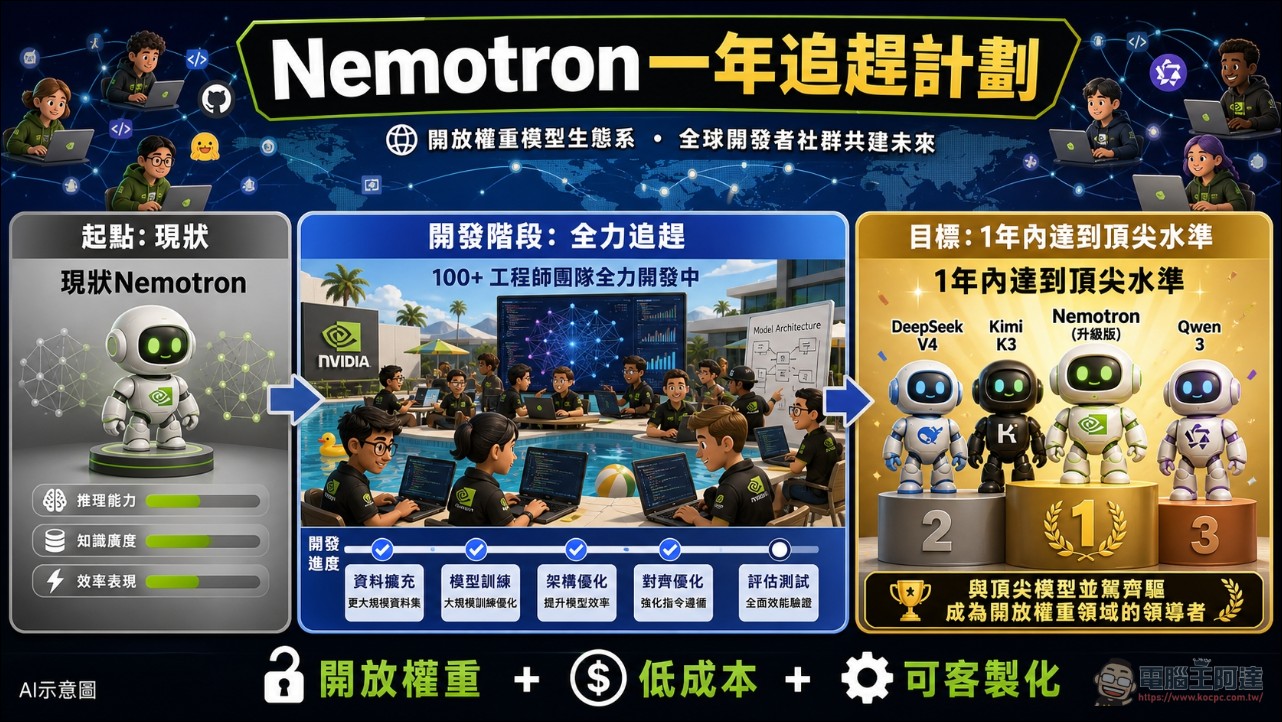
Nemotron’s goal: catch up to top-tier standards within a year.
Since its launch in 2024, NVIDIA’s Nemotron series has been a major player in the open-weight model space, but compared to Chinese open-source models like DeepSeek and Qwen, it has always lagged in visibility. With Poolside now joining in, the goal is to bring Nemotron to a performance level comparable to frontier models within a year.
WSJ reported that what NVIDIA aims to build will be “one of the world’s most powerful open-weight AI models,” offering a lower-cost, more customizable option compared to the closed systems of OpenAI and Anthropic. The model will continue NVIDIA’s open strategy, allowing developers to freely download, modify, and deploy it.
This plan echoes the larger initiative NVIDIA disclosed in SEC filings this March. According to documents obtained by WIRED,Declaration documents.NVIDIA plans to invest $26 billion over the next five years to develop open-weight AI models and related infrastructure. The $6 billion Poolside licensing deal is just the beginning of this budget, with more similar technology acquisitions and team hires to follow.
Why would NVIDIA get directly involved in making models itself?
As the absolute dominant supplier of global AI chips, NVIDIA reaps enormous profits from GPU sales. But the issue is that if the open-source AI model ecosystem in the market gradually becomes dominated by the Chinese camp, enterprise customers’ deployment decisions may tilt accordingly, ultimately eroding NVIDIA’s core hardware demand base (such as shifting to GPUs from Chinese or other vendors outside the CUDA ecosystem).
The successive release of Chinese models such as DeepSeek V4, Kimi K3, and Qwen 3 has begun to reshape enterprise procurement patterns. A growing number of companies are now turning to self-deployable open-weight models when evaluating AI solutions, rather than purchasing API services from closed systems. This trend is both a threat and an opportunity for NVIDIA. If Nemotron can take the lead in the open-weight space, NVIDIA can offer customers a complete path from chips to models: buy NVIDIA GPUs, run NVIDIA’s Nemotron, eliminating additional model evaluation and integration costs.
From this perspective, the $6 billion authorization for Poolside is just one step in NVIDIA’s broader strategy. Earlier this year, the company also added $2 billion to its investment in CoreWeave and put $5 billion into Ilya Sutskever’s safe AI lab. These moves all point in the same direction: NVIDIA is transforming from a chip company into a full-stack provider of AI infrastructure.
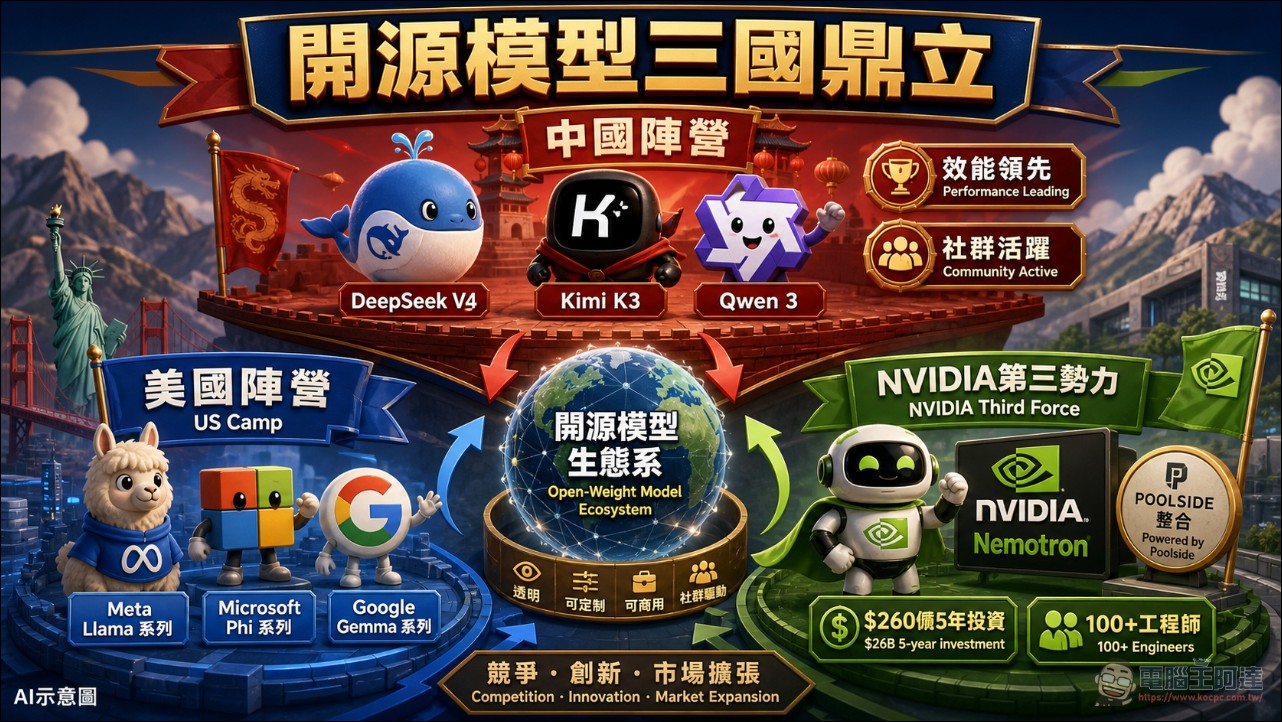
In the open-source model landscape, NVIDIA joins as a third force.
The current open-weight model market can be broadly divided into two major camps. The Chinese camp, represented by DeepSeek, Alibaba’s Qwen, and Moonshot AI’s Kimi, leads in model performance and open-source community activity. The US camp is led by Meta’s Llama series, along with Microsoft’s Phi series, Google’s Gemma, and others.
NVIDIA’s Nemotron has long been a relatively marginal player. While it has a solid technical foundation, it has trailed far behind Llama and DeepSeek in developer community discussions and real-world use cases. This $7 billion Poolside deal, combined with a $26 billion five-year investment plan, signals that NVIDIA intends to use capital to quickly close that gap. For enterprise users, NVIDIA entering the open-weight model arena could be good news—more options mean lower licensing costs and more flexible open-source deployment choices. As for how effective it will be, we’ll have to wait and see.