


If you’re looking for a case of “even the top human engineers need AI assistance,” there’s no more compelling example than this. Linus Torvalds, the father of Linux, who has written core code for 35 years and is known for his extremely strict code reviews, spent 24 debug patches and 18 reboots on an Intel Xe graphics driver bug on August 21, finally relying on AI to find the problem. The fix itself was just changing a single function call.

The essence of the bug: the memory address was calculated one page off.
The problem lies with the Intel Xe driver. get_flat_ccs_offset() This function reads the flat CCS (Color Compression Storage) base address from hardware, multiplies it by the number of enabled L3 nodes, and then rounds to the 128K boundary. The address space below the rounding boundary is handed to the VRAM allocator as available memory. The problem is: the original code used round_up()(rounding up unconditionally), but a boundary value representing “available memory ends here” should not be rounded up. The extra space after rounding up will be allocated as usable memory, but that memory belongs to the compression hardware. On the Battlemage G21 (16GB) graphics card, the actual CCS base address is 0x3fafff800, after carrying, it becomes 0x3fb000000, the difference in between is 2KB, exactly one page.

These 2KB were allocated to the third-level page table of the Mesa virtual machine. On every cold boot, the page table lands at this location, overwriting the compositor’s batch-buffer heap. The compositor fails on its very first submission, gdm (the display manager) keeps restarting, and the user sees a black screen. Restarting gdm actually fixes it, because the next time the VM page table gets allocated somewhere else.
round_up() Change to round_down()On this machine, the change excluded exactly one page of memory. Torvalds later read that reserved page and saw the write pattern of the compressed metadata: a 2-byte compression marker in every 16 bytes, which was the hardware silently overwriting allocated memory. The assertion check that should have caught this problem, because the comparison value happened to be 128K-aligned, would not trigger a failure on unaligned base addresses, rendering it useless and completely ineffective.
24 patches, 18 reboots, one person who refused to give up
Torvalds wrote in the commit message that this was a “hellish debug session.” The entire process produced 24 debug patches (gradually adding more debugging information) and 18 kernel reboots before narrowing the problem down to that faulty rounding function.
The key turning point was AI’s involvement. Torvalds had the AI handle a large amount of tedious work, including adding debug code and analyzing output. But the AI’s performance wasn’t reliable all along: it repeatedly told Torvalds directly, “This problem can’t be solved, we should just write a report.” However, under his constant demands and whipping (?), the AI still located the problem and solved it.
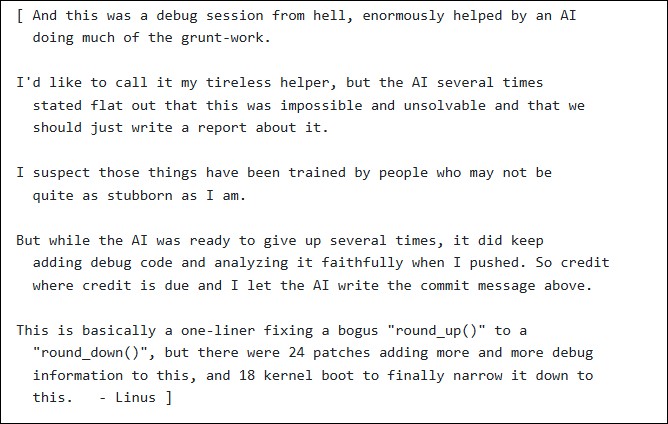
Torvalds at commit message In it, he wrote down his observations:
「我懷疑這些東西是被一些不像我這麼固執的人訓練出來的。但當我堅持下去的時候,AI 確實持續加入 debug 程式碼並忠實地分析結果。功勞歸功勞,我讓 AI 寫了上面那段 commit message。」
The same person, just two months ago, was telling AI critics to “go fork” themselves.
This fix is noteworthy not just because it fixed a two-year-old bug, but because it comes two months after Torvalds publicly expressed support for AI programming tools. In July this year, he wrote on the Linux kernel mailing list: “Linux is not one of those anti-AI projects. If anyone has a problem with that, they can do what open source does: fork it. Or just leave.”
The debate at the time originated from Sashiko, an “agentic Linux kernel code review system” that claimed to independently find 53.6% of bugs ultimately fixed by humans, but with a false positive rate of around 20%. Maintainers were divided over whether they should be flooded with large volumes of automated bug reports. Software Freedom Conservancy issued a statement arguing that “those who completely reject LLM/AI systems should be supported,” while Torvalds explicitly opposed that stance.
He stated that his stance is pragmatic, “based on technical merits, not fear of new tools.” He also countered: “Anyone who points out problems with AI had better take a good look in the mirror and point at themselves, because human intelligence isn’t all that impressive either.”
Different usage leads to different conclusions.
Torvalds’ use of AI this time is fundamentally different from the AI usage he criticized. The mailing lists he receives are flooded with low-quality patches and spam generated by AI — that’s the “AI auto-generates, humans submit without review” model. But this debugging was a “human-led, AI-assisted” model, where Torvalds himself set the direction, and AI handled the tedious code insertion and result analysis. When the AI said “give up,” the human chose to ignore it and keep going.

This distinction is key. AI’s value in debug scenarios lies in “accelerating the process of elimination”—across 24 debug patches and 18 reboots, AI handled a large amount of mechanical work, allowing Torvalds to focus on analysis and decision-making. But the moment the problem was finally found came down to human stubbornness.
Timeline of Torvalds’ changing attitude toward AI
Torvalds was not initially receptive to AI programming tools. In early 2025, a study conducted by METR found that open-source developers using AI tools actually saw a 19% decrease in productivity, even though these developers themselves felt they were “20% faster.” But by February 2026, the same group of researchers updated their conclusion, stating that “the speedup developers are getting from AI tools in early 2026 is likely larger than our early 2025 estimate.”

Torvalds himself revealed this January that he’s been using Google Antigravity for so-called “vibe coding,” building a Python audio visualization tool for his guitar effects pedal project. He wrote: “It started as my typical Google-then-copy programming style, but then I skipped the middleman, which is myself, and just used Antigravity directly.”
From personal experiments to officially using AI in core development, and then publicly telling critics to go fork themselves, Torvalds’ change in attitude took only a little over half a year. And this debugging experience with the Intel Xe driver is essentially him providing concrete evidence for his stance through firsthand experience.
This patch is expected to be included in Linux 7.3 and backported to the stable kernel. For users using Intel Battlemage G21 graphics cards who occasionally encounter black screen issues, the two-year wait is finally over.
Data source:1 / 2
Source: KOCPC Chinese