


Exposé-style posts are a common sight in community discussions involving relationship disputes, consumer conflicts, and workplace grudges. In the heat of anger, those involved often publicly release the other party’s name, photos, employer, license plate number, and even ID documents, all in the name of seeking justice or hoping to rally netizens to teach the other side a lesson. This practice, colloquially known as “doxxing to seek justice,” essentially involves piecing together scattered bits of information from multiple sources to identify a specific person’s identity and whereabouts. It has become a widespread and deeply entrenched phenomenon in today’s online communities.

From a psychological perspective, doxxing persists despite repeated bans because it stems from an illusion of righteousness rooted in “the many overwhelming the few.” Those who engage in it believe that by putting someone on public display and letting internet users pass judgment, they can make up for the grievances they suffered in the original dispute. What they fail to realize is that this seemingly cathartic emotional release can instantly flip them from victim to defendant.
After a highway collision, he sought justice by doxxing the other party’s personal information—and ended up being sentenced instead.
A criminal judgment from the Kaohsiung District Court in Taiwan (Case No. 106, Jian-Zi No. 3069) is a classic example of “doxxing someone to seek justice, only to end up getting yourself prosecuted.” The judgment states that a man surnamed Lin had a traffic dispute with another man on the highway. After the two sides failed to reach an agreement on vehicle damage compensation, Lin, unwilling to let the matter go, chose not to pursue legal channels. Instead, he used the traffic accident report form issued by police to obtain the other party’s mobile phone number and license plate number. He then posted the other party’s personal information—including birth year and occupation as a dentist—on the social media site “爆料公社” (Expose Commune), publicly urging netizens to be aware of the individual in an attempt to pressure the other party into resolving the vehicle damage dispute through public opinion.
After trial, the court determined that Lin’s conduct constituted a violation of Article 20, Paragraph 1 of the Personal Data Protection Act, which provides that “non-government agencies shall not use personal data beyond the necessary scope of the specific purpose for which it was collected,” and sentenced him under Article 41 of the same Act to two months’ imprisonment, convertible to a fine, along with a two-year suspended sentence and a requirement to complete three sessions of legal education during the probation period. Notably, the prosecution had also alleged that Lin’s public statement urging netizens to “pay extra attention to the treatment situation when visiting this dentist” constituted defamation; however, after review, the court found that this statement was a subjective comment on the handling of a medical dispute, concerned the public interest, and fell within matters subject to public scrutiny, and therefore did not render a conviction on that charge.
This ruling clearly draws a line: commenting on an event and disclosing someone else’s personal information without consent are two entirely different matters. The former is protected by freedom of speech, while the latter already violates the Personal Data Protection Act. In other words, simply publishing a person’s name, photo, address, or similar information online out of personal grievance is generally unlikely to satisfy any of the above exceptions, and therefore constitutes a violation of the Personal Data Protection Act.
More seriously, if the purpose of doxxing the poster involves a subjective intent to “seek unlawful benefits for oneself or a third party” or “harm others’ interests,” and the other party’s rights are at risk of being damaged as a result, it will further violate Article 41 of the Personal Data Protection Act, which carries a maximum sentence of up to five years in prison and a fine of up to NT$1 million. This is also a “non-complaint offense,” meaning that even if the victim later withdraws the complaint or the parties reach a settlement, prosecutors may still continue the investigation. In addition to criminal liability, those who have been doxxed and publicly shamed may also file civil claims for damages if their reputation has been harmed, their right to work has been affected, or they have suffered emotional distress—potentially escalating the original dispute even further.
Doxxing and Legal Evidence Gathering: Only a Thin Line Apart? Their Purposes and Methods Are Entirely Different
Internet doxxing and lawful evidence collection may both seem to involve gathering information about others, but they are fundamentally different in nature.Taiwan Association of Professional DetectivesSecretary-General Chen Yi-chun pointed out: “The two are fundamentally different in both purpose and means. Most online mob searches are carried out to bring personal disputes to social media platforms for public opinion, letting unrelated netizens judge who is right or wrong. Lawful evidence collection, in contrast, entrusts disputes to professional procedures authorized by law.”
He further explained that a legitimate investigation agency will first confirm whether the client’s reason for commissioning the case and the purpose of evidence collection are reasonable and justified before accepting it. The direction of evidence gathering also follows the principle of proportionality, targeting only the behavioral traces relevant to the case, rather than irresponsibly exposing all of the subject’s personal information like online doxxing does. For example, if a client suspects their spouse of infidelity, the focus of evidence collection would be on specific evidence of the time and place of the affair, organized into a chain of evidence admissible in court—not on making the other party’s unethical private life public for online condemnation.
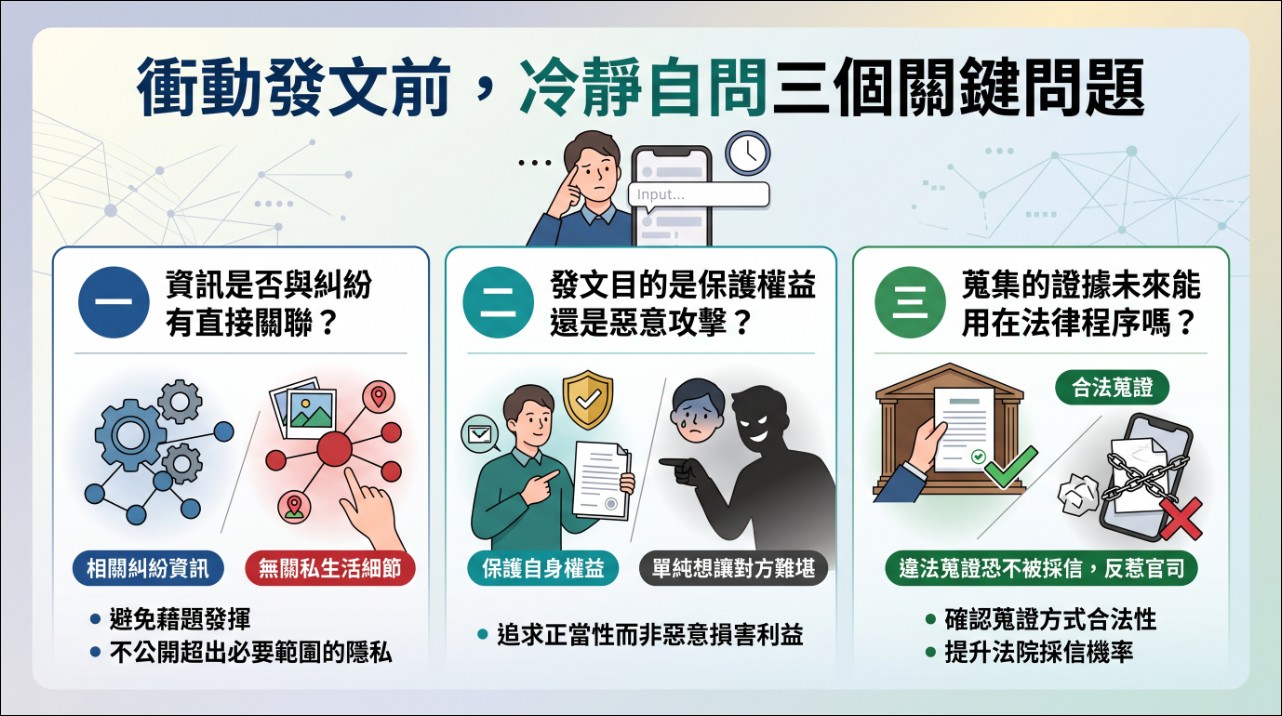
Before impulsively posting, calmly ask yourself three key questions.
When dealing with relationship, consumer, or workplace disputes, if you act on impulse and choose to dox someone online to seek justice, you may not only go from being the original victim to being sued and facing criminal liability, but because the evidence was obtained illegally, it may also lose legal validity and be unusable.Chen YijunIt is advisable that when people are at their most emotional, they should first calm down and ask themselves three questions:
First, is the information I’ve collected or published directly related to the original dispute? If the intent is merely to use it as a pretext and casually expose unrelated private details about the other party, then it already exceeds the necessary scope.
Second, is my purpose in doing this to protect my own rights and interests, or simply to embarrass the other party? The former is more likely to be deemed legitimate, while the latter is easily interpreted as maliciously harming others’ interests.
Third, can this evidence be used in legal proceedings in the future? If the method of gathering evidence is itself illegal, even if the content is true, it may be difficult for the court to accept it later, and you could even end up facing a lawsuit yourself.
These three questions may seem simple, but at the very peak of emotional intensity, they can buy you a moment of space for clear-headed judgment. Rather than rushing to socially destroy the other person, it’s better to first confirm whether the ground you’re standing on can hold up under legal scrutiny.
Make good use of legal channels, and avoid letting momentary emotional impulses lead to losses that outweigh the gains.
Chen Yi-chun pointed out that most people choose to dox others and post online to seek justice because they feel that taking legal action is too slow, too troublesome, and too time-consuming and costly. But in reality, online public shaming usually only provides a temporary emotional outlet—afterward, the other party may file a lawsuit for damages, and you’ll have to spend even more time and energy responding to the case, making things messier than the original dispute. In contrast, although steps like sending a certified letter, going through a mediation committee, or hiring a professional investigation agency to legally gather evidence and proceeding through legal channels may seem tedious, every step accumulates into valid evidence for future claims or lawsuits, and you won’t lose everything because your evidence-gathering methods were illegal.
If members of the public have concerns about credit reporting services, or wish to better understand the boundaries of lawful evidence collection, they can do so throughTaiwan Detective Occupational AssociationThe established appeal mechanism reports to and consults with the head office. In an era where everyone can post and publicly judge, first clarifying where the legal red line lies may be the most solid first step to protecting yourself.
Source: KOCPC Chinese