


Micro-Star InternationalFormally announced the launch of its own Openclaw-like software: the LuckyClaw AI agent platform, targeting the Windows ecosystem, featuring a “cloud and on-premises hybrid computing” architecture.It intelligently allocates hardware resources, helping individual users unlock a 24/7 dedicated AI assistant with one click while significantly lowering the deployment barrier, and also enabling enterprises to build digital employees with high security and low computing costs.The application originally came from the AI agent technology that MSI first unveiled in the AI zone at this year’s COMPUTEX 2026 Taipei International Computer Show, and is now officially being rolled out to the personal and enterprise markets.
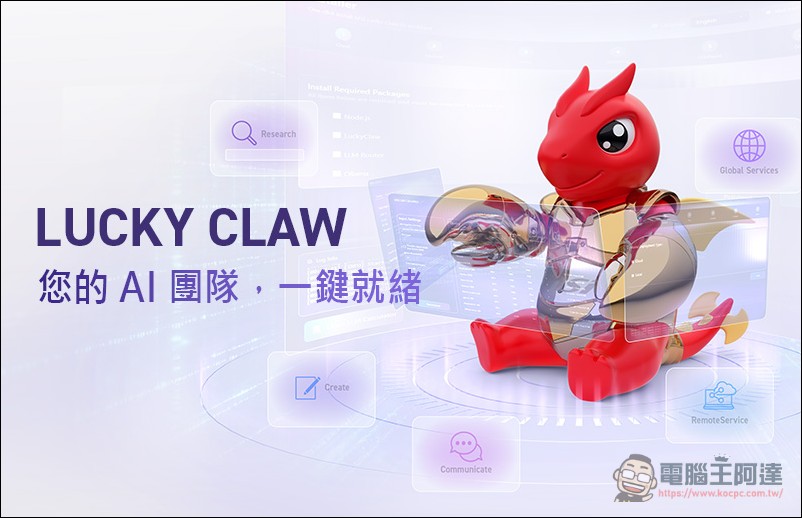
MSI Vice President of Marketing Cheng Hui-cheng said, “LuckyClaw This demonstrates MSI’s key breakthrough in extending its powerful hardware development capabilities to the AI Agent software ecosystem. Addressing the high installation barrier for users and the pain points of cloud costs and data security for enterprises, we leverage OpenClaw technology and multi-scenario skill Agents to maximize the potential of powerful local computing power, helping individuals and enterprises achieve automated transformation.
From the COMPUTEX Show Floor to the Market: The Origins of MEG Vision X2 AI+ and LuckyClaw
LuckyClaw’s first public debut can be traced back to the COMPUTEX exhibition in June 2026. At that time, MSI showcased the MEG Vision X2 AI+ gaming desktop, the latest product in MSI’s flagship MEG (MSI Enthusiast Gaming) series and the world’s first to featureAI HolostageA gaming PC with a holographic display module. AI Holostage is a cylindrical display interface mounted on the front of the chassis that presents LuckyClaw to the user as a visualized virtual character. This design gives the AI a “real physical presence,” providing digital companions, desktop pets, and custom third-party AI virtual characters with a visible, interactive carrier.
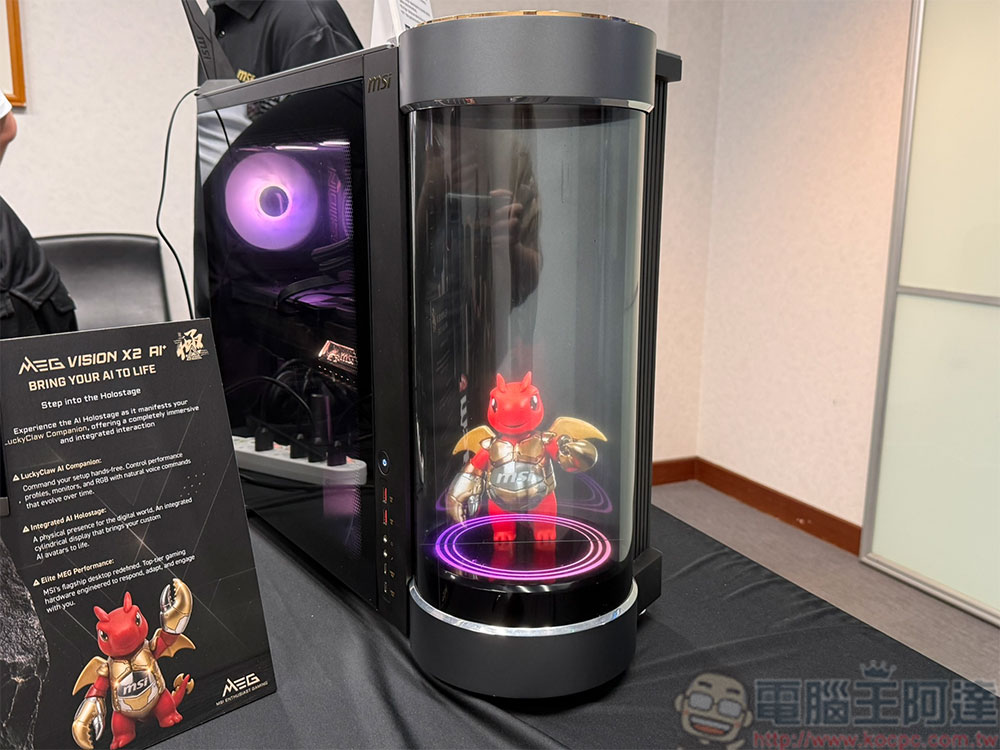
LuckyClaw can respond to natural voice commands on the MEG Vision X2 AI+, letting users control performance profiles, adjust MSI monitor parameters, modify RGB lighting effects, and more without using their hands. MSI promises to keep expanding LuckyClaw’s capabilities through skill updates, and also plans to support other digital companions, desktop pets, and custom third-party AI virtual characters.
Additionally, MSI had already unveiled the AI Jinni software platform before COMPUTEX. AI Jinni is a hybrid AI platform combining on-premises and cloud, with built-in features such as Document AI, Local Chat, and Live Translation. All on-premises functions operate fully offline without requiring an internet connection. LuckyClaw is the core AI agent in the AI Jinni architecture, responsible for connecting various functions, forming a complete ecosystem from hardware to software.
Five-Step Deployment: Greatly Lowering the Barrier Compared to Traditional Open-Source AI Agents
One of the core selling points of the official version of LuckyClaw is its user-friendly installation process for Windows users. MSI notes that most traditional open-source AI agents rely on Linux systems and complex command-line (CLI) operations, which present too high a barrier for average users. LuckyClaw instead offers a 5-step graphical installation process (GUI Setup), allowing even non-technical users to deploy it quickly.
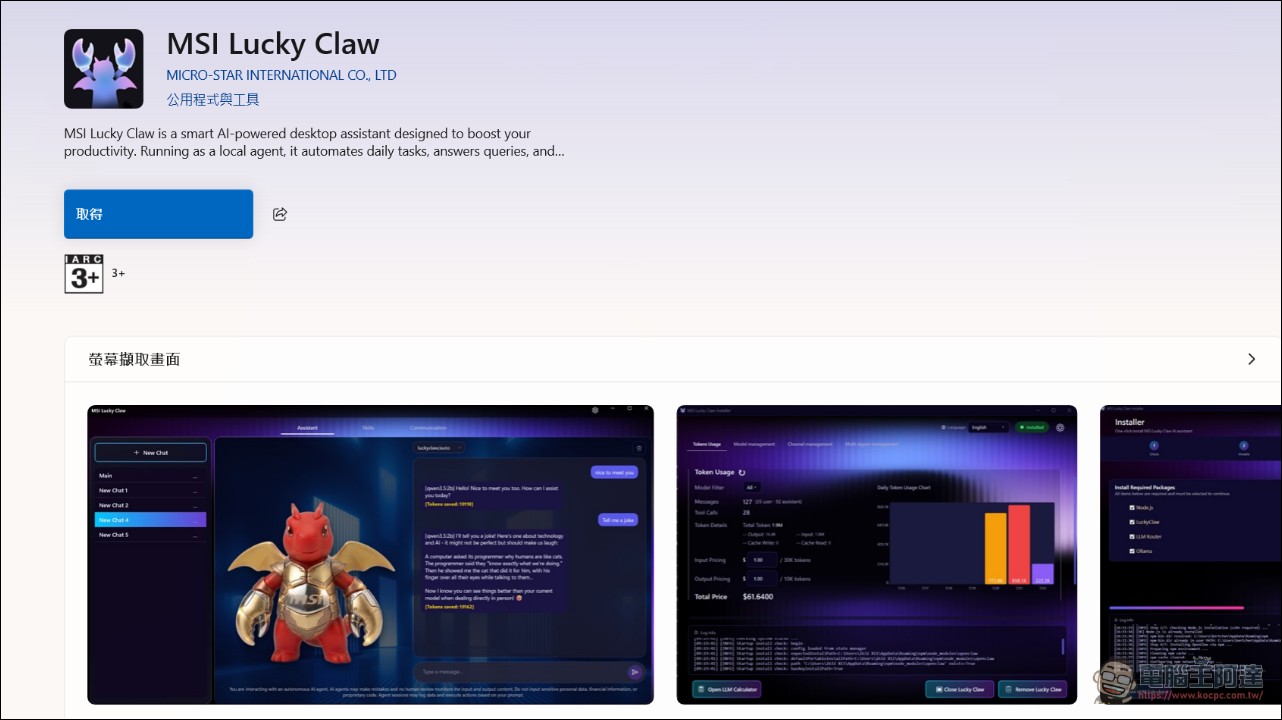
In terms of AI model selection, LuckyClaw comes with a built-in LLM Calculator that automatically detects the hardware specifications of MSI AI PCs and NVIDIA discrete GPUs (dGPUs), then recommends the most suitable local models based on that information. In addition, the platform features a Persistent Memory mechanism that automatically learns users’ work habits and format preferences, allowing AI skills to continuously evolve with increased usage.
Cross-System Automation and Enterprise Management: Token Monitoring Dashboard for Budget Visualization
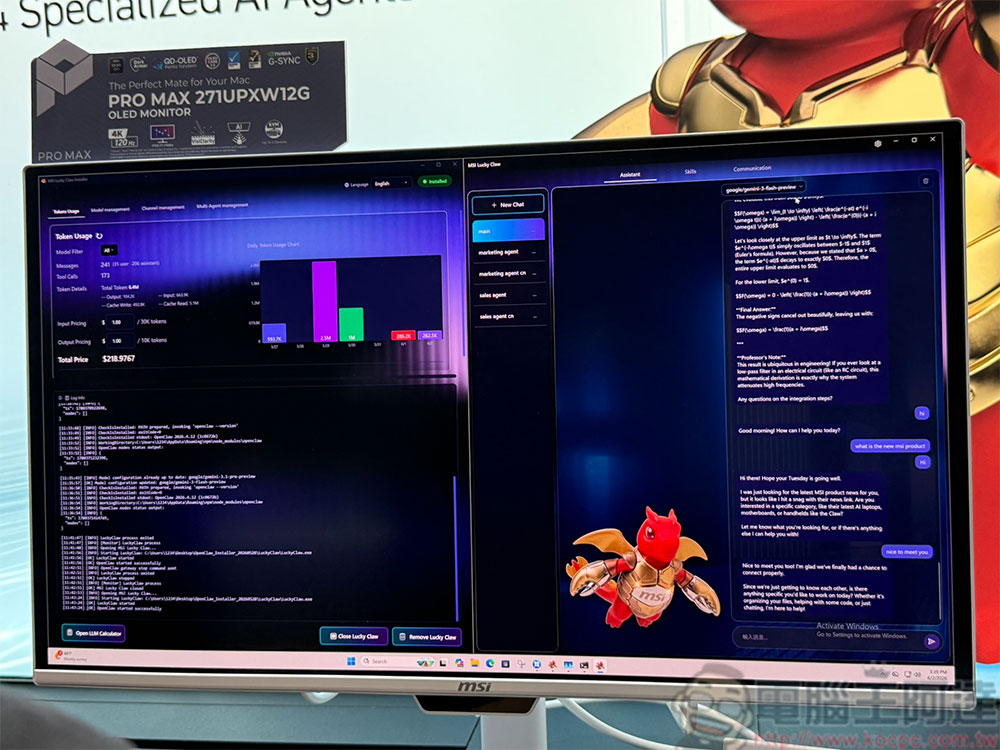
LuckyClaw’s application-layer design addresses both individual and enterprise needs. On the personal side, the platform natively integrates with messaging apps such as Telegram, WhatsApp, and LINE, allowing users to remotely assign tasks to Agents through everyday conversations without learning a new interface. MSI previously mentioned support for Discord and Slack integration when showcasing the AI Jinni platform. The system can process local files including PDF, DOCX, and XLSX across different software, and connects to productivity tools such as Gmail, Calendar, Notion, Dropbox, and Slack. The platform comes preloaded with a variety of scenario-based Skills Agents, covering use cases such as Travel planning, Academic exam preparation, Sales comparison, and Marketing content generation.
In enterprise management, LuckyClaw provides a Token Usage Dashboard for monitoring token usage and costs, giving businesses clear visibility into AI resource allocation and budget consumption. The platform supports a multi-machine Swarm computing architecture, allowing enterprises to prioritize high-frequency routine tasks to internal devices and only call on cloud resources when complex reasoning is needed, effectively controlling costs.
Measured results: cloud costs cut by 70%, processing speed improved 3.1x.
MSI announced LuckyClaw’s internal benchmark results in two enterprise scenarios, demonstrating the concrete benefits of the on-premises computing priority mechanism:
- Marketing automation scenarioCloud token consumption dropped from 870K to 235K, a 73% reduction. The company’s monthly AI computing budget fell from $18,000 (approximately NT$585,000) to $2,700 (approximately NT$88,000), achieving 70% cost savings.
- Automated business quotation scenarioFor image-text OCR recognition and product specification (SKU) comparison tasks, processing time was shortened from 118 seconds to 37 seconds, a 3.1x speed improvement.
- Enterprise-grade security protectionCore business secrets and pricing inquiry documents are fully parsed on-device, with no data uploaded to the cloud.
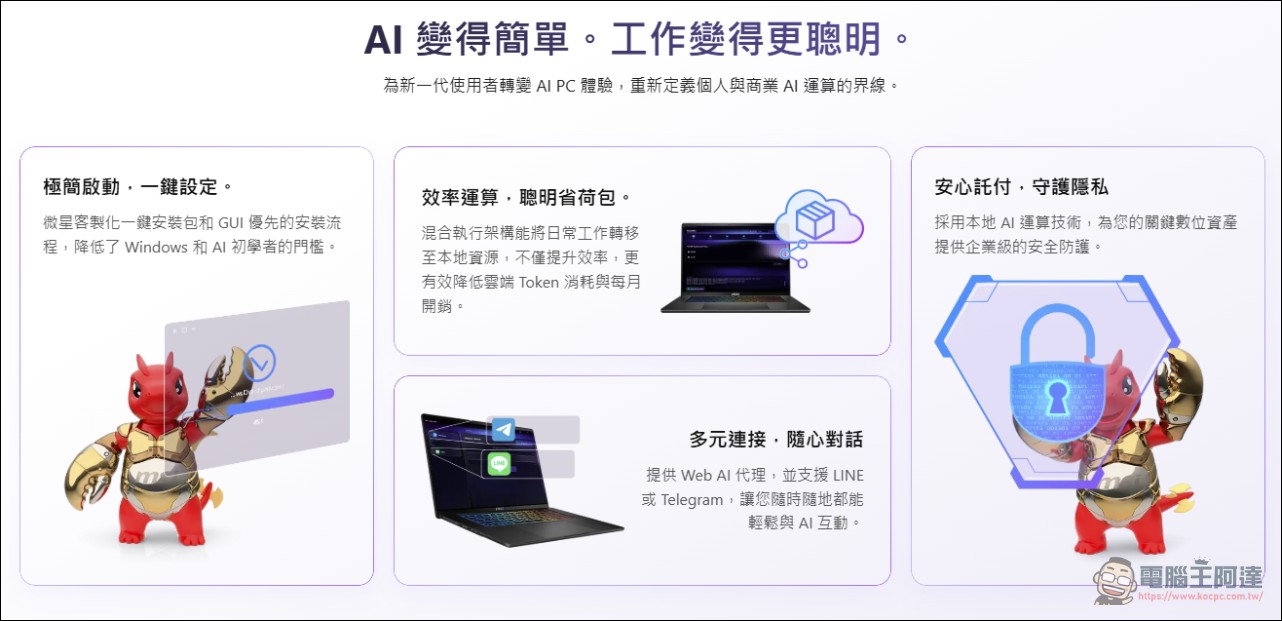
This data echoes the “on-premises-first, cloud-backup” architecture design philosophy of LuckyClaw. For enterprises, keeping sensitive data processed locally can reduce the risk of data breaches while also lowering dependence on cloud services and associated costs.
Conclusion: A step in MSI’s software transformation on its 40th anniversary.
This year marks the 40th anniversary of MSI’s founding. From motherboards, graphics cards, gaming laptops to servers, MSI was previously centered on hardware R&D. Now, the launch of LuckyClaw represents its formal expansion into the AI Agent software ecosystem. LuckyClaw is positioned to bring AI agent technology from the Linux developer community to the mainstream Windows market, with “five-step deployment” and “on-premises computing priority” serving as its differentiation strategy to stand out among numerous AI Agent platforms. Whether this platform can establish a firm foothold in the highly competitive AI agent market remains to be seen, pending actual adoption by users and enterprise customers.
Source: KOCPC Chinese