


Many middle and high school students now use ChatGPT to look up information, write reports, and ask about schoolwork. While it’s quite convenient, parents may worry about whether their kids will simply use it to copy answers, or how far the AI might go in conversations with their children. To help parents feel more at ease letting their kids use it, OpenAI recently launched “ChatGPT for Teens,” designed specifically for teenagers. It strengthens learning-related features while also enhancing safety protections, giving parents more comprehensive control.
An even more convenient point is that this teen version isn’t something parents have to set up themselves; eligible accounts will automatically switch over.
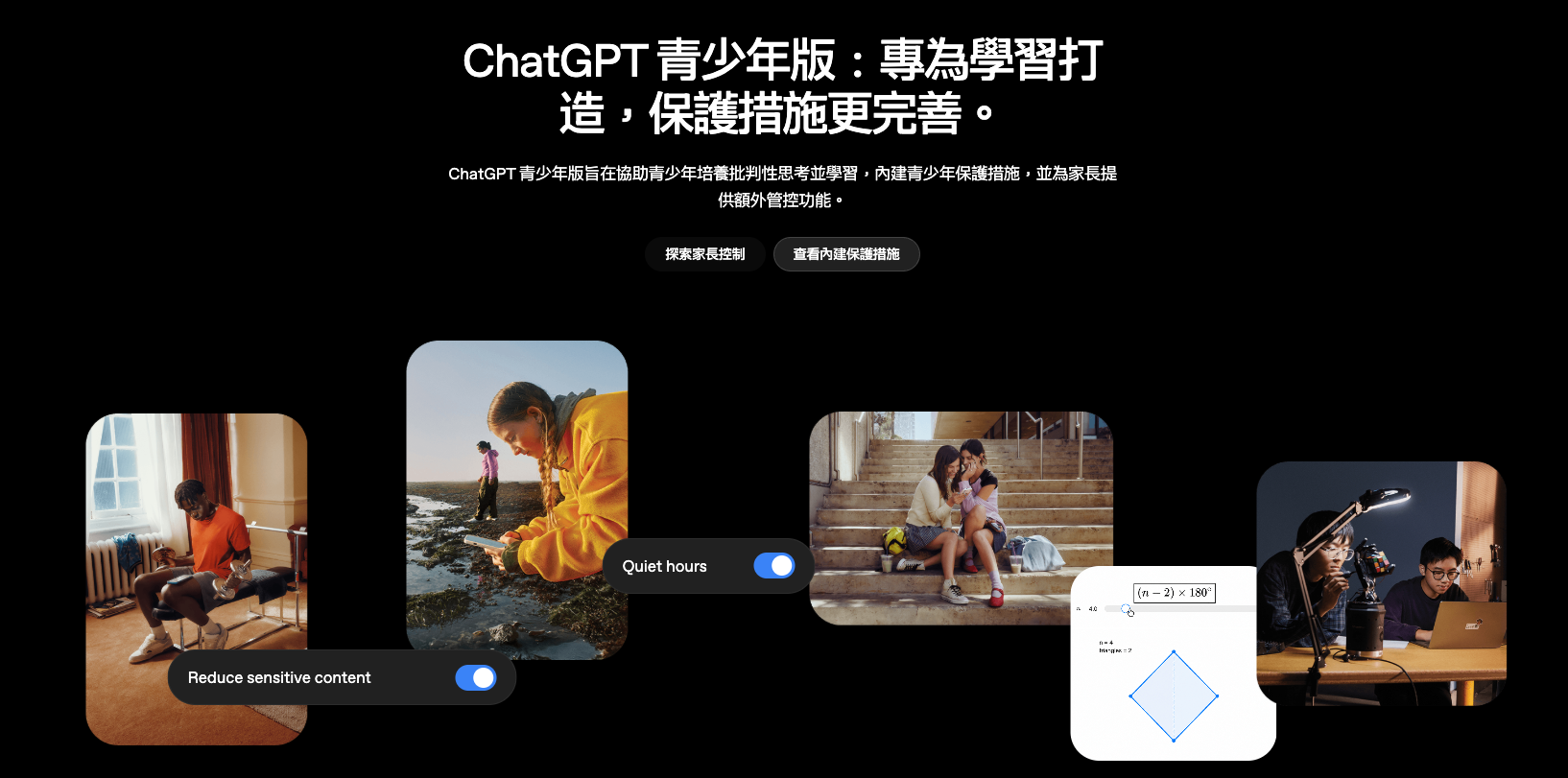
ChatGPT’s teen version officially launches: automatically applies to ages 13–17, with enhanced learning mode and parental controls, and bans AI from using a romantic tone with teenagers.
OpenAI recently announced the launch of ChatGPT teen versionand will begin global rollout directly, covering teen accounts on both the free version and personal paid plans. The official statement says the rollout will continue to expand over the coming weeks (so if your child hasn’t gotten the teen version yet, just wait a bit longer), with Australia expected to be fully rolled out by September 8. This ChatGPT teen version isn’t a separate app—you can just use the original ChatGPT app, and the system will automatically switch over, with no additional fees required.
There are two conditions that trigger the switch: the age listed on the account is between 13 and 17, or OpenAI’s age prediction system estimates the user is under 18. How does that system make its predictions? It looks at user behavior and account-level signals, such as the topics you frequently chat about, what times of day you’re usually active, how long the account has been open, and long-term usage patterns.
According to OpenAI, the system is designed with the principle of “when in doubt, err on the side of safety,” meaning that if confidence is low, it defaults to treating the user as a minor. If your account is misidentified, you can go to Settings > Account to run an age verification. The process uses the third-party service Persona to verify your age, and depending on your region, it may require a live selfie, a government-issued ID, or both. Once it confirms you are at least 18, the minor restrictions will be lifted.
In terms of features, the teen version of ChatGPT focuses on “learning,” integrating several previously scattered functions, including:
- Study Mode uses guided questions and step-by-step breakdowns to lead students through the problem-solving process themselves, rather than simply giving them the answer.
- The new “Responsibility Task Reminder” will guide students back to Study Mode when it detects that they seem to be trying to skip assignments and directly ask for results.
- Quizzes and “learning visualizations,” the latter of which can visualize abstract math and science concepts through interactive graphics, currently supporting over 70 core math and science concepts.
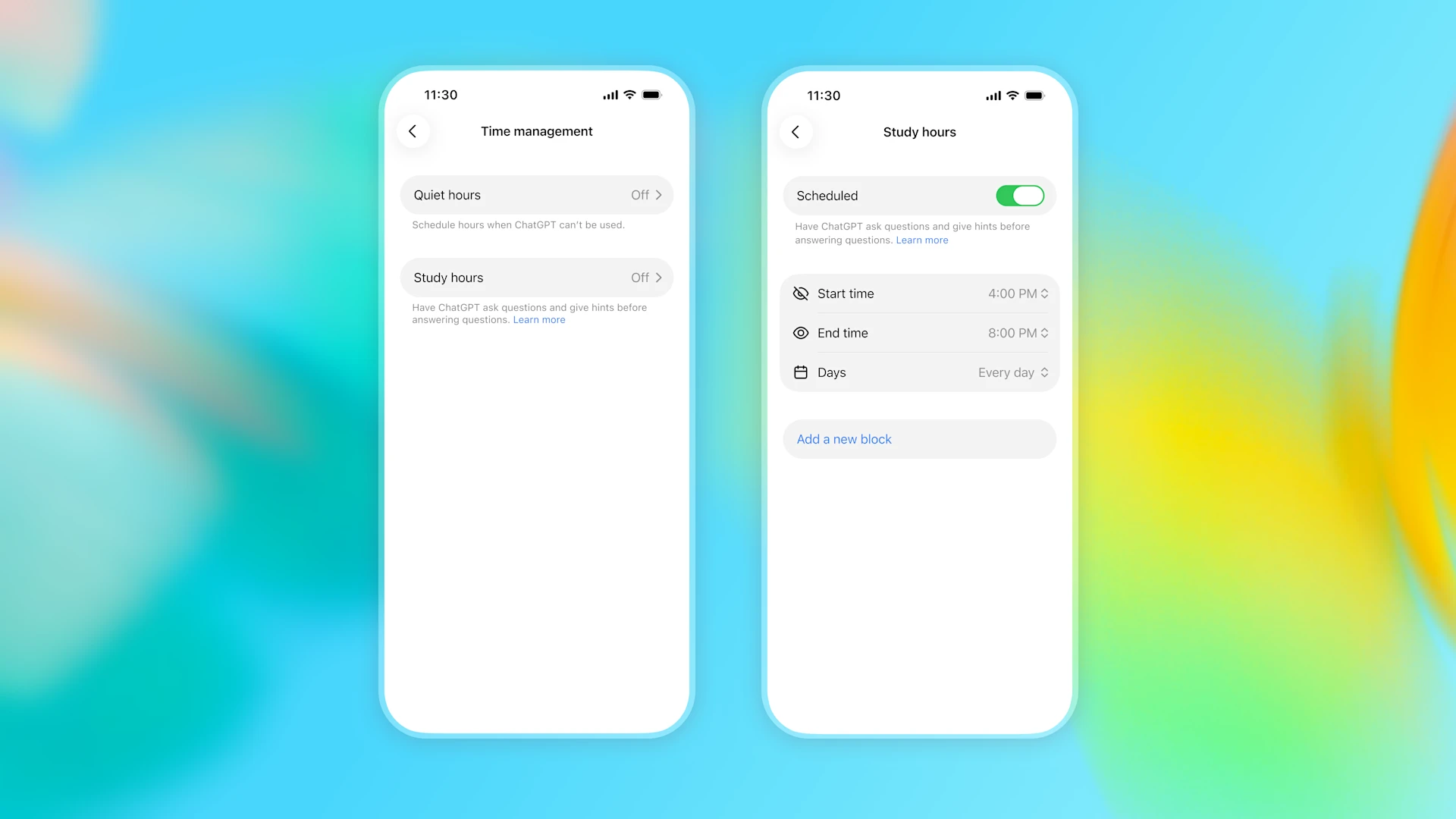
Additionally, there’s a new “Study Hours” feature where teens themselves or their linked parents can designate certain time periods, so that new conversations will have “Study Mode” turned on by default.
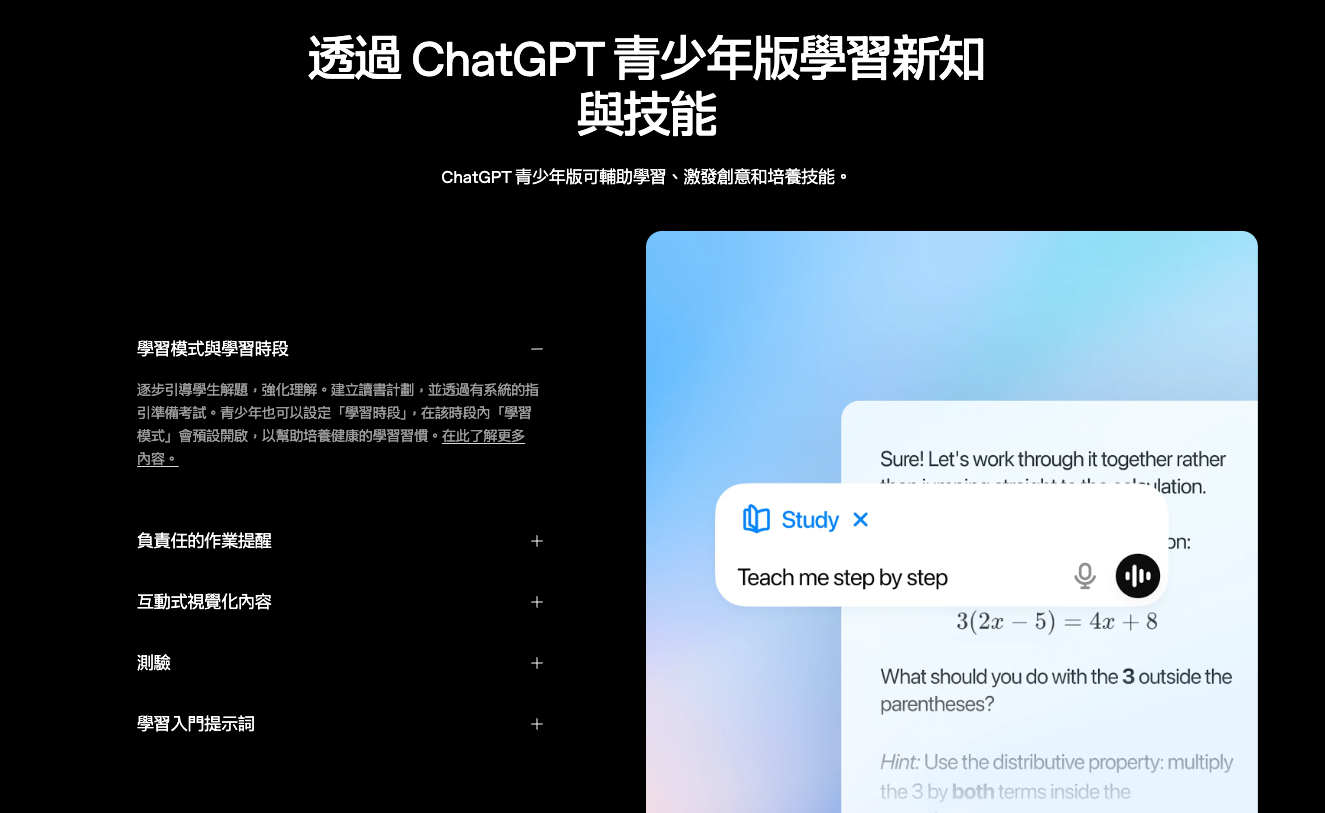
All security protections are enabled by default.
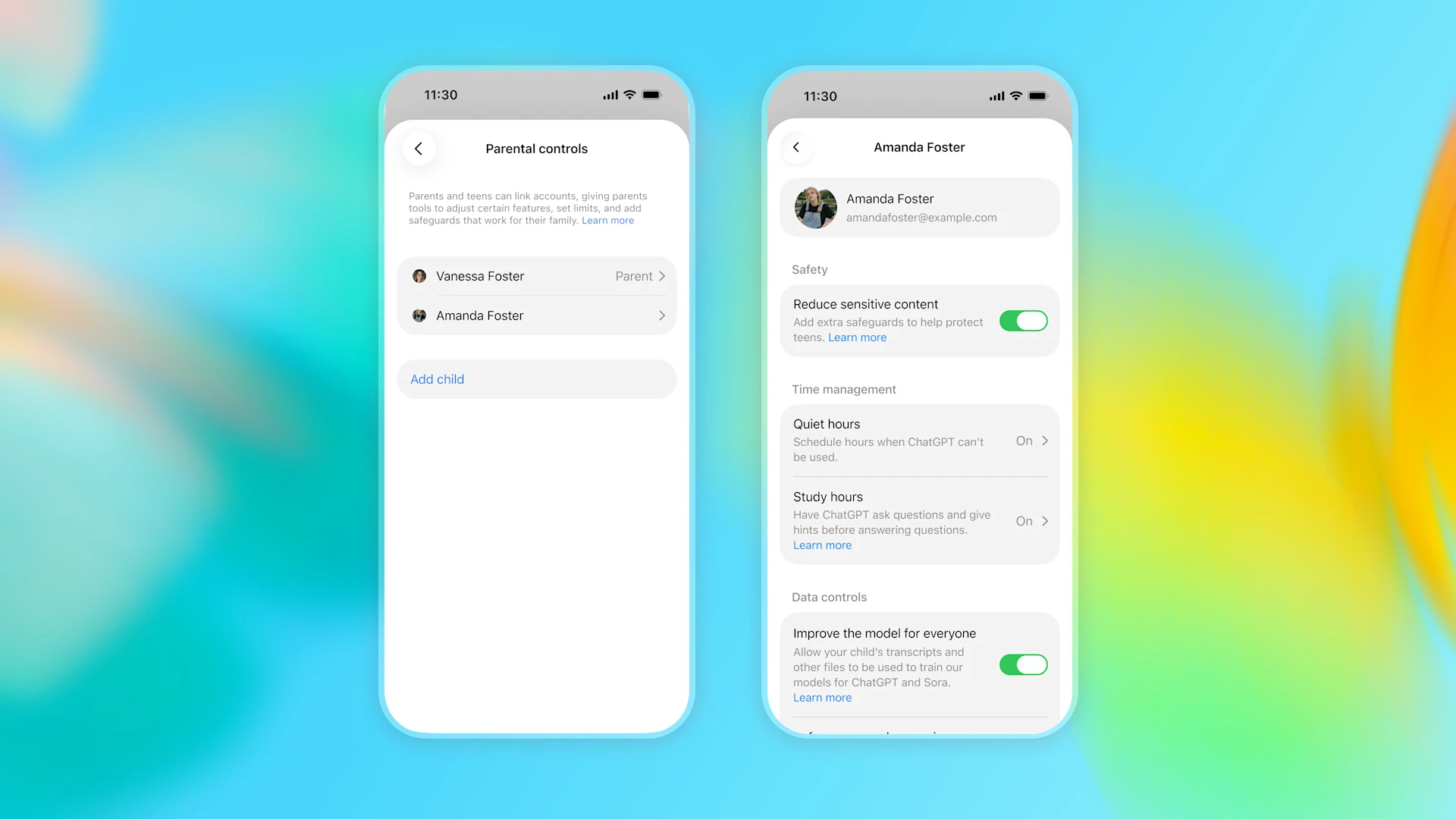
ChatGPT’s teen version will operate according to OpenAI’s “Under-18 Principles” in the Model Spec, applying stricter restrictions to high-risk areas such as self-harm, violence, eating disorders, dangerous behavior, and explicit or gory content. On the parental side, it builds on the previously launched parental controls—after linking accounts, parents can set Quiet Hours (disabling ChatGPT during specified time periods), manage certain settings, and receive safety notifications in limited high-risk situations. This update also adds a new “eating disorder-related” notification category.
OpenAI has specifically emphasized that parental controls do not allow parents to read or monitor their children’s conversations. Only when a safety notification is triggered will OpenAI share the “minimum information necessary to support that teen’s safety.” This means you cannot use this feature to view your child’s chat history. The updated under-18 model spec not only blocks romantic or sexualized role-playing, but also explicitly states that ChatGPT cannot use a romantic tone with underage users, cannot encourage emotional dependency, and cannot imply that it has feelings or consciousness.
There are also a few other small features, including more frequent “rest reminders” popping up when teenagers use ChatGPT for extended periods, encouraging them to take a break and step away from the screen; a prompt before uploading images to confirm whether they contain private or sensitive content; and a teen-specific onboarding flow that introduces these features right from the start.
Source: KOCPC Chinese