


AI video generation has long been almost exclusively NVIDIA’s one-man show. While open-source models let everyday users deploy locally, all officially supported frameworks revolve around the CUDA ecosystem, leaving Apple Silicon users watching from the sidelines. But after MiniMax released the H3 video model weights on August 3, one person broke that deadlock: Redis creator antirez (Salvatore Sanfilippo) built a native inference engine in pure C plus Metal, letting Macs run MiniMax H3 to generate videos—just seven days between the weights going public and running on a Mac.
MiniMax H3: An open-source model that generates video and audio tracks together
MiniMax H3 is a 33.1B-parameter multimodal generation model whose standout feature is the ability to produce both video and a 32kHz stereo audio track in a single pass—dialogue, sound effects, and ambient audio are all generated at once, with no need for separate post-production dubbing. Architecturally, it uses a dense single-stream omni transformer paired with Qwen3-VL-32B as the text encoder, and the official release includes two weight sets: FL2VA (text-to-video with first-frame/last-frame control) and Ref2VA (image, video, and audio reference inputs). It supports text-to-video, first-frame/last-frame control, and multi-image/multi-video reference, with a default output of 768p at 24 frames per second and a maximum duration of about 15 seconds, covering 11 languages. The model was announced on July 31 and its weights were released on August 3, hosted on available for download on Hugging Faceis currently the best open-source AI video generation model in the world.
We also used MiniMax H3 to practice on some videos, and the results were pretty good:
Official ecosystem: starting from a 24GB graphics card, Mac is not on the list.
The problem lies in the officially recommended execution environment. By the minimum configuration of ComfyUI’s official workflow, the pruned INT8 plus NVFP4 quantized files total about 42.5GB, requiring 24GB-class GPU memory—meaning only RTX 4090 or higher graphics cards can run it smoothly. Community testing indicates that a 12GB graphics card with tiered offloading can barely run it, but stability isn’t guaranteed. The INT8 full version for maximum image quality requires a 48GB-class GPU, while full-precision bf16 goes straight to 80GB-class graphics cards, with the official SGLang example defaulting to four GPUs. The officially listed execution frameworks—Diffusers, SGLang, vLLM, and ComfyUI—are all within the NVIDIA ecosystem, with no official or community-verified Apple Silicon support and no third-party backing either.
Redis creator steps in: h3.c in pure C + Metal
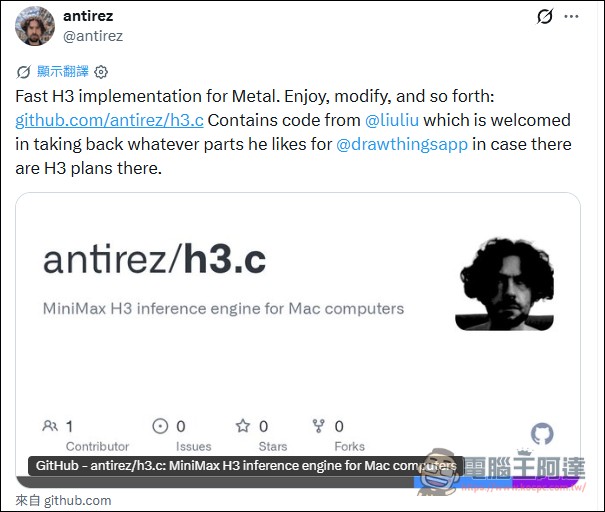
The turning point in the story came later, when Redis creator antirez uploaded h3.c to GitHub on August 9th, and the next day announced it in a post on X with a very brief message: “Fast H3 Metal implementation, enjoy.”
Fast H3 implementation for Metal. Enjoy, modify, and so forth: https://t.co/FuyzEtUW7S Contains code from @liuliu which is welcomed in taking back whatever parts he likes for @drawthingsapp in case there are H3 plans there.
— antirez (@antirez) August 10, 2026
This project has no Python, no PyTorch, no ComfyUI—it’s pure C with Metal shaders, directly calling Apple’s GPU interface. It’s developed using a vertical slice approach: first confirming model and metadata parsing, then aligning the Metal compute blocks, then sequentially working through prompt encoding, text-to-video and audio, first-frame/last-frame conditioning, and Ref2VA multi-reference input, with each layer validated before moving on. The project is MIT-licensed (the engine itself, excluding model weights), and by August 11 it had accumulated nearly 800 stars, all committed by antirez alone.
h3-metal – Github
Performance: On M5 Max, 512×512 is about 3.5 seconds.
According to explainx The tests show that h3.c takes about 3.5 seconds to generate a 512×512, 22-frame video with 4 denoising steps on the M5 Max, with memory usage peaking between 25.9 and 36.4GB depending on precision settings. For comparison, the community reports that running ComfyUI on a Mac takes over an hour to produce a short clip, while h3.c cuts that down to a few minutes. antirez is currently focusing his development efforts on Metal performance and memory tuning for the M3 Max and M5 Max.
In his vlog, he also explained how H3 works: during video generation, all frames are denoised simultaneously rather than being generated sequentially one after another, with cross-attention used to maintain coherence between frames and between the video and audio tracks. He described H3 as the most powerful open-source video and audio generation model, and mentioned that MiniMax researchers stated in a Reddit Q&A that they are also currently experimenting with cross-attention to strengthen inter-frame consistency.
Two days before the project’s release, he had already posted a demo clip generated by H3, which took just 10 denoising steps to produce, captioned “H3 is really fun.”
Only 10 steps in this example to make the video short, yet H3 is quite fun. pic.twitter.com/do1Jq49WSJ
— antirez (@antirez) August 8, 2026
This buzz even caught the attention of MiniMax’s official account. When it reposted h3.c, it wrote: “You can’t hire talent like this, so the only way is to open-source it and let it happen.” The post accumulated over 130,000 views within 12 hours.
One of the best programmers on Earth just wrote a MiniMax H3 inference engine for Mac computers.🫨
Open weights mean anyone can bring H3 to any hardware, and sometimes “anyone” turns out to be the creator of Redis. You can’t hire this, you can only open-source and let it… https://t.co/EwhCHBs0pi
— MiniMax (official) (@MiniMax_AI) August 10, 2026
h3.c is still under development. antirez himself describes it as “a series of working vertical slices,” and there’s still a lot of engineering work ahead. There are also some limitations to accessing the full feature set: the 2K upscaling module H3-Regenerate-2K has not been open-sourced and can only be used via MiniMax’s cloud API; video length is constrained by the model’s temporal structure; additionally, H3’s Community License sets a threshold for commercial use—organizations with annual revenue over $20 million need to negotiate a separate license. In terms of execution environment, h3.c relies on FFmpeg and FFprobe for media input/output. Mac users need to install these two tools via Homebrew before generating videos.
The significance of h3.c is not just giving Mac users another new toy. On the seventh day after H3’s weights were opened, someone already ran it using languages and frameworks the original developers had never touched. That is exactly the difference between open weights and closed APIs: closed models’ capabilities are forever defined by the original developers, while open models’ capabilities are completed by the community. antirez doesn’t need MiniMax’s permission, nor does he need to wait for the official roadmap—he gets the weights and does it himself. That kind of thing would never happen in a closed-source ecosystem.
Summary
H3 weights were opened for seven days, and a native Mac engine was born—created by a retired master developer who asked for nothing in return. While the official ecosystem is busy serving NVIDIA’s high-end users, the open-source community filled the Mac gap in a single weekend. For Apple Silicon users, AI video generation went from “visible but out of reach” to “download and play.” This is the value of open weights: someone will always build what the original manufacturer never intended to make.
Source: KOCPC Chinese