


Bloomberg reporter Mark Gurman revealed on X that OpenAI’s long-awaited AI hardware device finally has a concrete form. It will be a “human-like” smart speaker, shaped like a doughnut, about the size of a hockey puck, and deliberately designed so users can pick it up with one hand and carry it around. Gurman noted that the device is equipped with a camera, speaker, microphone, and lights, and most notably, it also has moving parts to display interaction and response status. The price is expected to be between $300 and $400.
NEW: OpenAI’s device – a human-like smart speaker –
will look like a doughnut and be the size of a hockey puck. It meant to be held. It has a camera, speakers, microphones, lights and, most notably, moving parts to show interactivity. It’ll be $300-400. https://t.co/gDxQU6FB8E— Mark Gurman (@markgurman) August 6, 2026
This is not the first time OpenAI has been called out for making hardware. Bloomberg had already reported earlier that OpenAI’s first move into consumer devices would be a portable, screenless smart speaker, positioned as a “new kind of home computer for the AI era.” The device is a physical embodiment of ChatGPT, meant to bring AI out of the mobile app and into everyone’s home.
A donut-shaped AI companion with moving parts, designed to be something you can “pick up and hold.”
According to information obtained by Bloomberg, the product is a smart speaker without a screen, shaped like a donut and roughly the size of a hockey puck. It was designed so users can easily carry it around the house with one hand, whether placing it on the bedside table, the kitchen counter, or holding it while talking. The device is battery-powered and features a speaker grille and microphones to receive voice commands and conversations. It is equipped with lights to indicate when it is listening, as well as a camera and other sensors to perceive the surrounding environment and feed visual information to the AI.
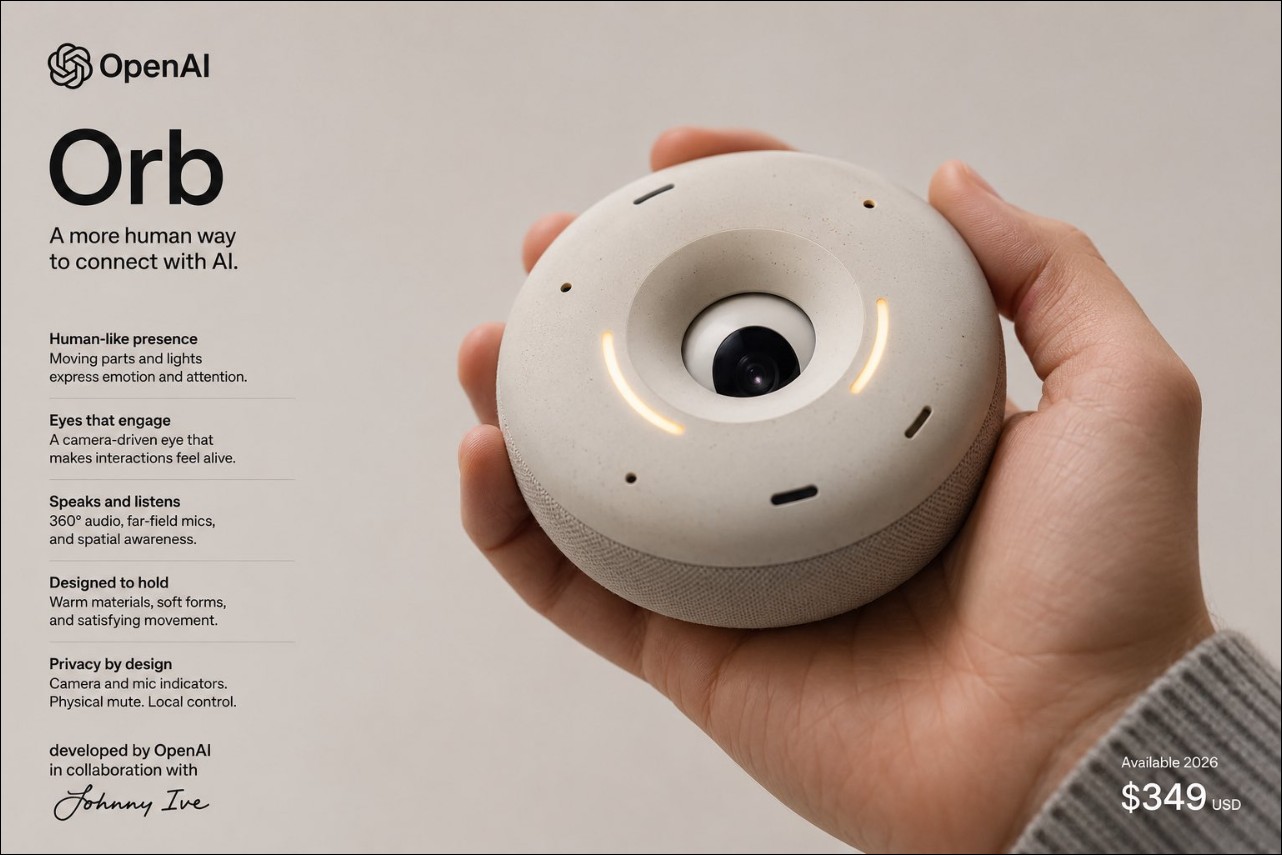
What stands out most are the parts that move on their own. According to people familiar with the matter, these moving components show that the device is responding and interacting with the user, with the goal of making the machine feel more “alive” than existing fixed speakers.
An “AI-first” little computer, not sold as an ordinary speaker.
Bloomberg’s report emphasized that this device won’t be positioned as an ordinary smart speaker, but rather as an “AI-first” mini computer that helps users get things done. It operates similarly to ChatGPT Live voice mode on phones, but uses a more advanced model, making interactions feel more human. The device will also learn user habits over time, gradually adjusting its conversational style to make it feel more like a real person.
This hardware was developed in collaboration with Jony Ive’s design studio, LoveFrom. In his earlier career, Ive oversaw the design of the iPhone, iPad, iPod, and Apple Watch, and he also co-founded a device startup that OpenAI acquired in 2025. Like Ive’s past work, the new device takes a premium approach, using high-quality materials such as fine metals. Even at a glance, its appearance clearly sets it apart from other consumer electronics.
According to Bloomberg, OpenAI has been hoping to unveil this device this year and release it to general consumers in 2027. In terms of pricing, OpenAI has internally discussed a price of $300 to $400 (approximately NT$9,600 to NT$12,800), which is more expensive than most smart speakers but cheaper than a standard iPhone.
The exterior design avoids Apple’s shadow, but the shadow of litigation still lingers.
The ring-shaped design of this device is intentionally meant to differentiate it from Apple’s products. Although Apple has the HomePod speaker product line, it doesn’t have a battery-powered version, nor has it released an AI-focused home device. OpenAI wants to use this hardware to prove it didn’t copy Apple’s design. But the Apple lawsuit is still hanging over its head. Apple is suing OpenAI for stealing trade secrets, claiming OpenAI asked a longtime supplier to develop a metal finishing technique similar to Apple’s. OpenAI dismissed the claim as “too vague and too general,” stressing that its device is “completely new and different from any Apple product.” Apple also filed for an injunction this week, which, if granted, could affect the device’s launch timeline.
In response to the accusations, OpenAI emphasized in its motion to dismiss Apple’s lawsuit that the company is “building a completely new product unlike anything Apple has.” Apple, in turn, believes the case is about who will dominate future AI devices, which may no longer rely on traditional apps or operating systems. Sources familiar with the matter said OpenAI remains fully committed to developing the device internally, believing the product has not used or infringed on any of Apple’s trade secrets.
The first step is just the beginning—OpenAI’s long-term goal is to replace smartphones.
For OpenAI, this donut-shaped speaker is just the beginning of its push into hardware. In the long run, OpenAI wants to build an entire product line of devices, and eventually even release hardware that could replace smartphones. This small, portable device centered on an “AI-first” approach is their first step down that road. But to get this device into everyday households, OpenAI first has to clear two hurdles: whether consumers will be willing to shell out $300 to $400 for a smart speaker, and whether it can launch on schedule in 2027 while under the shadow of Apple’s lawsuit. For a company that has historically focused on software and services, this is an entirely new kind of battle.
For OpenAI, this device means far more than the sales of a single product. It determines whether OpenAI can break free from its position of “running models on someone else’s hardware” and put AI into its own designed hardware, into users’ homes—simultaneously seizing both influence and users’ everyday contexts. If this step is executed well, OpenAI will no longer just be a company providing services from behind the cloud.
Source: KOCPC Chinese