


In the field of AI development, NVIDIA’s CUDA ecosystem has long dominated, and most large-scale language model training and fine-tuning tools are designed based on NVIDIA GPUs. This puts AMD users at a disadvantage in local LLM fine-tuning. Even if AMD hardware performs well in inferring CP values, the training workflow has always been a shortcoming. Recently, Unsloth, a new startup founded by former NVIDIA engineer Daniel Han, announced that its open source LLM fine-tuning tool officially supports AMD GPUs, covering Radeon, Instinct, Ryzen AI and data center GPUs, and can operate on the three major platforms of Windows, WSL and Linux. This collaboration, completed with AMD engineering teams, focuses on training up to 2x faster and reducing VRAM usage by 70% without sacrificing accuracy.

What is Unsloth
Unsloth AI Founded in 2023, it is a new startup in the 2024 summer batch of Y Combinator. It is headquartered in San Francisco and currently has a team of only 8 people. It was co-founded by brothers Daniel Han and Michael Han. Daniel Han once worked at NVIDIA and is good at algorithm optimization. He has also fixed more than 20 bugs for open source models such as Gemma, Llama, Mistral, and Phi.
Unsloth’s product is an open source native LLM training and inference tool that has accumulated more than 68,000 stars on GitHub. YC calls it an “open source reinforcement learning and LLM fine-tuning” platform that uses customized core and memory optimization technology to increase model training speed by 30 times and reduce memory usage by 90%. It provides a graphical operation interface that integrates tool call repair, code execution, secure web search, remote API connection and HTTPS deployment.
Prior to this, Unsloth was mainly focused on the NVIDIA CUDA platform. this time AMD supportThe launch means that developers using AMD graphics cards can also enjoy the memory optimization and training acceleration brought by Unsloth.

Supported AMD hardware range
Unsloth’s support for AMD spans the entire product line from consumer to data center:
- RDNA 4 (Radeon RX 9000 Series): Fully supports Windows, WSL, Linux
- RDNA 3.5(Ryzen AI 300 / Ryzen AI MAX,Strix Halo): Full support for all platforms
- RDNA 3 (Radeon RX 7000 Series): Full support for all platforms
- CDNA 4/3/2(Instinct MI350、MI300、MI200):Full support for Linux
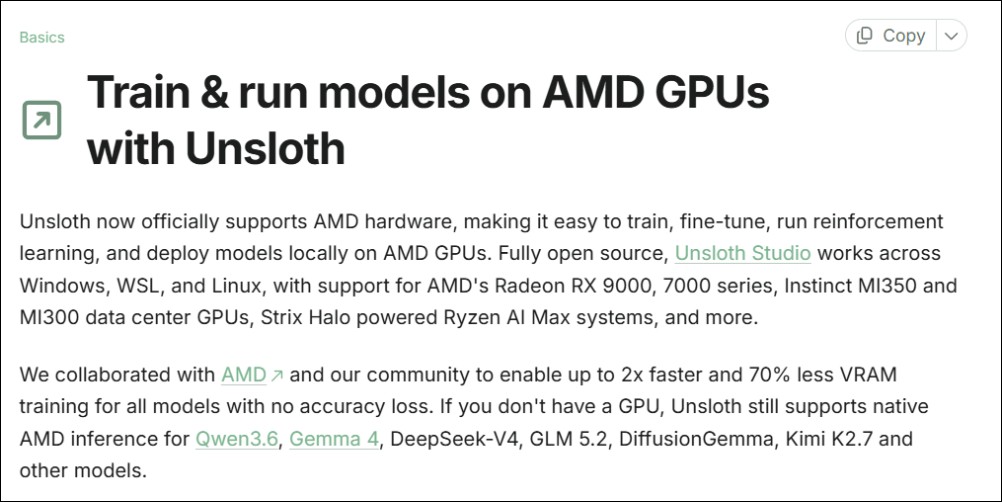
In other words, everything from the Radeon RX 9070 in the hands of ordinary players to the enterprise-level Instinct MI300X data center accelerator card is within the scope of support. Strix Halo-based Ryzen AI Max systems are also optimized for Linux, WSL and Windows.
Technology Core: Customized Triton core and memory optimization
The reason why Unsloth can achieve such a substantial performance improvement on AMD GPUs relies on its custom Triton core and mathematical algorithms. A number of optimization technologies significantly reduce VRAM usage, specifically in the following aspects:
- training memory: In the LoRA SFT test of Llama-3.1-8B, Unsloth had a peak VRAM of 18.3 GB, a 33% reduction compared to TRL + FA2’s 24.3 GB. Unsloth’s VRAM usage remained flat throughout the training session, while other solutions spiked to 22.8 GB every few steps.
- reinforcement learning: In reinforcement learning scenarios such as GRPO, VRAM can be reduced by up to 80%. Unsloth directly uses the LoRA path of vLLM, avoiding the floating point precision drift problem caused by merging and unmerging LoRA weights in traditional methods.
- reasoning ability: Even if there is no GPU and can only use the CPU, users can still run inference on the AMD platform through Unsloth, which supports optimized ROCm construction in GGUF and Safetensors formats.
In terms of training speed, in the same set of Llama-3.1-8B tests, Unsloth reached 2.07 seconds per step, which is about 1.39 times faster than TRL + FA2’s 2.87 seconds. It only takes 56 seconds to complete 25 steps compared to 75 seconds.

Low VRAM threshold: 3 GB can train the model
One of the most topical features of this update is the extremely low VRAM threshold. According to official instructions, on AMD hardware, users only need 3 GB VRAM to train Qwen series models, and 8 GB VRAM to train Gemma 4.
Introducing Unsloth for AMD 🚀
You can now train & run LLMs on your AMD hardware• We collaborated with AMD to enable you to train & run 500+ models on AMD GPUs
• Works on Windows, WSL, Linux
• Train Qwen, Gemma on 3GB VRAMGitHub: https://t.co/aZWYAtakBP
Works on Radeon,… pic.twitter.com/hSSj694Upl
— Unsloth AI (@UnslothAI) July 20, 2026
This significantly lowers the hardware threshold for locally fine-tuned LLM. LoRA fine-tuning work that used to require high-end NVIDIA graphics cards can now be done with an entry-level AMD graphics card. This change is significant for developers and researchers who want to try model fine-tuning in a local environment but have limited budgets.
Unsloth Studio and Agent integration
In addition to the core capabilities of training and inference, Unsloth has also simultaneously updated Unsloth Studio, bringing a number of improvements:
- Model Hub: Brand new model exploration interface, supporting popular ranking, search, README preview and resumable download manager
- Dynamic NVFP4 Quantization: Dynamic 4-bit quantization launched for NVIDIA Blackwell GPU, supporting Qwen3.6 and Gemma 4
- Multi-language support: 12 new languages including Japanese, Chinese, Portuguese, Arabic, etc.
- GPU memory panel: You can choose which GPUs to use, set the number of GPU layers, and control MoE expert removal
In terms of Agent tool integration, users can unsloth start claude、unsloth start codex、unsloth start hermes and other instructions to directly connect the local model to mainstream Agent frameworks such as Claude Code, OpenAI Codex, and Hermes Agent.
community reaction
This news has received great attention in the AI development community, with many developers pointing out that the long-standing gap in the LLM training tool chain for AMD GPUs has finally been filled. In the past two days, 30 commits have been pushed to the Unsloth warehouse. The development pace is very fast. AMD hardware has already been feasible in inference, but training and LoRA workflow have always been the biggest obstacles.
Some users have also begun actual testing on AMD hardware. Some users have shared their experience of executing Unsloth Dynamic 2.0 GGUF quantization on AMD EVO X2 (128 GB unified memory) with the Vulkan backend. The decoding speed reaches 17 tokens per second, and the prefill speed is between 110 and 230 tokens per second. Although there is still a gap between the performance of NVIDIA’s high-end cards, it is already a usable level for consumer-grade hardware.
What it means to the AMD ROCm ecosystem
AMD’s ROCm software platform has made significant progress in 2026, but the maturity of the tool chain still lags behind CUDA. The addition of Unsloth is equivalent to injecting a high-profile open source tool into the ROCm ecosystem, which is expected to accelerate AMD’s adoption in the field of LLM training. For AMD, this type of collaboration is critical. When users choose NVIDIA because of its tool ecosystem, the advantages of hardware specifications become irrelevant. Unsloth’s AMD support directly responds to this pain point, so that AMD graphics card users no longer need to switch to the NVIDIA camp in order to use mainstream LLM tools.
Users only need one line of instructions to complete the installation. Unsloth will automatically detect the hardware environment and install the corresponding ROCm structure, PyTorch, llama.cpp precompiled version and optimized core, greatly simplifying the AMD platform setup process.
Conclusion
Unsloth officially supports AMD GPU, which is an important step in the development of the local LLM training ecosystem towards multi-platform. The 2x speed increase, 70% VRAM saving, the low threshold of training with 3 GB, and the direct integration of Agent tools such as Claude Code and Codex allow AMD users to get an experience similar to NVIDIA users in the complete LLM development workflow for the first time. As the Unsloth team continues to invest in the optimization of the AMD platform, the tools of the ROCm ecosystem are expected to further narrow the gap with CUDA, which will be a major breakthrough for users of AMD graphics cards and related AI ecosystems. On the other hand, another X86 giant, Intel, has been saying that it is fully committed to AI for a long time, but so far it seems that it has not come up with any examples, and there seems to be no news of actively cooperating with the open source community or new startups such as Unsloth. It may need more fuel.
Source: KOCPC Chinese