


Office workers in Taiwan have probably noticed over the past two days that when they opened Outlook in the morning, they couldn’t receive emails, couldn’t start meetings in Teams, and even the Ministry of Transportation and Communications announced that day that the minister’s public opinion mailbox was temporarily unavailable because of the global Microsoft 365 outage. This global service disruption, which began on the morning of the 12th U.S. time and lasted more than 24 hours, affected more than 70 countries, and even OpenAI and Anthropic services were dragged into it. Today Microsoft officially posted an apology on X, saying this was a technical issue and had nothing to do with a cyberattack or AI agents.
The official reason is quite specific: the incident originated from an issue created during an earlier network capacity upgrade and surfaced after a recent network change. Simply put, this was a change incident planted by an upgrade and triggered some time later.
We are deeply sorry for the disruption this incident has caused our customers and partners. We know the trust they place in our services and take that responsibility extremely seriously. We are seeing broad recovery and stability across our services. This was a technical issue not related to cyber or AI / agents. The incident was introduced by an issue during an earlier network capacity upgrade that surfaced following a recent network change. We have addressed the underlying issue and continue to restore service to remaining customers and regions. Given the scale of demand, we restored services gradually, validating stability at each stage. While this took longer, it helped ensure a stable restoration. We will provide a full post-incident report once our review is complete.
— Microsoft (@Microsoft) November 13, 2026
Exactly how long has it been down, and which services are affected?
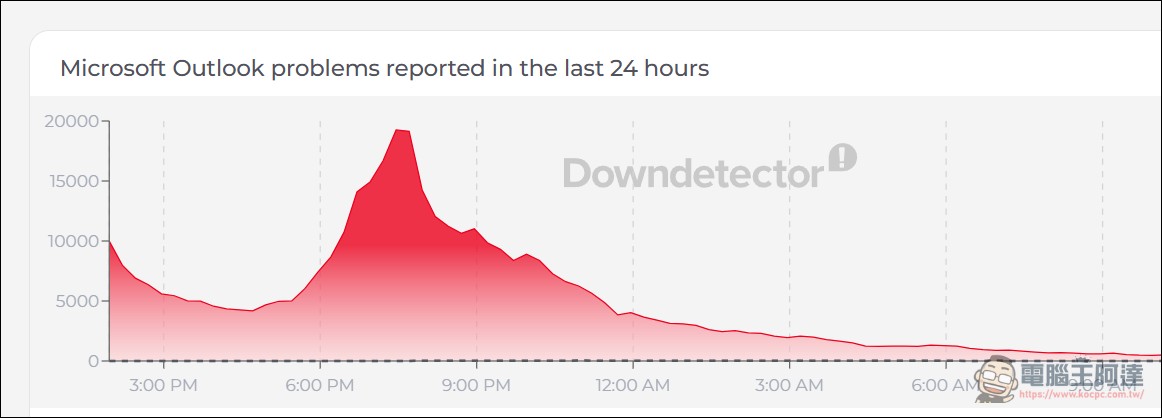
The outage began around 10 a.m. U.S. time on November 12. According to data from outage-tracking website Downdetector, abnormal reports were first detected around 16:15 GMT, then spread to 74 countries and territories within an hour. Around 18:00 GMT, global reports of Outlook problems peaked at nearly 140,000, more than 2,000 times the normal level.
The scope of affected Microsoft services was broader than commonly recognized. In addition to core Outlook email and Exchange Online, Microsoft 365, Teams, SharePoint, Copilot, OneDrive, Word, Azure, and Defender XDR were all affected as well. Microsoft later said that any application involving email or Exchange Online was affected, and users might be unable to access or send new emails, unable to use Copilot, and unable to join scheduled Teams meetings in their calendars.

The impact in Taiwan has also been officially documented. The anomalies mainly involve the hosted email service Exchange Online; some users found that Outlook could not connect to their mailbox or send and receive email, and Teams calendar and meeting scheduling features also experienced issues.
Microsoft’s handling and the twists and turns
Microsoft’s response process can be seen from a series of updates on X from the company itself. The initial assessment was that some servers had unexpectedly gone offline, causing increased load on the remaining infrastructure. Remediation measures included pausing all deployment operations, routing some traffic to alternate paths, and restarting the affected servers.
But the recovery process was not smooth. In an update on the 13th, Microsoft wrote that servers brought back online could become unresponsive again as soon as they received traffic, and the engineering team was analyzing diagnostic data to identify the trigger. Later, Microsoft said it had observed that changes applied to improve service availability were not working as expected, and it was continuing to monitor the results of the changes to identify strategic actions that could improve service health across regions.
Microsoft Executive Vice President Charles Lamanna posted in the early hours of the 13th that there are currently no indications that this outage is related to malicious or cyberattack activity, and the engineering team is working full out on repairs. He oversees Copilot, agents, and platform businesses. Microsoft’s status update described the technical symptoms: core processes on the affected servers were overwhelmed, causing the servers to stop responding and resulting in capacity loss. Microsoft also emphasized that there is no evidence of malicious activity.
I want to share what we know so far. This was not a cyberattack or an issue caused by AI tooling. Our amazing team was able to work through a very challenging situation to restore service. Our investigation points to technical challenges and failure modes (cascading failures + thundering herds at our network perimeter) that made recovery more difficult than normal. I’m working closely with the engineering team to complete the full post-mortem. We will publish the post-mortem shortly covering the step-by-step timeline and our many repair items to avoid similar outages in the future. We take our responsibility to our customers seriously and will do everything we can to learn from this and prevent it going forward.
— Charles Lamanna (@clamanna) November 13, 2026
Regarding recovery progress, Microsoft updated at around 4:15 a.m. ET on the 13th, extending the “email timeout window” to 48 hours to protect delayed messages while the service continued to recover. This timeout window is the maximum time a mail server or mail client waits for a message; extending it means client messages will be retained longer rather than failing outright. By before 12 p.m. ET, Microsoft again stated that it was still working through messages in the queue and rebalancing traffic; customers may see improvements in sign-in and access, but mail delivery and processing were still catching up, and there was no estimated time for full recovery.
AI services suffer collateral damage as well.
The most notable knock-on effect of this incident is that even AI services were tied to the same outage. OpenAI said it was investigating a problem affecting its connection to Microsoft services, causing some tools to fail to operate as expected. Anthropic said its Microsoft 365 connector was affected by an upstream service outage. Shortly after 6 a.m. ET, Anthropic announced that it had deployed a fix and was monitoring recovery. According to Downdetector data, thousands of Claude users reported problems on the morning of the 13th.
This cascading effect highlights the structural problem with cloud services. Microsoft’s user-scale figures are as follows: more than 430 million people worldwide use Microsoft 365 applications, and the number of businesses using the platform is between roughly 3 million and 4 million. When this layer of infrastructure has problems, third-party services that rely on it as a data source will fail as well.
The government, hospitals, and businesses were all affected.
The BBC reported that banks, government, healthcare services, railways, and courts all reported outages of Microsoft products. Some NHS medical procedures were rescheduled as a result, and Australian police and government departments in Japan and Germany also reported issues. The US House of Representatives said the outage affected its users, and engineers are working with Microsoft to address it.
The most direct loss for enterprises is delayed financial reports. Electric truck maker Workhorse Group was originally scheduled to announce its third-quarter results on November 12, but postponed them to November 16 because the global Microsoft service outage disrupted its business. Swiss luxury group Richemont and U.S. electric truck maker Workhorse Group were both forced to delay their financial report releases this week; Richemont later completed its submission.
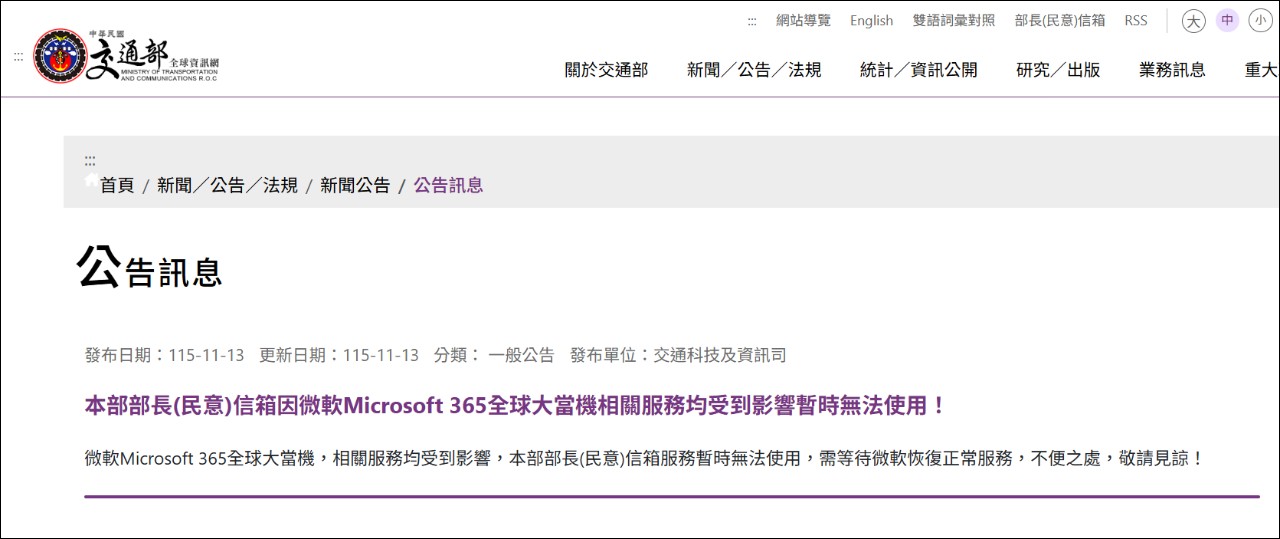
In Taiwan, the Ministry of Transportation and Communications issued a very straightforward announcement: due to the global Microsoft 365 outage, the Minister’s public feedback mailbox and related services have been affected and are temporarily unavailable.
Microsoft’s apology isn’t over yet.
At the end of its apology statement, Microsoft said it would provide a full post-incident review report after completing an internal review, but did not give a timeline. The statement also noted that because the scale of demand was enormous, Microsoft took a phased approach to restoring services, first confirming stability at each stage; this process took longer but helped ensure the recovery process was stable.
The market reaction to this incident was fairly muted. Bloomberg reported that Microsoft shares fell about 2.1% in premarket trading on the 13th, already Microsoft’s second large-scale cloud outage in nearly a year. In October 2025, Microsoft had reported an outage of the Azure cloud platform, affecting office tool suites at companies such as OpenAI and businesses around the world. The BBC’s observation is that this incident once again highlights how fragile companies’ heavy reliance on cloud services is.
Source: KOCPC Chinese