


Claude has frequently been targeted by hackers. Following the earlier fake website incident, it was recently discovered that some users’ login sessions had been stolen, causing their credits to be heavily consumed. Anthropic observed this situation and forcibly logged out the affected users, while also sending notification emails stating that their computers were likely infected and advising them to be especially careful. So if you feel your credits have been depleting faster than usual lately, you might want to check whether you’ve received an email from Anthropic.

Image source: BleepingComputer
Anthropic warns: malware is stealing Claude login sessions, draining your credits without passwords or 2FA.
According to foreign media outlet BleepingComputerAnthropic has already sent notification letters to some Claude users, explaining that attackers used info-stealer malware on users’ computers to steal Claude login sessions, then used these sessions to access accounts and consume usage quotas. The malware identified by Anthropic on affected devices includes five variants on Windows: Vidar, LummaC2, StealC, RedLine, and Acreed, while on Mac, Atomic Stealer (AMOS) was found on a small number of devices. The company has not yet disclosed the number of affected accounts or how long this wave of theft lasted.
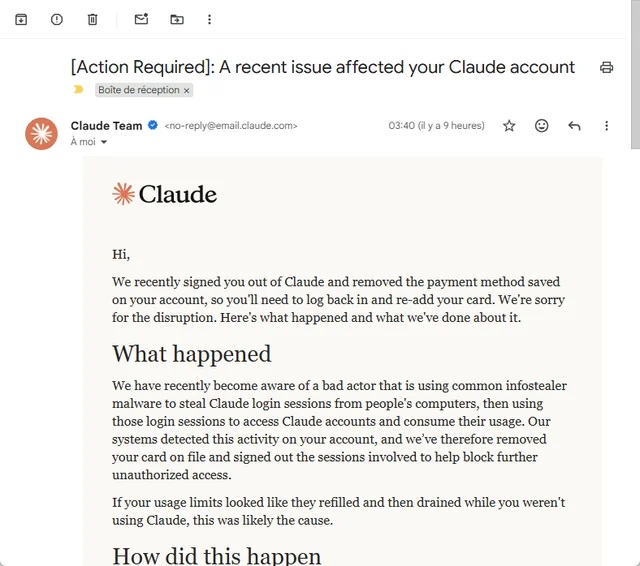
Image source: BleepingComputer
The so-called login phase means that after you log in to Claude in your browser, the website stores a set of credentials on your computer to remember that “this device has already been verified,” so the next day when you open the webpage, you don’t have to log in again.
Infostealer and similar malware simply copy that piece of data and take it away. After obtaining it, the attacker pastes it into their own browser, making it appear as an “already authenticated” device to Claude. So they don’t need your password, and they won’t trigger the verification code prompt on your phone.
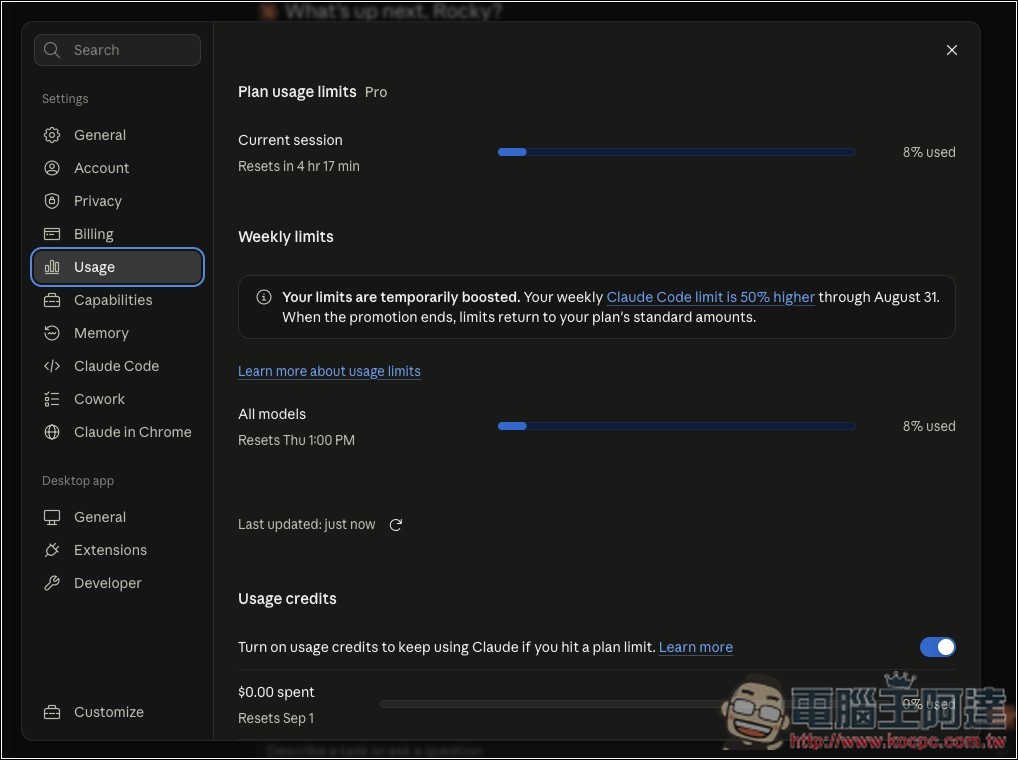
For victims, the only clue they can detect is the unreasonable quota usage—for example, shortly after a reset, while they’re asleep and their computer isn’t even running Claude, a significant portion of the quota has already been deducted.
Notably, all six malware programs named above are “general-purpose” info stealers — they weren’t written specifically for Claude, but rather grab whatever they can get their hands on. Vidar, RedLine, LummaC2, and StealC have been circulating on the underground market for years, operating on a subscription model where buyers pay a monthly fee to get ready-made tools and a backend dashboard. Acreed is a newer player that has only risen to prominence in the past year or two. Atomic Stealer, meanwhile, targets macOS specifically and has long been spreading through fake cracked software and fake update pages.
The infection paths are almost all the same: users download software from unofficial channels—cracked versions, plugins—and malware infects their computers. It then packages up the passwords, cookies, autofill data, and local certificate files stored in the browser, and sends them to the attacker’s server.
Anthropic specifically clarified in the notification letter that this malware has nothing to do with Claude, was not installed through Claude, and is also unrelated to anything you did with Claude. In other words, there is currently no indication that the Claude service itself was compromised—it was the user’s own computer that led to this account theft incident.
Although Anthropic has forcibly logged out affected accounts, invalidated stolen sessions, and removed saved payment methods from accounts, it cannot remove malware from users’ computers, so it has also warned these potentially affected users that their computers may already be infected.
Source: KOCPC Chinese