


G REIGNS, a subsidiary of HTC that focuses on 5G and future communication technologies, announced on the 11th that it has completed system integration and laboratory verification of end-to-end Open RAN solutions with Taiwanese radio frequency and satellite communication technology supplier Taiyang Technology (MTI) and Alaska communication service provider Sateo Inc. (operating under the Microcom brand). This cooperation is promoted under the National Telecommunications and Information Administration’s (NTIA) Public Wireless Supply Chain Innovation Fund (PWSCIF) NOFO2 project. The goal is to export the integration capabilities of Taiwan’s Netcom industry chain to remote areas in the United States to fill the long-standing communication coverage gap.
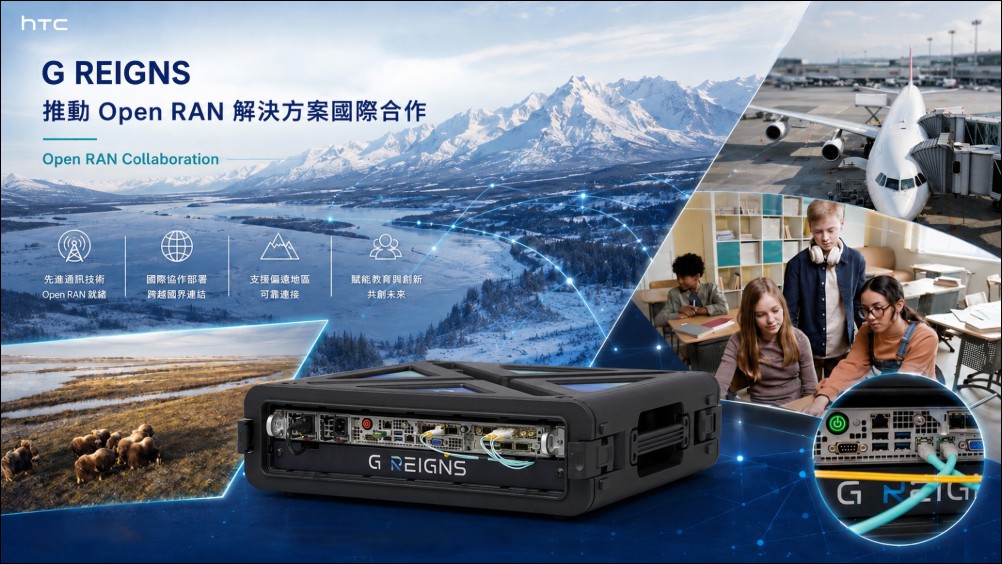
In the global Open RAN market, which is fiercely competed by major manufacturers such as Mavenir, Rakuten Symphony, Samsung, and Nokia, this three-party cooperation represents a different entry path: it does not pursue the replacement of the backbone networks of large-scale telecom operators, but targets remote areas with harsh geographical conditions that make it difficult for traditional equipment manufacturers to deploy economically, and uses the elastic advantages of open architecture to solve the “last mile” coverage problem.
Three-party division of labor: Taiwan software integration + radio frequency hardware + local operation in the United States
The division of labor structure of this cooperation is clear. G REIGNS is responsible for software development and system integration of Distributed Unit (DU) and Centralized Unit (CU), which is the core link in the Open RAN architecture responsible for baseband processing and high-level protocols. Taiyang Technology provides Radio Unit (RU), which is the front-end equipment responsible for sending and receiving radio frequency signals. Microcom acts as a local communications service provider in Alaska, providing actual operational requirements, deployment environment conditions and site application planning.
Gong Wenqi, General Manager of G REIGNS, said that the team has been investing in Open RAN and 5G private network technology for a long time. This cooperation demonstrates the integration capabilities of Taiwan’s Netcom industry in advanced communication solutions and also proves that Open RAN can provide more flexible network deployment options for remote areas. The team is very much looking forward to the next field trial in Alaska.
Taiyang Technology’s role is particularly critical. Taiyang has more than 40 years of experience in the development of microwave and satellite communication equipment. Its core technologies cover remote radio heads, microwave transceivers, satellite transceiver modules and other fields. In January 2025, with the assistance of the Chunghwa Telecom Research Institute, Taiyang stood out from 227 competitors around the world and became one of the seven global fund recipients of the NTIA NOFO2 project. It received US$35 million (approximately NT$1.15 billion) in financial support and was on the same list as Nokia. Taiyang General Manager and CEO Wu Yongqin pointed out that this three-party cooperation echoes the NOFO2 project’s goal of promoting innovation in the wireless communications ecosystem and diversifying suppliers.
Microcom (Sateo Inc.) is an indispensable local player in this puzzle. This communications service provider was founded in 1984 and has been involved in satellite communications deployment in Alaska and Hawaii for more than 40 years. Its expertise includes antenna design, system integration and network infrastructure. Microcom general manager Alexander Schumann said the solution’s performance exceeded expectations and the team looks forward to testing it in real-world environments and underserved communities.
Alaska: An ideal proving ground for Open RAN
Alaska is the largest state in the United States, with more than 1.71 million square kilometers of land, but a population of only about 730,000, and a large number of settlements are scattered in remote areas that are inaccessible by roads. Some communities rely on satellite or microwave links to maintain communications throughout the year. The cost of deploying traditional base stations is extremely high, and terrain and extreme weather also make maintenance difficult.
The U.S. federal government has been paying attention to this issue for a long time. In 2025, Alaska Senators Murkowski and Sullivan announced US$629 million (approximately NT$20.4 billion) in federal broadband subsidies to improve the quality of internet connections across the state. NTIA itself has invested more than $50 million in Alaska Native communities through the Tribal Broadband Connectivity Program.
The reason why the Open RAN architecture is suitable for such scenarios lies in its open interface and modular design. Traditional telecommunications equipment is provided by a single manufacturer to provide a closed solution from hardware to software, and operators are locked into a specific supply chain. Open RAN breaks this binding, allowing operators to mix and match DU, CU and RU components from different vendors according to field requirements, reducing dependence on a single supplier and improving deployment flexibility. This resiliency is critical in an environment like Alaska, with its complex terrain and diverse needs.
Open RAN market competition: Taiwanese vendors’ niche positioning
The global Open RAN market is in a stage of rapid growth but fierce competition. According to estimates from multiple market research institutions, the Open RAN market will grow from billions of dollars in 2025 to US$20.9 billion (approximately NT$680 billion) in 2030, with some more optimistic forecasts even looking at US$86.3 billion (approximately NT$2.8 trillion).
In such a competitive situation, the strategic positioning of Taiwanese manufacturers is not to challenge these telecom equipment giants head-on, but to lock in specific niche markets. G REIGNS has commercial results in the field of 5G private networks. At the beginning of 2026, it just demonstrated the German 5G private network deployment results with Lite-On at MWC 2026. It has also cooperated with Nissan to introduce a private 5G network to support high-end VR applications. Taiyang has deep foundation in the field of radio frequency hardware. It is also cooperating with Japan’s Rakuten Telecom in the NOFO2 project to promote 5G Open RAN technology. This tripartite combination of “software integration + radio frequency hardware + local operations” is in line with the U.S. federal government’s policy direction of promoting supply chain diversification.
Interop Tokyo 2026: The international stage for Taiwan’s open Internet industry
While promoting the US market, G REIGNS is also actively deploying in the Asia-Pacific market. With the support of the Industrial Development Administration of the Ministry of Economic Affairs, the Information Strategy Council organized the “ConnectX Taiwan” Taiwan Pavilion and led 9 Taiwanese network operators, including G REIGNS, LITEON, Askey, WNC, and SERCOMM, to Japan to participate in Interop Tokyo 2026.
Interop Tokyo is Japan’s largest ICT and network technology exhibition and will be held at Makuhari Messe from June 10 to 12, 2026. With the theme of “Integration of Open Networks and AI Communications”, the ConnectX Taiwan Pavilion exhibits integrated solutions covering base stations, radio frequency equipment, core networks, terminal access, high-mobility deployment and AI network management.
G REIGNS demonstrated its carrier-grade O-RAN solution with global commercial success on site, as well as the verification results of 5G private network combined with satellite communications in actual field applications. This is also the fourth time that Taiwan has organized a group to participate in Interop Tokyo. Since the Ministry of Economic Affairs launched the international layout of the open network industry in 2020, a total of 16 international collaboration results have been created, including the integration demonstration of 5G private network for offshore fisheries and low-orbit satellites in cooperation between G REIGNS and Fuji Software.
From the lab to Alaska: What’s next
Completion of laboratory verification is only the first step. From system integration to actual deployment in remote communities in Alaska, there are a series of hurdles such as field testing, environmental adaptation, regulatory certification, and operator acceptance. The interoperability of Open RAN in a multi-vendor environment has always been a recognized technical challenge in the industry. Whether DU, CU, and RU components from different vendors can collaborate stably in a real environment determines the commercialization prospects of this solution.
But the structure of tripartite cooperation itself provides a certain degree of risk buffering. G REIGNS has the verification experience of SONIC Labs (British Digital Catapult) in multi-vendor integration. Taiyang’s radio frequency hardware has been verified by the industry for more than 40 years. Microcom has first-hand knowledge of Alaska’s terrain, climate and community needs. This triangular structure of “technology integration + hardware quality + local knowledge” is more robust than any single manufacturer entering an unfamiliar market alone.
For the Taiwan Netcom industry, the significance of this cooperation goes beyond a single project. It validates a model: Taiwanese manufacturers don’t have to become the next Ericsson or Nokia to find an irreplaceable position in the wave of global telecom supply chain restructuring. The open architecture of Open RAN is essentially a “decentralized” supply chain revolution, which just gives Taiwanese manufacturers who are good at system integration, radio frequency modules and flexible manufacturing an entry point. Alaska’s remote communication needs may be just the first verification field for this model.
Source: KOCPC Chinese