


USB Type-C has always been a specification that many companies are paying attention to. Not long ago, UBS-IF launched a new specification. The charging specification has made a huge leap forward, from the previous 100W to 240W. Although it sounds like a fantasy, in fact once the new standards are formulated, related peripherals will gradually be developed. For example, Club 3D, a Dutch graphics card manufacturer, recently launched the first USB Type-C transmission cable that supports 40Gbps connection speed and 240W power supply. Now that the actual cable is available, I believe related applications will be available soon.
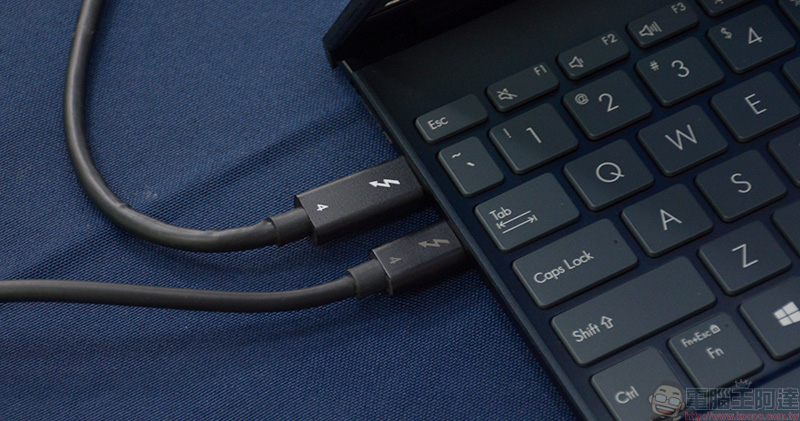
In response to the increasing fast charging specifications and demands, USB-IF launched a new charging specification named USB Power Delievry 3.1 last year. The main content of this specification is to improve the power supply capacity of the original USB PD 3.0 specification, and add a new technology standard called EPR (Extend Power Range), which allows the power supply capacity of the USB PD specification to jump from 100W to 240W.
240W power supply sounds quite scary. This is already the power supply requirement of most entry-level or quasi-flagship gaming laptops, and can even drive some desktop graphics cards. Club 3D obviously intends to push first and win first, not only to gain the reputation of being the best in the world, but also to show its research and development strength in the market and attract big customers. Even though USB PD 3.1 is not popular at this stage, this problem only needs to pass over time. Naturally, many companies will develop related supporting products to improve the entire USB PD 3.1 standard and even the USB4 ecosystem.
Club 3D has launched three Type-C cables that support the new power supply specifications while the iron is hot. One is 2 meters long and has a connection speed of 480 Mbps; the second is the same 2 meters long but supports 20 Gbps speeds; and the last one is only one meter long but supports USB4 Gen 3×2, which is the full version of the 40 Gbps speed specification.
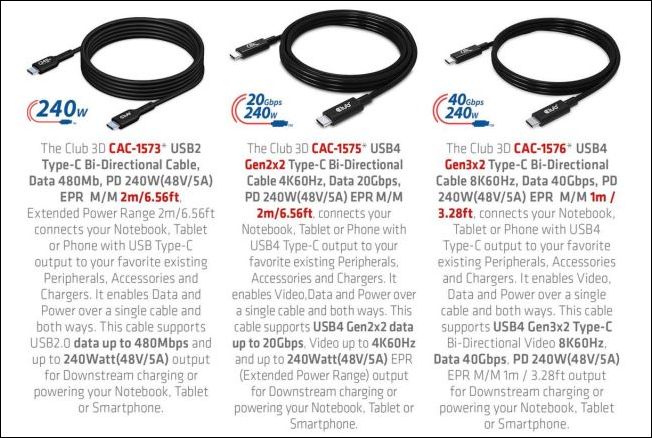
These three lines can provide 240W of power. To be precise, the power specification is 48V 5A. In order to provide higher transmission speed and power supply specifications, these lines may be slightly thicker than the lines that supported 3A in the past. But the biggest problem is that there are currently very few devices that require power supply with such a large wattage, so it will definitely suffer a bit in terms of popularity.
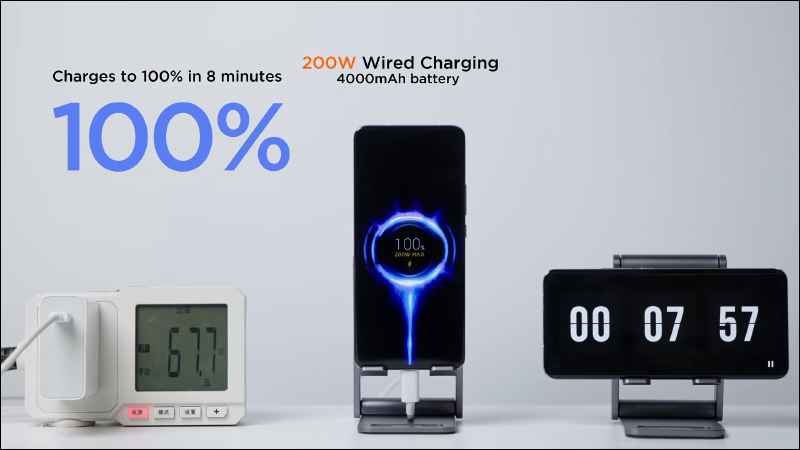
At present, mobile phone fast charging specifications include Oppo VOOC rushes to 240W spectrum,Xiaomi also demonstrated its own 200W HyperCharge technology last year, is actually not far from 240W, but both VOOC and HyperCharge are closed standards currently held by their respective patents, and are different in nature from the PD specifications open to various manufacturers.\
If we want to take advantage of this new specification, it seems that the most suitable field at this stage is external graphics cards. Although there is still a big gap between the speed of USB4 and PCI-E, if it has its own proprietary connection port XG Mobile like ASUS, but the graphics card requires an additional transformer for power supply, this new line may be able to realize the situation where the external graphics card is powered directly from the laptop or the laptop uses a transformer.
However, although this vision looks quite attractive, it also depends on the interest of major technology manufacturers in this specification. Club 3D has not officially announced the pricing information of these new lines until now, and there is no USB power supply on the market that supports such a high wattage. The new line is certainly attractive, but his potential will have to be watched for a while to see its development.
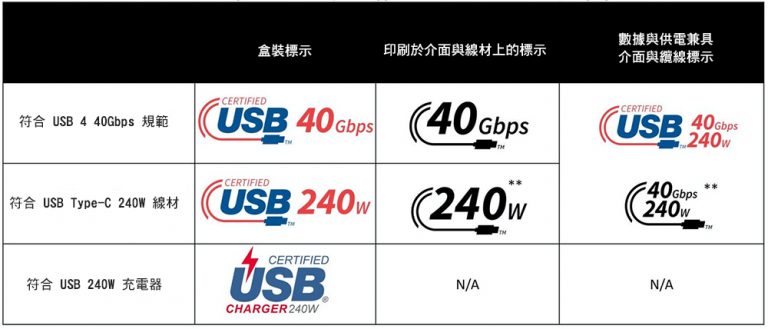
For consumers, if they need to purchase their own cables and peripheral equipment in the future, they need to pay special attention to whether there is a USB-IF certification mark. Whether it is a 40 Gbps transmission speed or a 240W power supply capability, these cannot be easily judged by appearance alone. The new specifications are known to have a certain degree of downward compatibility, so the old and new specifications may also cause confusion in purchasing, or even become the culprit of damaging the device interface. These are things that need to be paid attention to when encountering similar items in the future.
Source: KOCPC Chinese