


After weeks of rumors, Intel officially announced the new Intel Arc display chip at 11pm Taiwan time on March 30. The chip will be used in notebook computers or other similarly positioned mobile devices, and will be paired with Intel’s 12th generation processor “Alder Lake” to provide users with a powerful computing combination with moderate power consumption. Intel Arc series models will be named A series, and the brand part will be divided into Arc 3, Arc 5 and Arc 7. The latter two have not been officially announced yet. It is only known that laptops equipped with this GPU will be seen in the second quarter of this year. Users currently shopping for laptops will only find new products equipped with Arc 3 GPU.
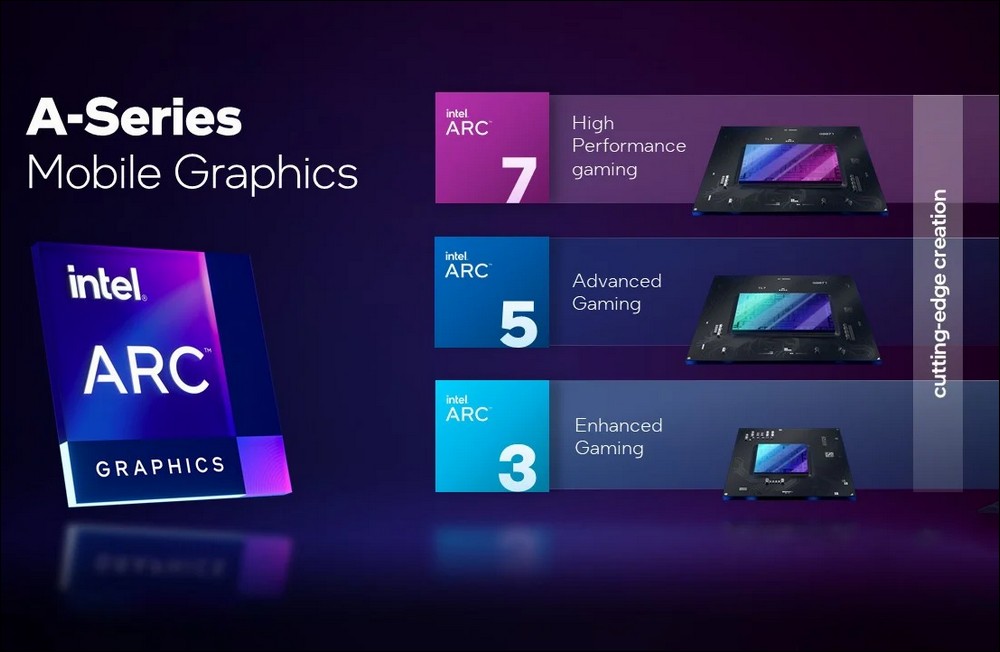
The naming and division of the Arc product line can be roughly similar to the positioning of Core i7, Core i5, and Core i3. Arc 3 is the most entry-level GPU among the three, and its main usage environment will be Evo/Ultrabook. Although the performance may not be as good as other mainstream GPUs, it may be the best independent graphics solution for Ultrabook environments with limited installation conditions.
Arc 3 GPU currently has two models, namely A350M and A370M. Both are very similar in design and both feature 4GB of 64bit GDDR6 display memory. The A370M will have more Xe cores and ray tracing units than the A350M, and the clock speed will be set higher. Also because of the stronger specifications, the power consumption figure is also relatively high. Specifically, the A350M requires approximately 25 to 35 W, while the A370M requires 35 to 50W.
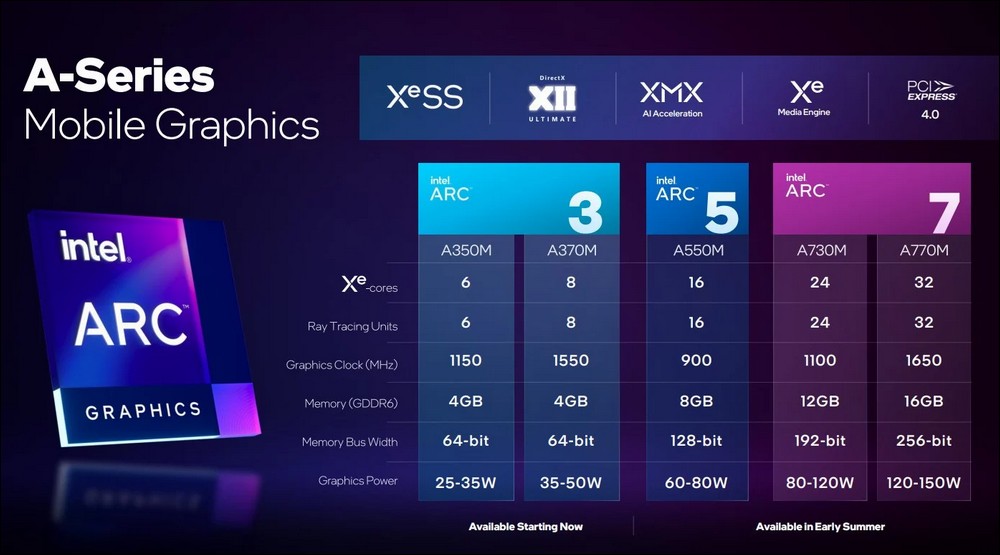
The highest-end Arc 7 A770M will have 32 Xe cores, 32 ray tracing units, a display memory of 16GB, and a memory bandwidth of 256 bits. In terms of power consumption, it also looks at 120 to 150W. In contrast, the NVIDIA RTX 2050 GPU is clocked at 1477MHz and consumes 30 to 45W of power. It is speculated that the energy efficiency ratio of the Arc 3 GPU can be comparable to that of the RTX 2050, while the Arc 5 or even the higher-spec Arc 7 is roughly similar to NVIDIA’s mid-to-high-end notebook GPUs.
Game performance is a concern for many players. After all, in addition to using GPUs for transcoding and editing, the most common application that people think of is games. According to data given at the official press conference, Arc A370M can run 60 to 78 frames in a variety of games at 1080P resolution. For example, Hitman 3 ran 62 frames at medium settings. Other games also have excellent results when played at medium and high settings.
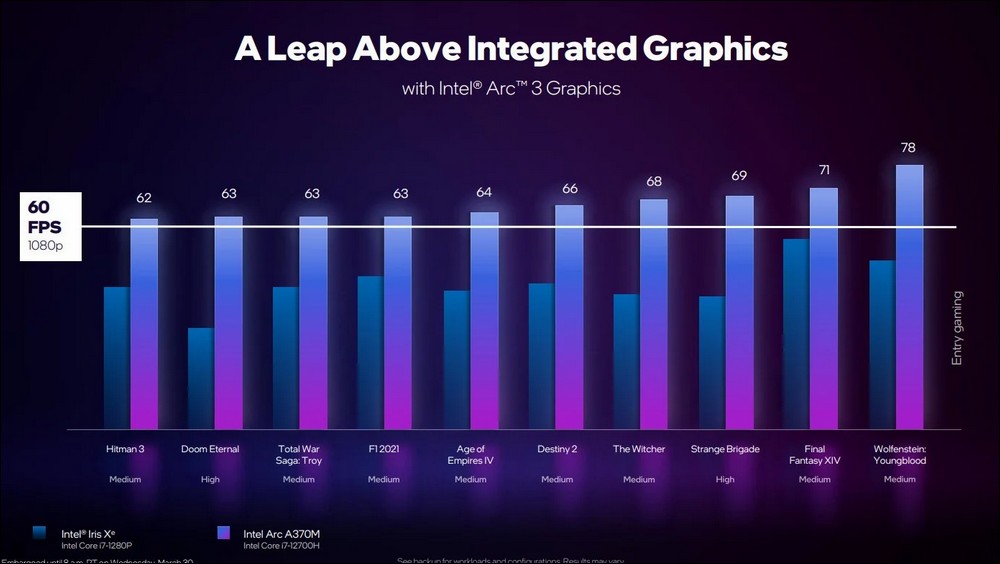
However, at best, this only shows that the strength of A370M as the Arc series flagship chip is indeed at the level of generally recognized independent GPUs, but there seems to be some room for effort to compete with NVIDIA and AMD for the strongest throne. And since Arc is coming out as a new GPU series, driver integration and game optimization will take time to catch up. Therefore, even if the running scores look good, whether the compatibility is good enough and how the performance will be after turning on sampling technologies such as ray tracing or XeSS, these all need to be discussed in depth.
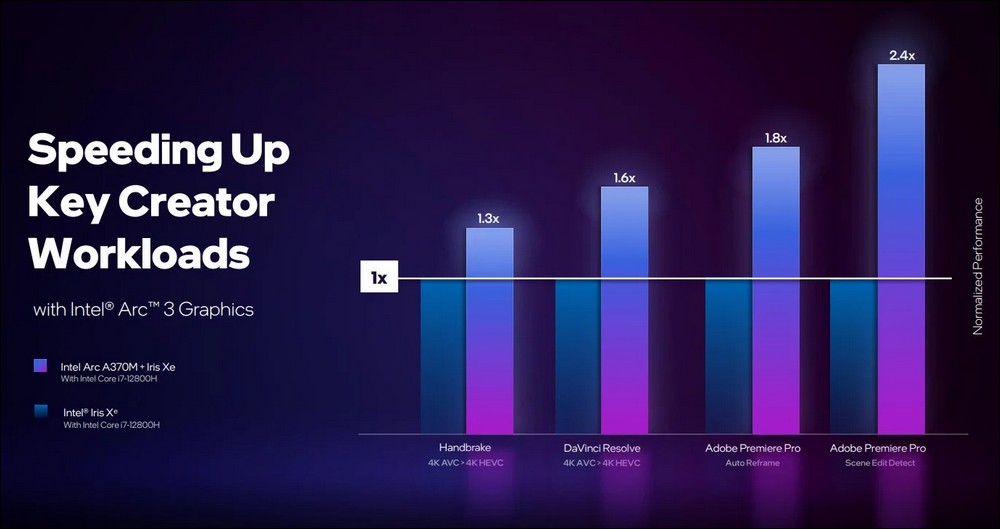
However, Arc at least inherits the good performance of Intel chips in productivity software. The official also gives the operating results of A370M in software such as Handbrake, DaVinci Resolve and Adobe Premiere Pro. Rather than comparing it with others, it can be clearly seen that the performance is much higher when compared with Iris Xe GPU alone.
The performance data is roughly here, and the rest mainly explains some technologies on the GPU. Intel XeSS super sampling technology is a point of concern for many users. This technology currently seems to be similar to AMD FSR and NVIDIA DLSS technology. However, NVIDIA DLSS requires AI machine learning in advance and requires dedicated hardware to be enabled. FSR technology requires powerful GPU computing power to make the sampling process almost delay-free. XeSS is technically closer to NVIDIA DLSS and also relies on AI to calculate high-resolution picture materials.
Intel also demonstrated XeSS technology. According to the official screen, it can be clearly seen in the Dolmen game that with the help of XeSS technology, the game can be upgraded from 1080P to 4K screen. The smoothness has not been seriously affected, and the screen details are also quite rich.
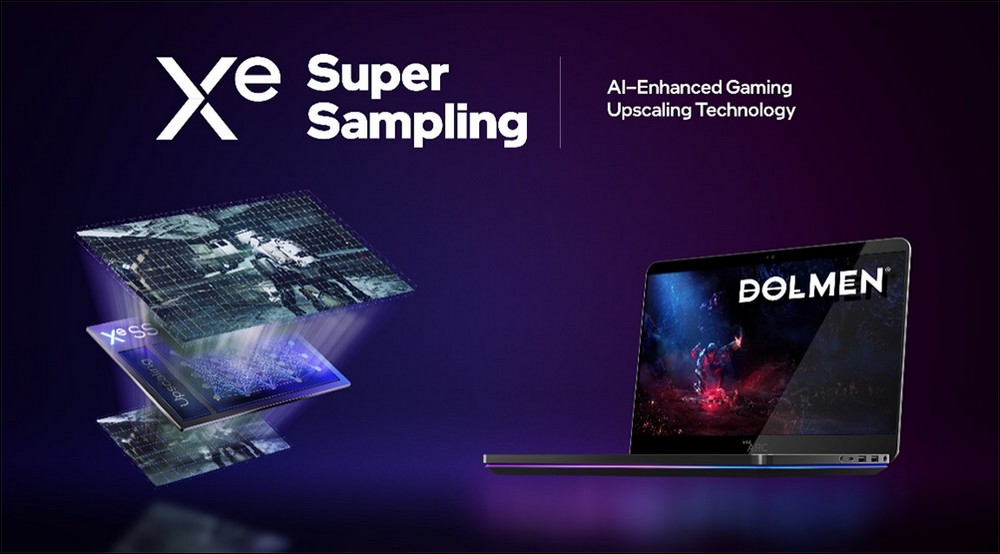
In addition to XeSS, Intel also disclosed Deep Link technology this time, which is similar to AMD SmartShift and extracts additional computing resources when specific tasks require it. Deep Link’s Dynamic Power Share function flexibly schedules CPU or GPU computing power when the system needs computing to achieve acceleration.
Other technologies like Hyper Encode can directly call the media encoding engines available on the CPU and GPU/iGPU, thereby allowing computing power from different sources to be scheduled for situations that require a large number of encoding and decoding tasks. Hyper Compute accelerates Ai computing. It can be said that Deep Link fully utilizes Intel’s powerful CPU and newly released GPU, allowing the two cores with different architectures and computing modes to maximize benefits for various computing scenarios.
Arc GPU also supports AV1 codec this time, and is even considered the first GPU in the industry to support AV1 hardware-accelerated codec at the same time. Although this format is open source, it is widely supported in the industry. Even the live broadcast of games required by gamers is mainly achieved by AV1. Hardware acceleration that supports this format is believed to provide better performance for players during live broadcasts or other similar applications.
As for the price, after all, only the Arc 3 GPU is currently on the market. Officially, only one notebook, the Galaxy Book 2 Pro, has been confirmed to be equipped with the GPU, so the price reference is not enough. However, Intel’s partners have begun to produce notebooks with Arc GPU. I believe that this month we will see many companies announce that their products will start to support this GPU. The price is roughly estimated to be around US$899 (approximately NT$25,684).
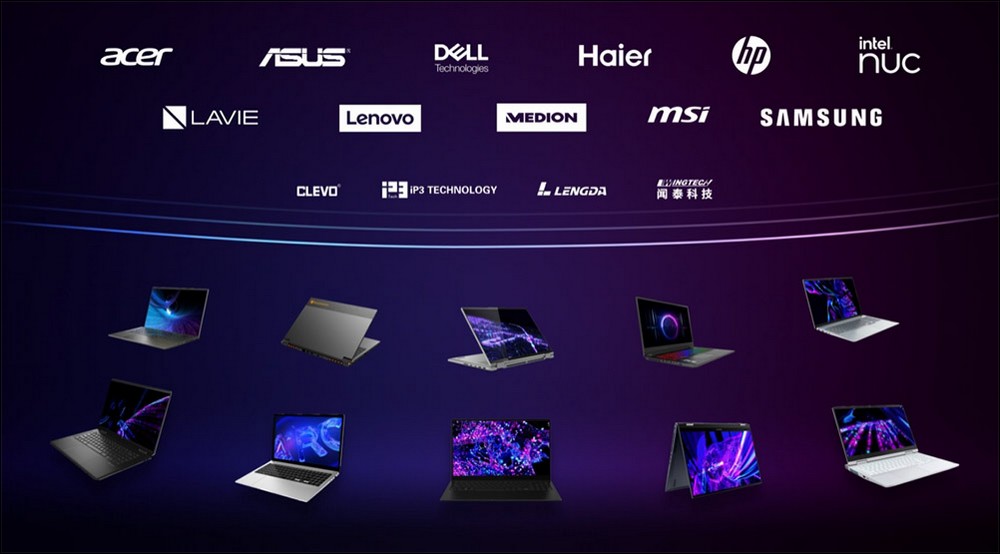
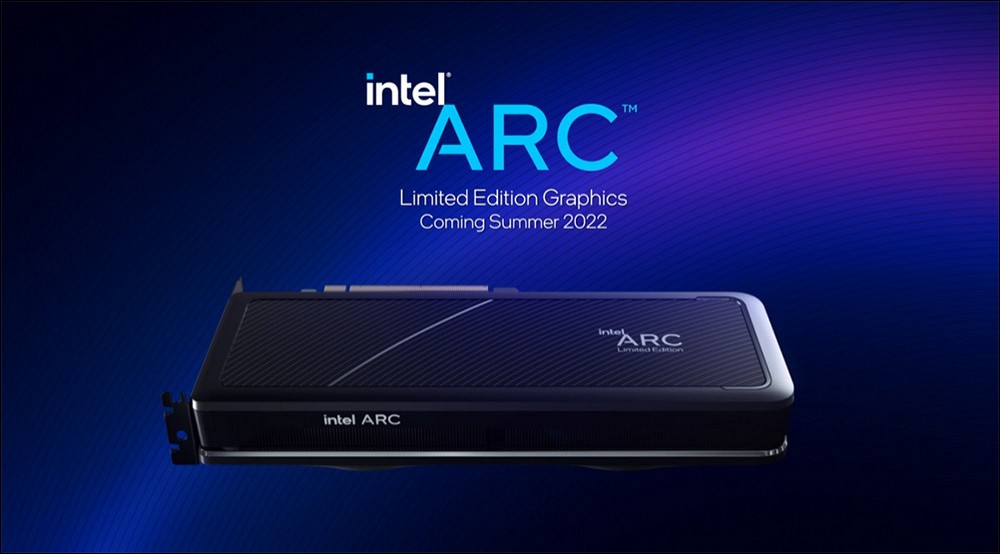
As for the higher-end Arc 5 and Arc 7, or even desktop discrete graphics cards, Intel did not elaborate much, only mentioning that they are scheduled to debut this summer. Those who expect Intel to take advantage of its high CPU share to disrupt the coexistence of GPUs may still need to wait. Whether Intel GPUs can meet users’ needs in terms of performance and battery life is believed to be the most important thing to care about at the moment.
Source: KOCPC Chinese