


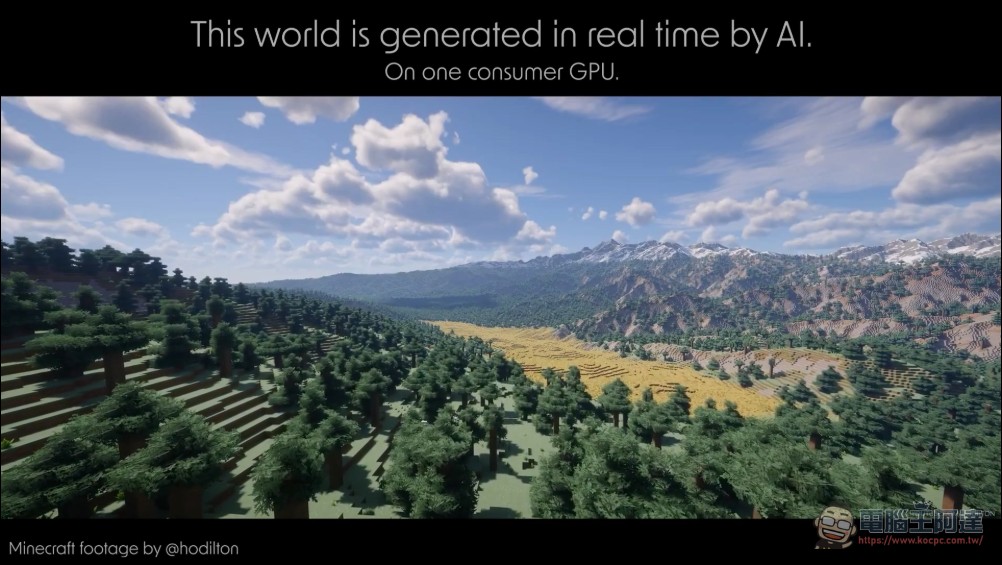
Previously, designing a powerful “world model” was a field almost exclusively within reach of large AI companies like Google or Tencent. However, a machine learning paper by Alexander Goslin, a recent graduate of the University of Maryland who currently works as a software engineer at Walmart, was recently accepted at SIGGRAPH 2026, drawing widespread attention. His entire research equipment consisted of only a single RTX 3090 Ti graphics card, and he had no funding, no supervising professor, and no team—it was completely done independently. According to relevant information, this is also “the first machine learning paper by an independent researcher in SIGGRAPH history.” The remarkable aspect of this paper is that it enables real-time generation for infinitely extended terrain using just an ordinary consumer-grade graphics card.
What is SIGGRAPH?
SIGGRAPH (short for Special Interest Group for Computer GRAPHICS and Interactive Techniques) is a computer graphics professional organization under the Association for Computing Machinery (ACM), founded in 1967 by Brown University professor Andries van Dam and IBM’s Sam Masta. The organization has held an annual conference since 1974, and added a Computer Graphics exhibition in 1981, encompassing paper presentations, technology demonstrations, art galleries, and other activities. Major computer graphics hardware and software companies and animation creators from around the world gather every year to release their latest research and artworks. Conference papers are published in the journal ACM Transactions on Graphics (CCF Class A / SCI Q1 Top), with an acceptance rate of only about 21%. It can be regarded as the highest hall in the field of computer graphics research, so it is no small feat that Alexander Goslin received recognition for a paper as an independent non-professional researcher.
This paper has two main contributions:
InfiniteDiffusionA novel method that leverages diffusion models for infinite generation.
Terrain DiffusionThe world’s first learning-based procedural terrain generator.
InfiniteDiffusion: Breaking the Trilemma of Infinite Generation
To understand this paper’s contribution, one must first recognize a fundamental problem that the graphics field has long faced: when generating infinitely large worlds in a computer, quality, infinite scalability, and stateless random access cannot all be satisfied at the same time.
The traditional approach is procedural noise, such as Perlin Noise invented by Ken Perlin in 1983. These methods are fast and infinitely extensible, but the generated results have fundamental limitations in realism and large-scale structural consistency. Diffusion models can produce extremely high-quality images, but are usually confined to a fixed-size canvas. Autoregressive methods can achieve infinite generation, but must be extended sequentially, with each access incurring O(n) time complexity, and their outputs depend on the sampling order, making reproducibility impossible to guarantee.
InfiniteDiffusion’s core contribution is breaking this trilemma. It is a training-free algorithm that redesigns the diffusion model’s sampling process as “lazy computation”: content is generated for a region only when that region is requested, and the generation of each region is completely independent.
Introducing InfiniteDiffusion, my independent paper accepted to #SIGGRAPH2026!
I have one RTX 3090 Ti. No funding, advisors, or team. By day I’m a new grad SWE at Walmart.
The paper has two main contributions:
– InfiniteDiffusion: a new approach to infinite generation with… pic.twitter.com/7LnmjHoHhE— Alexander Goslin (@xandurglar) June 25, 2026
Put more plainly, InfiniteDiffusion turns diffusion models into an upgraded version of Perlin Noise, inheriting all the properties that have made procedural noise the backbone of world generation for four decades: seamless infinite expansion, seed consistency (the same seed always produces the same world), and constant-time random access. The difference is that the content it generates is no longer constrained by human-written formulas, and can instead learn any structure from training data.
A Comprehensive Comparison with Autoregressive Methods
Goslin outlined the systematic differences between InfiniteDiffusion and autoregressive methods in the paper:
- random accessAutoregressive is O(n), InfiniteDiffusion is O(1); to jump to any point on the map, only one query is needed.
- certaintyAutoregressive outputs depend on sampling order, while InfiniteDiffusion is completely order-independent: the same seed + coordinates will always produce the same result.
- parallelizabilityAutoregression is inherently sequential; InfiniteDiffusion supports embarrassingly parallel generation, allowing multiple regions to be generated simultaneously.
- Status RequirementsAutoregressive models require storing the full generation history; InfiniteDiffusion only uses a limited LRU cache as a performance optimization and needs no persistent storage.
- Training-freeAutoregressive methods require additional training, while InfiniteDiffusion can be directly applied to existing diffusion models.
These features make InfiniteDiffusion especially well-suited for multiplayer games and distributed environments. Worlds can be shared via seed, players can teleport to any location on the map in O(1) time without regenerating intermediate regions, and it consumes no persistent storage space at all.[6]。
Terrain Diffusion: The First Learned Procedural Terrain Generator
The paper’s second core contribution is Terrain Diffusion, the world’s first learning-based procedural terrain generator. Its design philosophy is to use a cascade of diffusion models to generate terrain from planetary-scale structures all the way down to local details.
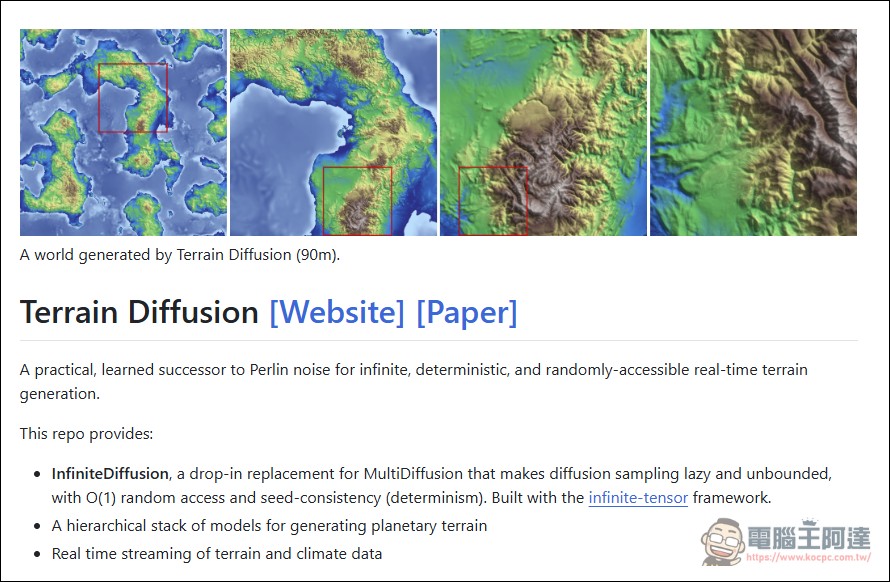
Technically, Terrain Diffusion integrates several key components:
- Hierarchical Cascaded Diffusion ModelsUse diffusion models at different scales to couple planetary-scale context with local details, generating terrain features spanning hundreds of kilometers.
- Compact Laplacian EncodingStabilize output across an Earth-scale dynamic range from the Mariana Trench (-10,000 meters) to Mount Everest (nearly 9,000 meters).
- Open Source Infinite Tensor FrameworkInfrastructure supporting constant-memory operations on unbounded tensors
In terms of performance, Terrain Diffusion generates data 9 times faster than a satellite orbit on a consumer-grade GPU, requiring only 1.5GB of VRAM to run. Each 1024×1024 topographic relief map spans 100 kilometers in width.
From Minecraft to Unity: Practical Real-World Implementation Demo
To prove Terrain Diffusion is more than a paper exercise, Goslin packaged it as an open-source Minecraft mod with no external dependencies. Players can experience infinitely generated, learning-based terrain in Minecraft: worlds can be shared via seed, players can teleport millions of miles away instantly, and multiplayer mode works normally.
In Unity’s tech demo, players can fly through the world at three times satellite orbital velocity on consumer hardware while maintaining smooth frame rates. The video went viral on X, and YouTuber AsianHalfSquat also made a showcase video for the Minecraft mod.
The InfiniteDiffusion paper was first uploaded to arXiv in December 2025 and accepted by SIGGRAPH in 2026, spanning roughly half a year. It does not address a peripheral issue, but rather the core bottleneck that has plagued procedural world generation for decades: how to enable generated content to surpass the limitations of hand-crafted formulas while maintaining infinite scalability and random access.
For the gaming industry, the potential impact of this technology is the most direct. Traditional procedural terrain (such as the Perlin Noise used in Minecraft) is limited by the expressive power of noise functions, while Terrain Diffusion demonstrates that learning-based methods can achieve equivalent interactive speeds on consumer-grade hardware while generating far more realistic landscapes than noise functions. The existence of an open-source Minecraft mod also allows anyone to experience this difference firsthand.
More broadly, Goslin’s story shows that when open-source models and algorithm design mature enough, a researcher without institutional backing can produce academic work worthy of top-tier conferences using just a two-generation-old consumer GPU.
Source: KOCPC Chinese