


Apple’s machine learning team recently GitHub Pages An image compression technology called PICO was disclosed on the Internet, which attracted attention in the field of computer vision and image processing. PICO, the full name of Perceptual Image Codec, is a learning image compression algorithm optimized directly for the human visual system. It only takes 230 milliseconds to encode a 12-megapixel photo on the iPhone 17 Pro Max, and it only takes 150 milliseconds to decode.根据 Apple 在 Papers published on arXiv, PICO can save 2.3 to 3 times the bit rate under the same image quality. The comparison objects cover current mainstream and next-generation image compression standards such as AV1, AV2, VVC, ECM and JPEG-AI.
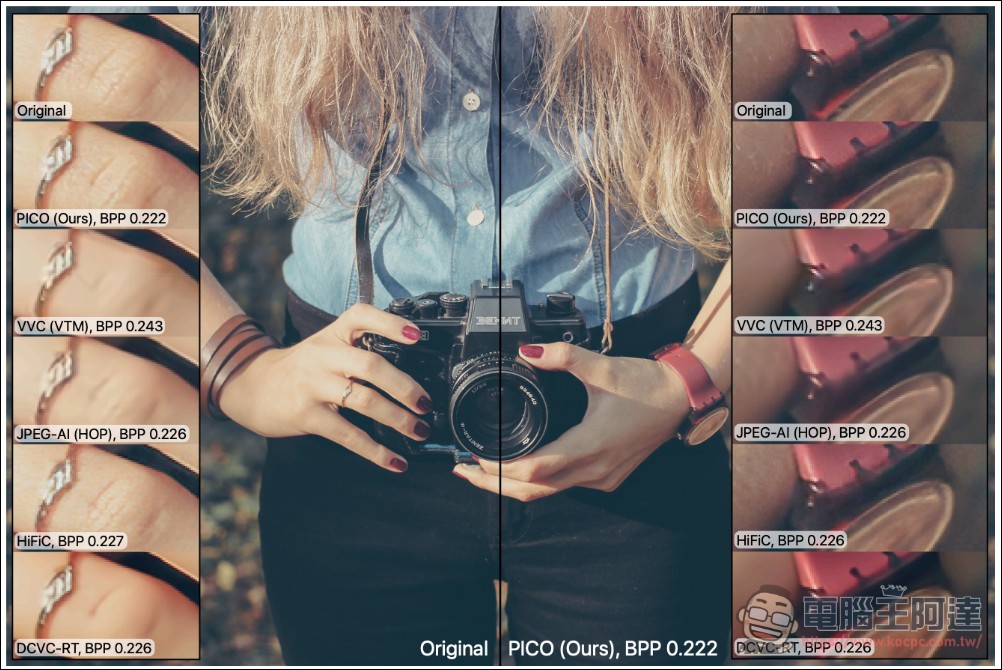
Apple releases PICO perceptual image codec
What is a learned image codec?
Traditional image compression technologies (such as JPEG, WebP, AVIF) rely on manually designed mathematical conversion and quantization rules, and engineers have spent decades fine-tuning these algorithms. The learned codec is completely different: it uses a neural network to automatically learn the best compression strategy from a large amount of image data, and can theoretically be more efficient than manually designed rules. It’s been more than 30 years since JPEG was introduced in 1992, and learning codecs have only begun to show practical potential in the past five years.
However, learning codecs have always faced a practical dilemma: although they have high compression efficiency, their operation speed is too slow, making it difficult to be practical on mobile devices such as mobile phones. This is also the core problem that PICO is trying to solve.
PICO’s technical features
The Apple team did two key things during the development of PICO: First, they conducted a comprehensive study on the design selection of the learning codec, covering ablation experiments of a variety of new technologies; second, they performed a large-scale Neural Architecture Search (NAS) to find a model combination that satisfies “mobile phone running speed” and “best perceived image quality” in millions of backbone network configurations. This approach is quite rare in the field of image compression, because NAS usually requires huge computing resources, but Apple has overcome this threshold by leveraging the integration advantages of its own chips and data centers.
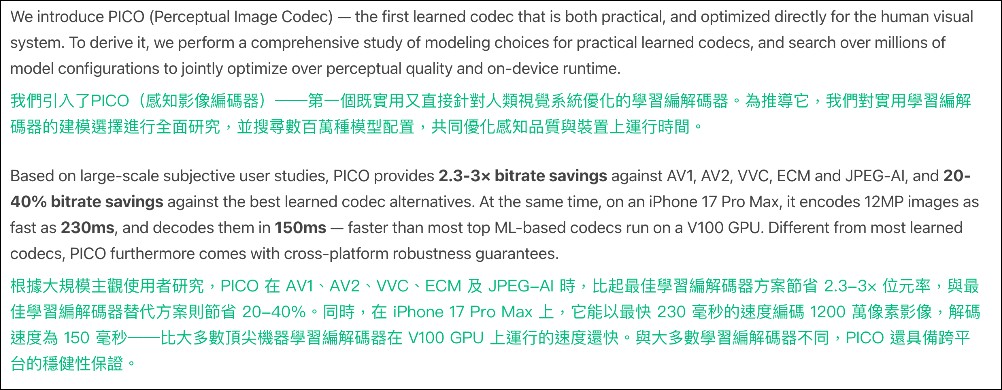
The end result is a codec that strikes a remarkable balance between speed and image quality. According to large-scale subjective user research conducted by Apple, PICO’s performance is impressive:
- Compare traditional codecs: Under the same perceived image quality, the bit rate only needs 1/2.3 to 1/3 of AV1, AV2, VVC, ECM and JPEG-AI, which is equivalent to saving 57% to 67% of data volume.
- Compare similar learning codecs: Bit rate savings of 20% to 40%
- Running speed: Encoding a 12-megapixel photo on iPhone 17 Pro Max in just 230 milliseconds and decoding in just 150 milliseconds
- Cross-platform stability: Unlike most learning codecs, PICO provides cross-platform robustness guarantees
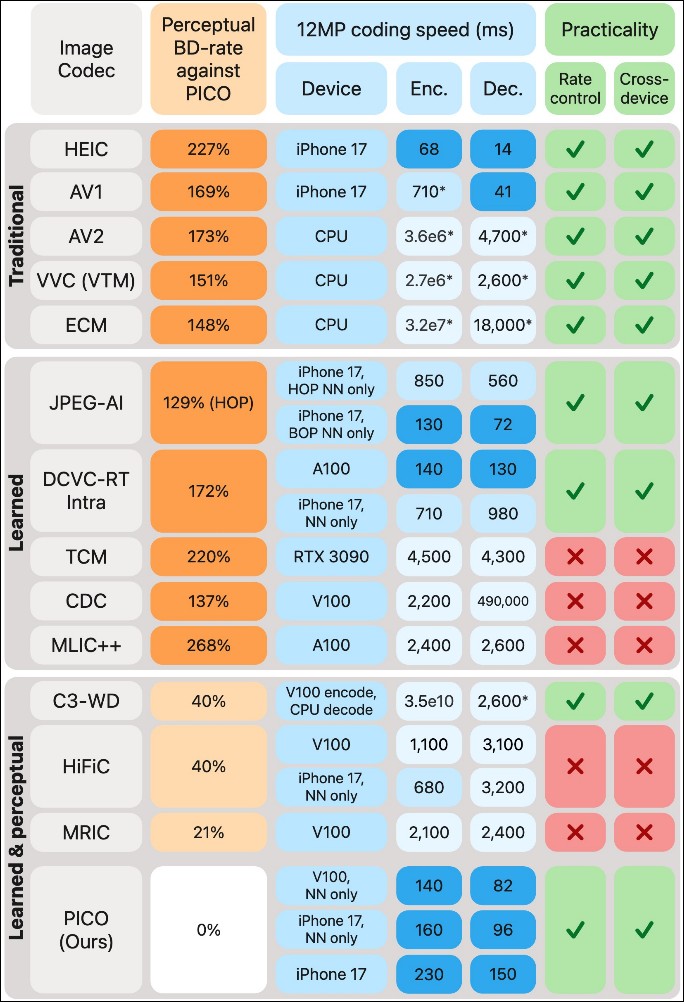
Speed comparison: iPhone beats V100 GPU
One of PICO’s most impressive numbers is that it runs faster on iPhone 17 Pro Max than most leading machine learning codecs on NVIDIA V100 GPUs. This highlights the hardware advantages of Apple chips in dedicated neural network acceleration, and also proves that PICO was designed from the beginning with the goal of “practicalization”, rather than just a digital competition for academic benchmarks.
The decoding speed of 150 milliseconds means that users will experience almost no delay after taking a photo, which is crucial to the iPhone photo storage and sharing experience. In contrast, most learning codecs still remain in cloud servers or research laboratories due to excessive computational overhead. PICO can achieve faster speeds on mobile phones than data center GPUs, demonstrating the huge potential of the co-design of dedicated neural network accelerators (Apple Neural Engine) and algorithms.
Who developed PICO?
PICO was developed by Apple’s machine learning research team, with lead authors including Kedar Tatwawadi, Parisa Rahimzadeh, Zhanghao Sun, Zhiqi Chen, Ziyun Yang, Sanjay Nair, Divija Hasteer, and Oren Rippel. The paper was submitted to arXiv on May 6, 2026, and is classified in the fields of computer vision (cs.CV) and artificial intelligence (cs.AI). The team also made the data set available for academic research, demonstrating Apple’s increasingly open attitude in the field of machine learning research.

Potential impact on iPhone camera experience
While Apple has yet to announce when PICO will be integrated into iOS or macOS, the technology’s usefulness and relevance to Apple products are self-evident. Currently, iPhone already uses the still image version of High Efficiency Video Coding (HEVC) when taking photos in HEIF/HEIC format. If you switch to PICO in the future, it can provide better image quality at the same file size, or further reduce the storage space occupied by photos at the same image quality.
For iCloud Photo Library users, this means they can store more photos without sacrificing image quality, or consume less network bandwidth when uploading and syncing. Take a 256GB iPhone as an example,If photos save an average of 60% of storage space, it is equivalent to storing thousands more high-quality photos.。
In addition, PICO’s cross-platform robustness guarantee also hints that Apple may deploy it on multiple platforms such as Mac, iPad, Apple Vision Pro, etc., not just limited to iPhone.
Summarize
PICO represents an important step in learning image compression from academic research to practical products. Although most similar technologies perform well in terms of compression efficiency, they are often hindered by insufficient computing speed in practical applications. Through large-scale neural architecture search and comprehensive design selection research, Apple has successfully achieved an industry-leading balance between perceived image quality and device running speed.
Considering Apple’s consistent product integration strategy, PICO is likely to appear as a next-generation alternative to HEIF in future versions of iOS or macOS. By then, photos taken by users on iPhone will enjoy more efficient compression technology support in invisible places. For photography enthusiasts, this means less storage anxiety and a faster sharing experience.
Source: KOCPC Chinese