


On June 19, Cloudflare announced a new feature at Agents Week 2026 that is of great significance to the AI developer ecosystem: Temporary Accounts. Any AI Agent can now simply execute wrangler deploy --temporary, you can get a real and usable Cloudflare Worker deployment environment in a few seconds. There is no need to register an account, no OAuth browser authorization process, and no need to copy and paste API Token.

Cloudflare launches: AI Agent can be deployed with one click, claimed with one click, and Temporary Accounts can be deployed without deleting files.
AI Agent Deployment Wall
To understand why this feature is important, you must first understand the “wall of friction” that AI Agent encounters when deploying. Cloudflare’s official blog clearly states at the outset: “Everyone writes programs with AI Agent. But when the Agent needs to deploy things, register, and create an account, it will directly hit a high wall designed for humans.”
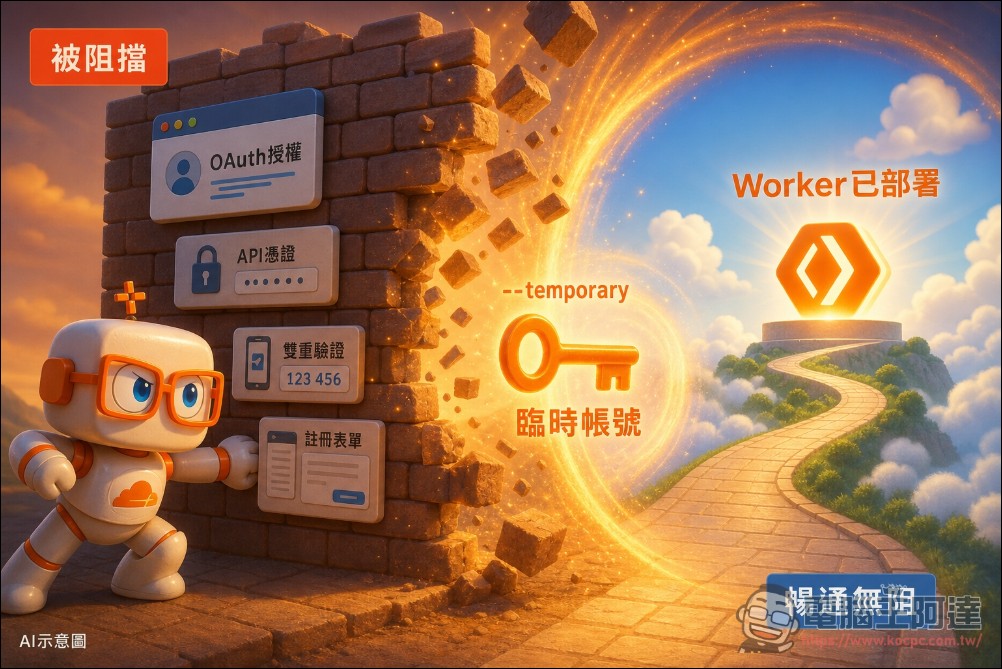
The components of this wall include the browser-based OAuth authorization process, the click-to-set operation steps in the Dashboard, the cumbersome process of manually copying and pasting API Tokens, and the verification requirements of multi-factor authentication (MFA). For a human developer, these steps are cumbersome but acceptable. But for an AI Agent executing in the background, without any humans in the loop, these steps are “hard stops” that the Agent cannot cross at all.
Trial and error is Agent’s superpower
The Cloudflare team made another key argument in the announcement: trial-and-error is the real superpower of AI Agents, not pure code generation.
The workflow of a self-developed Agent is essentially a tight feedback loop: write code → deploy → test your own endpoint with curl → confirm the results → correct errors → redeploy. What this “write → deploy → verify” cycle needs is a low-cost, disposable deployment target, so that the Agent can iterate over and over again and quickly verify its own ideas, instead of being stuck in the account application process.

In the past, the only way for the Agent to complete this process was for the developer to manually set all cloud credentials and API Tokens in advance, and then let the Agent use these set environments. But doing so is a waste of time and completely goes against the core vision of “letting Agents complete tasks autonomously.” The emergence of Temporary Accounts allows Agents to complete the complete cycle from writing code to testing, deployment, and verification independently for the first time with zero human intervention.
How the system works
The core design of this feature lies in the “Agent awareness” capability of Wrangler CLI. When a non-logged-in Agent executes wrangler deploy When , Wrangler will not directly report an error and terminate, but actively prompt the Agent to use --temporary Parameters: “To continue without logging in, rerun this command with –temporary. Wrangler will use a temporary account and print a claim URL.”
The Agent re-executes the deployment after receiving the prompt, and Cloudflare’s backend will complete the following actions within milliseconds:
- Create a temporary Preview account for the Agent
- Allocate a set of valid API Tokens for Wrangler to use
- Deploy the Worker to
workers.devsubdomain and pass back the public URL - Generate a Claim link that allows the developer to claim the account within 60 minutes
Command output example:
Temporary account ready:
  Account:        example-name (created)
  Claim within:   60 minutes
  Claim URL:      https://dash.cloudflare.com/claim-preview?claimToken=...
Uploaded example-worker
Deployed example-worker triggers
  https://example-worker.example-name.workers.dev
During the 60-minute validity period, the Agent can modify the code and redeploy it at will, and each time it will obtain the latest live URL for testing and verification. Wrangler will cache the status of this temporary account and reuse it within the validity period without re-creating it each time.
Claim with one click and deploy without deleting files
The most critical design of this feature is the Claim mechanism: developers only need to click on the Claim URL and log in (or register) to Cloudflare, and all resources created by the Agent will be completely transferred to the developer’s permanent account.
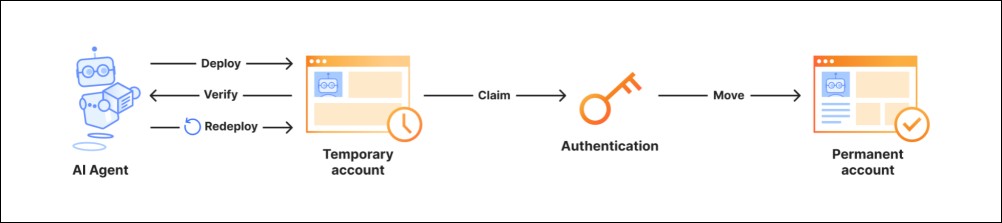
According to the official document: “After claiming, the Worker and all Cloudflare resources created in that temporary account become permanently owned.” This means that all resources such as the Worker itself, static resources, KV storage space, D1 database, Durable Objects, Queues, etc., are all directly converted to permanent ownership, without redeployment or reconfiguration, and only need to be run once wrangler login After binding the account, there is no need to add deploy later. --temporary .

If not claimed for more than 60 minutes, all resources will be automatically destroyed without leaving any residue. This design of “disappearing if you don’t claim it, and keeping it forever once you claim it” takes into account the convenience of Agent’s independent development and account security.
What it means to developers and the Agent ecosystem
The impact of this feature on Agent ecology can be viewed from several levels:
For the first time, the autonomous agent has a complete closed loop: In the past, although AI Coding Agents (such as Claude Code, Codex, and Cursor) could help developers write complete program codes, the deploy action always required manual human intervention. Someone had to open an account, set up a certificate, and run the CLI. Temporary Accounts breaks this limitation and allows Agent to truly achieve independent development “from scratch to online”.
Background Agent is no longer stuck: As background Agent scenarios such as scheduled tasks, automated maintenance, and CI/CD Pipeline become more and more common, any step that requires browser interaction or manual verification will interrupt the entire automated process. Temporary Accounts allow these background agents to successfully complete deployment tasks even without any humans present.
Low friction first experience: For developers or new projects who have never used Cloudflare, Agent can directly generate and deploy a Worker to display the results. Developers only need to click a link to claim and continue development. This significantly lowers the entry barrier to the Cloudflare ecosystem and makes the “deploy first and decide later” working model possible.
Safe and traceable: Temporary accounts have a life cycle limit of 60 minutes and will be automatically destroyed upon expiration. There will be no risk of resource legacy or account abuse. At the same time, the Claim mechanism ensures that the final ownership belongs to the real developer. The Claim URL itself is sensitive information, and owning the URL is equivalent to having control of the account.

Next step: Agent native infrastructure
Cloudflare also revealed its next development direction in the announcement: working with Stripe to establish a communication protocol that allows Agents to independently open Cloudflare accounts, subscribe to plans, set domains, and obtain API Tokens, without the need for humans to copy and paste Tokens or enter credit card numbers. At the same time, we also cooperate with WorkOS to promote auth.md Standards allow Agents to activate various cloud services through standardized OAuth processes, truly achieving an “Agent-native” infrastructure experience.
Temporary Accounts is just one of the announcements of Cloudflare Agents Week 2026. The same period also includes new features such as Agent Memory (persistent memory service) and Flagship (function switching service for Agent), which shows that Cloudflare is fully committed to deploying Agent infrastructure, from edge computing, storage, security to authentication, to create a complete set of cloud platforms that allow AI Agents to operate autonomously. As the official said: “Our goal? Let your agent code and ship.”
Conclusion
Temporary Accounts is just a small CLI parameter change, but much more --temporary This flag solves a fundamental obstacle in the AI Agent ecosystem. As Agents gradually evolve from “conversational assistants” to “autonomous developers,” cloud platforms like Cloudflare that proactively design infrastructure for Agents will become a key driver in shaping the next generation development process. For developers, from now on, with just one sentence, you can ask AI to help you write a program and put it online, and you can officially own it by clicking a link. This is like the development experience you should have in 2026.
Source: KOCPC Chinese