


Alder Lake is a new processor series that Intel has high hopes for. I believe many players have already gained an idea of how novel and powerful this new series is in recent reports. At present, Intel has announced that Alder Lake will have 60 different models of processors. The first batch of announced processors are mainly K series and KF series processors for desktop use. These processors can basically be regarded as a display of firepower under this development code name. Each model has a P core (or performance core) based on the Golden Cove architecture and an E core (energy efficiency core) based on the Gracemont architecture. With the combination of the two cores, it becomes a processor of various models. However, the launch of Alder Lake at this stage only shows half of the entire processor family. Regarding other desktop processors and mobile processors that will be used in notebooks, they have not yet been exposed. At this time, MSI revealed some key information in its own online event. For example, in addition to the currently known combination of 8 P cores and 8 E cores, the Alder Lake-S chip will also have a 6-core processor that only uses P cores, as well as a mobile version processor that mainly uses E cores and P cores as a supplement. The combination mode of these cores will become the key to the full range of processors showing their strength in different usage environments.
▲Intel’s 12th generation Alder Lake processors will have two core combinations in the desktop series (Image source)
Alder Lake’s current processor lineup is mainly mid-to-high-end desktop processors, and the remaining models have not yet been launched. However, for gamers, the performance of flagship processors is certainly fascinating, but entry-level processors are actually the area that attracts the most attention from consumers. Within this level, the performance of the processor is important, but how to balance performance and price and find the sweet spot will make consumers willing to pay.
In the past, Intel revealed in the description of the game development guide that the Alder Lake processor will have two configurations. One is composed of 8 P cores and 8 E cores, and the other is purely using P cores, but it will only provide a maximum of 6 physical core configurations. This statement was recently raised again by MSI’s official online event, this time in more detail. It seems that there will be a combination of 8 P-Core + 8 E-Core, with a chip area of 215.25 mm2, there is also a 6 P-Core combination, the chip area is 162.75 mm², the reason for the reduction in area is not difficult to guess, because the 6 P-Core combination is not equipped with E-Core, and the overall number of cores is reduced, so the area is reduced even more:
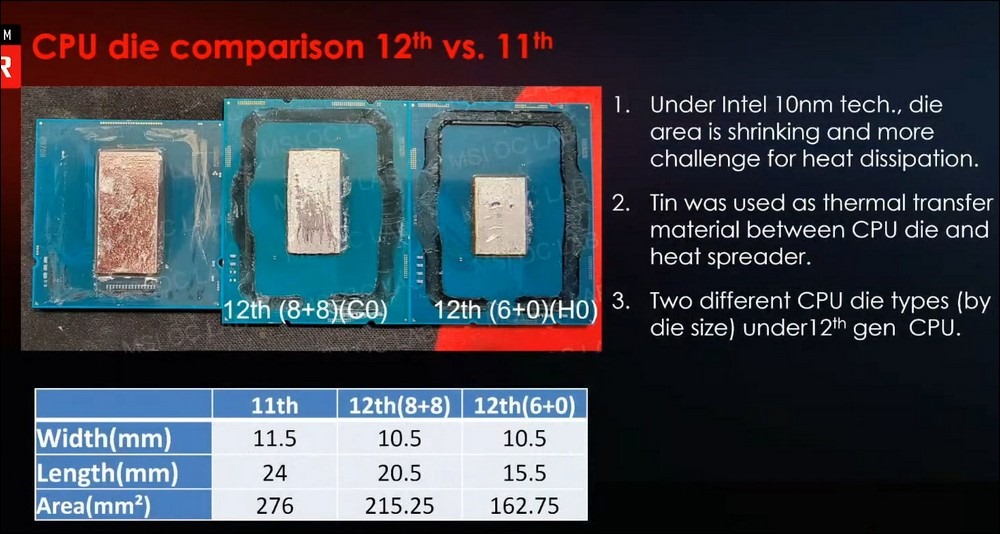
▲MSI revealed more information about the Alder Lake combination. Different combinations will indeed cause different changes in chip area, as shown in the figure (Image source)
As for which processors will actually be equipped with 6 P-Core chips, it is rumored that processors below Core i5-12600 will use this design. Judging from the information provided by MSI, we can know that the so-called pure P-Core combination is not the existing 8P+8E combination that covers part of the core, but a separately designed chip.
There are currently other models of processors that will be launched after Alder Lake. The desktop version will have two configurations: 8P+8E and 6P, while the mobile version will be configured with the E core as the core and will have two configurations: 6P+8E and 2P+8E. Interestingly, the 6P+8E combination of the mobile version processor is larger in chip area than the desktop 8P+8E combination. This reason is because the mobile version processor also integrates the display chip, so the area will naturally be larger.
Source: KOCPC Chinese