


NVIDIA is booming in the graphics card business. It can be said that most gamers who want to buy a graphics card will think of NVIDIA’s famous brand name before considering the model. However, there is another person in the world whose desire for graphics cards is much higher than the expectations of gamers, and that is the miners who make a fortune from virtual currencies. With the collective expedition of miners, a large number of graphics cards around the world began to be removed from the shelves. As a research and development company of GPU chips, what NVIDIA can do is to limit the computing power of its own graphics cards on virtual currency through software and hardware to balance the supply and demand issues of both parties. The recent RTX 30 series graphics cards even claim to have almost no dead ends, and miners will never be able to break through the limitations of computing power. However, NVIDIA’s guarantee this time was still ruthlessly ridiculed by the miners. The latest countermeasures have emerged. Although the GPU cannot be used 100% for mining operations of a certain virtual currency, it can at least squeeze out 100% of the graphics card’s performance for virtual currency operations:
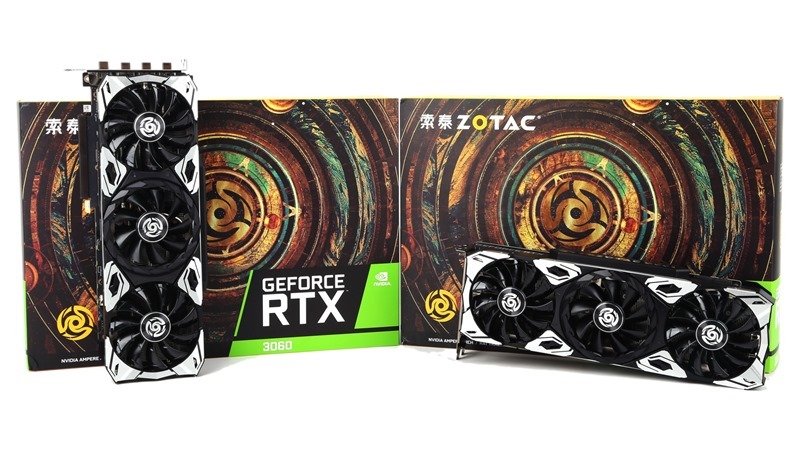
▲The original selling point of the LHR version of the graphics card was to limit the computing power, but now it has obviously become a favorite target for miners to crack.
If you want to play games, buy an N-card. This is a concept that many gamers are familiar with. This is not to say that graphics cards other than NVIDIA are not good, but in terms of technology, computing power, and even performance optimization through cooperation with game manufacturers, these are the assets that make NVIDIA graphics cards superior to their opponents. But over the past two years, fewer and fewer people are buying graphics cards to play games, and more and more people are buying graphics cards in large quantities just to make a fortune. Second-hand cards appearing on the second-hand market no longer advertise warranty, performance and benchmark scores, but emphasize the experience of computer mining and virtual currency computing power.
A single currency cannot break through the system limit. The combination of two currencies can fully consume the GPU usage.
For gamers who do not rely on an unstable source of income such as virtual currency to make a fortune, when buying a graphics card, they only need to consider whether it is suitable for the games they often play. However, virtual currency miners have digested almost all graphics cards on the market. Even mid-to-high-end cards from one or two years ago are still very popular. In order to calm the anger of gamers, NVIDIA began to add computing power suppression technology named LHR to new graphics cards. The latest version is locked at the hardware level. In the new version of the RTX 30 series GPU, as long as it is detected that the user is using the GPU to perform the same calculation state as virtual currency, the computing performance will be reduced. By suppressing the purchasing desire of miners, it achieves the purpose of supplying it to gamers, thereby balancing the needs of both parties:
▲Foreign Youtuber made a video introducing T-Rex’s cracking mode
The task of locking computing power from the software layer has been successfully cracked by miners, so what is said to be more difficult to crack at this stage is the blockade from the GPU level. Even if the software is good at inducement and deception, it is almost impossible to completely unlock the computing performance for mining. But after all, miners can’t just watch NVIDIA cut off their own financial resources. A computing power cracking program called T-Rex successfully found a loophole in this mechanism. Although it cannot operate at full speed on a certain kind of virtual currency mining, it can at least squeeze out the full performance of the graphics card, so that the GPU can maintain the highest load state to operate the virtual currency mining pool.
T-Rex’s method is to roughly divide the computing resources into a ratio of 30%-70%, and assign them to two different mining programs, each of which performs hash operations for different currency mining pools. Currently known information shows that the software can already allocate 30% of the computing power to the ETH currency, and 70% of the computing power to other currencies. This ratio cannot be reversed at present, that is, 70% of the computing power cannot be used on ETH and 30% of the computing power can be used on other currencies. Therefore, even if 100% of the entire GPU hardware resources can be utilized through this mechanism, the computing power of a single currency still cannot return to the level when it was not restricted in the past. Therefore, this mechanism is still not good news for miners who are always willing to invest resources in currencies with higher returns such as ETH coins and have little exposure to other currencies:
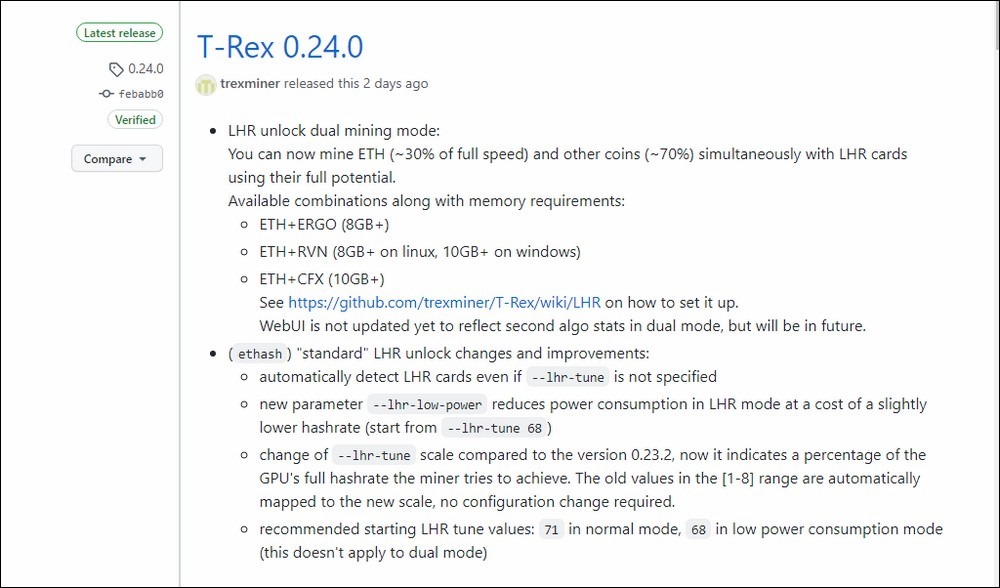
▲Currently, T-Rex lists several feasible virtual currency combinations, such as ETH with ERGO, or ETH with RVN, etc. It should be noted that some configurations require enough display memory to run (Reprinted from the Internet)
Of course, since it is now possible to allocate up to 37% of computing power to two virtual currency mining pools, it is only a matter of time to find a method that can focus 100% on a single currency. Even T-Rex has some inherent limitations. For example, when some virtual currencies are mined under this mechanism, a large amount of display memory is required, so some graphics cards with less than 8GB of display memory will have problems operating. But at this stage, the only one that can squeeze out 100% of GPU computing power is T-Rex. I’m afraid what NVIDIA needs now is to find a more stringent computing power limit solution to make the LHR version of the graphics card more convincing. In this war between computing power limitation and cracking, miners obviously have the upper hand for the time being.
Source: KOCPC Chinese