


Today I’d like to introduce a tool called “Linly-Dubbing” that provides multilingual AI dubbing and translation for videos. Linly-Dubbing can quickly and accurately translate the audio content in videos into other languages while maintaining professionalism and naturalness. It can even generate speech that is highly similar to the original video’s voice, so that the video doesn’t feel disjointed.

Open-source Tool for Multilingual AI Dubbing and Translation: Linly-Dubbing
Linly-Dubbing is an open-source multilingual AI dubbing and video translation tool. Simply copy a video URL and Linly-Dubbing will help you download videos from platforms like YouTube and bilibili. While Linly-Dubbing downloads the video, you can also set the video quality and other saving options.
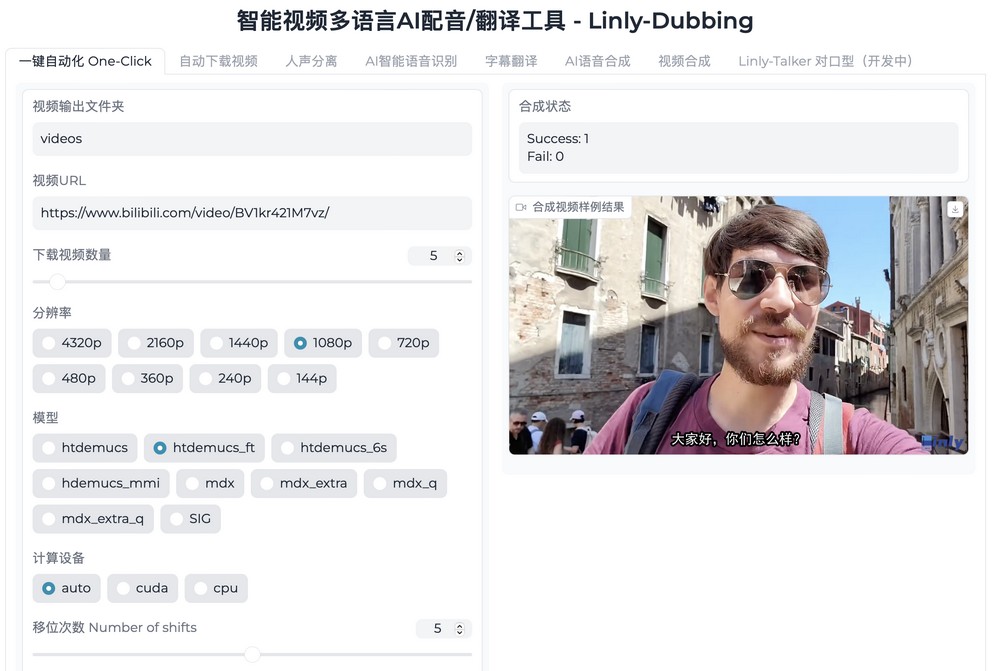
Besides helping you download videos from platforms like YouTube, Linly-Dubbing can also handle multilingual dubbing and subtitle translation needs. Linly-Dubbing uses AI technology for speech recognition, accurately converting speakers’ speech into text. Once converted to text, it then uses a large language model to quickly perform the translation.
In addition, AI voice cloning technology can be used to generate voices highly similar to those in the original video, maintaining continuity in emotion and intonation similar to the original. Everyone can take a look at Linly-Dubbing’s demo video:
Linly-Dubbing emphasizes the ability to generate similar voices based on the original audio tone of the video and also perform lip-syncing. However, I believe after watching the video, everyone will see that the current Linly-Dubbing effect isn’t very good and still has a lot of room for improvement. That said, Linly-Dubbing is free and open-source, so those who want to use it can still give it a try. If you’re interested in Linly-Dubbing, this multilingual AI dubbing and video translation tool, you canGo to Linly-Dubbing’s GitHub page.Learn more:
If you want to use AI video translation and lip-sync tools with better results, you can also check out HeyGen, which we introduced earlier. If you’re interested, you can watch the HeyGen test video below or click the link below to learn more:
Source: KOCPC Chinese