


Google DeepMind officially announced on June 24 that the Computer Use function is now built into the Gemini 3.5 Flash model, eliminating the need to call a separate computer to use the preview model as in the past. This is the latest and most complete Computer Use integration solution in the Gemini series. This change means that developers can enable computer operation capabilities directly in Gemini 3.5 Flash API calls, allowing AI Agents to see the screen, perform inferences, and perform operations in browsers, mobile phones, and desktop environments. Product manager Mateo Quiros said on Google’s official blog The Keyword that this feature has shown significant performance improvements in long-term tasks and enterprise automation scenarios, including practical application cases such as continuous software testing and cross-application knowledge work, as well as various enterprise scenarios.
Google announces Gemini 3.5 Flash is officially built-in Computer Use
In the past year, Computer Use functions mainly existed in the form of independent models, and developers needed to connect to specific endpoints in order to use them. The Gemini 2.5 computer-use-preview launched by Google in October last year operates in this mode. Now Google has directly integrated this capability into the main model Gemini 3.5 Flash, which represents the upgrade of Computer Use from an “experimental feature” to a “standard configuration.” This is a clear signal for developers who are developing browser automation, software testing, and cross-application workflows: computer operation is already the core capability of the Gemini ecosystem. This also allowed Gemini 3.5 Flash to go from a chaser to a leader in the competition with Anthropic Claude’s Computer Use feature.
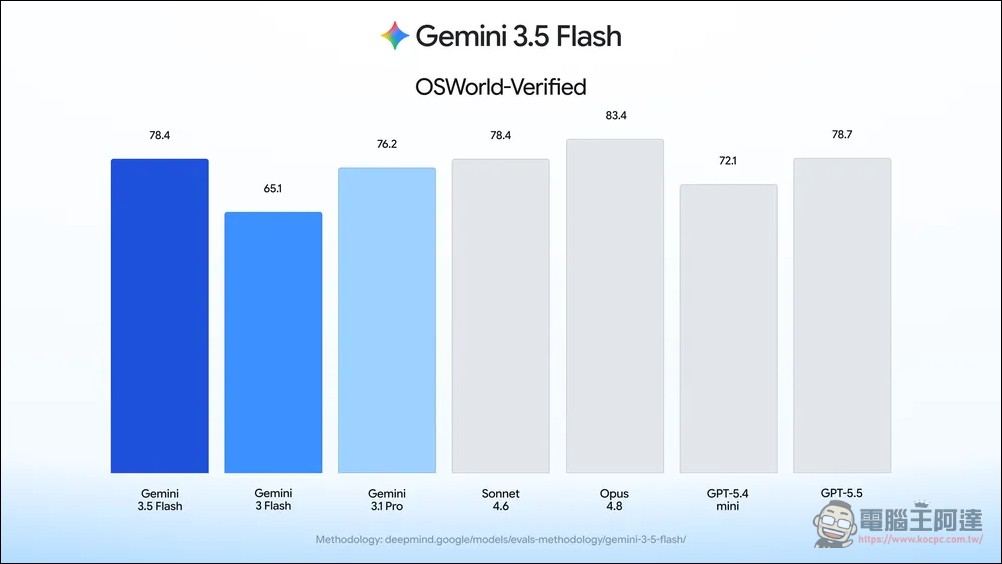
Built-in tool architecture: same model, multiple capabilities
Gemini 3.5 Flash already supports function calling and built-in tools such as Google search and maps. The addition of Computer Use completes the last piece of the puzzle, allowing AI Agents to not only query information, but also actually operate browsers and desktop interfaces. This “All-in-One” model design means that developers no longer need to switch between multiple models. A single API call can simultaneously enable reasoning, search, map positioning, and computer operations, greatly reducing the complexity of the Agent architecture. Compared with Anthropic’s Claude who still provides Computer Use as an independent feature, Google’s integration strategy is obviously more active.
In terms of technical architecture, Computer Use is designed as a built-in tool in Gemini 3.5 Flash, rather than an external plug-in. This means that the model can directly decide when it needs to operate the computer and when it needs to query information during its own reasoning process, without the need for external scheduler coordination. This design is particularly beneficial for long-term tasks, such as continuous software testing or cross-application workflow automation, where the model can maintain a coherent understanding of the previous and next steps during tens of minutes of operation. In addition, Gemini 3.5 Flash is currently one of Google’s most popular models, with extremely low latency and high throughput. With the addition of Computer Use, the overall practicality has been greatly improved.
Enterprise-level security mechanisms: adversarial training and prompt injection protection
The most worrying thing about letting AI directly operate the computer is the security issue. If the model is injected with malicious prompts, it may perform operations that should not be performed, such as deleting files, sending emails, or operating the financial system. Google uses targeted adversarial training for the Computer Use capability of Gemini 3.5 Flash, allowing the model to be exposed to various hint injection attack techniques during the training phase and learn how to identify and resist such attacks in real environments. In addition, two optional enterprise-level protection systems are provided: first, requiring users to explicitly confirm sensitive or irreversible operations, such as deleting accounts or transferring money; second, automatically stopping task execution when the model detects indirect prompt injection (such as hidden instructions from web content).
Google recommends that developers adopt a “defense in depth” strategy and use these built-in security mechanisms in conjunction with a secure sandbox environment, human-in-the-loop authentication, and strict access controls. This multi-layered protection is especially important for enterprise-level deployments, especially in highly regulated industries such as finance and healthcare. Google emphasizes that these security mechanisms are only the basis, and developers should conduct additional security assessments based on the risk level of their applications.
Industry reaction and immediate experience
In its announcement, Google cited positive feedback from multiple partners, including browser infrastructure company Browserbase, open source browser automation framework Browser Use, and executives from RPA giant UiPath. Among them, Miguel Gonzalez Fernandez of Browserbase is the driving force behind the previous gemini.browserbase.com Demo site, which is now listed as a recommended channel for immediate trial play by Google’s official article. Alvin Stanescu of UiPath pointed out that the built-in Computer Use will significantly reduce the technical threshold for building RPA processes.
Interested developers can get started through the following channels: There is a complete Computer Use guide in the Gemini API documentation, and Google also provides reference implementation on GitHub, and enterprise-grade deployment options for Gemini Enterprise Agent Platform. For developers who just want to experience it quickly, the Demo site hosted by Browserbase can be operated directly without writing any code. Google also providesDetailed API documentation and quick start guide, from environment setup to the first Computer Use call, takes only about 10 minutes to complete. This means that everyone from individual developers to large enterprises can find an import method that suits them.
Conclusion
Computer Use has been upgraded from an independent preview model to a built-in tool in Gemini 3.5 Flash. On the surface, it is a product release, but there is a deeper meaning behind it: Google is turning “AI operating computers” from an additional function into a basic capability. When a model has reasoning, search, map and computer operation capabilities at the same time, the application scenarios that developers can build will be completely different, from automated testing to cross-application knowledge work, from personal assistants to enterprise-level agents. This is an opportunity to significantly simplify the architecture for developers who previously needed to connect multiple models and write a lot of glue code. As Anthropic, Google, and OpenAI have successively launched the Computer Use function, 2026 is a key transition year for AI Agent to move from “dialogue” to “operation”. The AI Agent of the future will no longer be just a chatbot in the conversation window, but a real digital employee who can operate the software on your behalf on the screen.