


Not long ago, Intel, led by current CEO Pat Gelsinger, revealed the company’s process roadmap for the future to 2025. The announcement of a roadmap usually heralds the company’s future plans to advance to the next process node, but Intel’s announcement this time is somewhat different. For the first time, they have completely overturned the process naming model that everyone was familiar with and accustomed to in the past. Take Intel’s 10nm Enhanced SuperFin process as an example, which will be renamed Intel 7 in the future. In other words, it is obviously a 10nm process, but Intel gave a number 7 in its naming, and all subsequent process numbers will be renamed based on this logic:
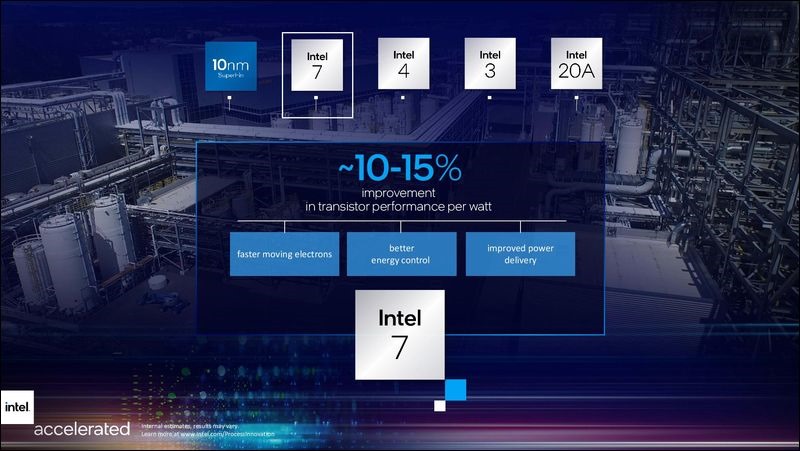
▲Intel redefines the process name, removes the word Nano and changes it to a number
Intel’s idea of renaming its own process is quite interesting. Because in the past, Intel was often described as a toothpaste factory by venomous commentators or gamers. The source of this joke lies in Intel’s continuous micro-optimization of the same architecture in the past few years. Even the process has been difficult to make breakthroughs. It did not work hard to show off its beef until the product was crushed by its opponents. Of course, there are no permanent winners in technology. Even if you are sitting on a mountain of gold and silver, there will always be a day when you are hollowed out. Intel’s process problems require a lot of money and R&D to catch up in a short period of time. But if it’s too late to catch up, you may still be able to achieve the effect by taking a sideways approach.
Changing the name will make the numbers look better, but Intel 7 is not a 7nm process
According to the company’s latest process roadmap, in addition to gradually advancing from nanometer processes to processes below angstrom (0.1 nanometer) in the future, all process names have been modified and simplified as much as possible to the “Intel + digital” naming pattern. Intel has confidently declared that by 2024, the company’s process technology will be on par with or even surpass the current industry leader TSMC, and it will become the first company to obtain next-generation high-NA EUV equipment from ASML.
As for the next-generation Xeon processor chip “Intel Sapphire Rapids”, although it is still using the 10nm Enhanced SuperFin (newly named Intel 7) process, the company also emphasized through its online media that the chip will have detailed information about Foveros Omni and Foveros Omni technology in the future. These technologies make Sapphire Rapids the industry’s first product with a dual-power reticle:
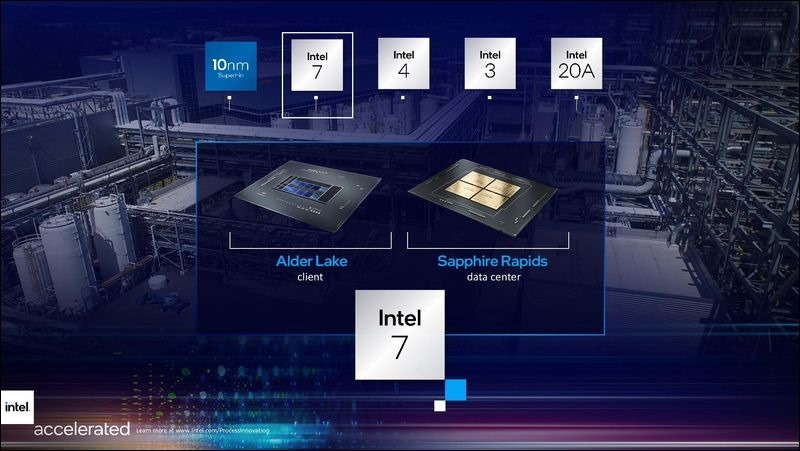
▲The Alder Lake processor will be applied to the newly named process, even though it sounds like it is switching to the 7nm process
Although it is a 10nm process, it is still named Intel 7. It gives people the impression that Intel may be inferior in process technology and care more about the asymmetry between its name and other competitors. Therefore, since our opponents have mature 7nm processes, we can also change the current 10nm process to Intel 7 process to differentiate ourselves. The first chip to apply this new name should be the upcoming Alder Lake processor. Since the suffix “nano” is missing, the naming of the process is mainly based on the maturity of the technology, the progress in power and area. The next generation of 7nm process will also be renamed Intel 4, and so on:
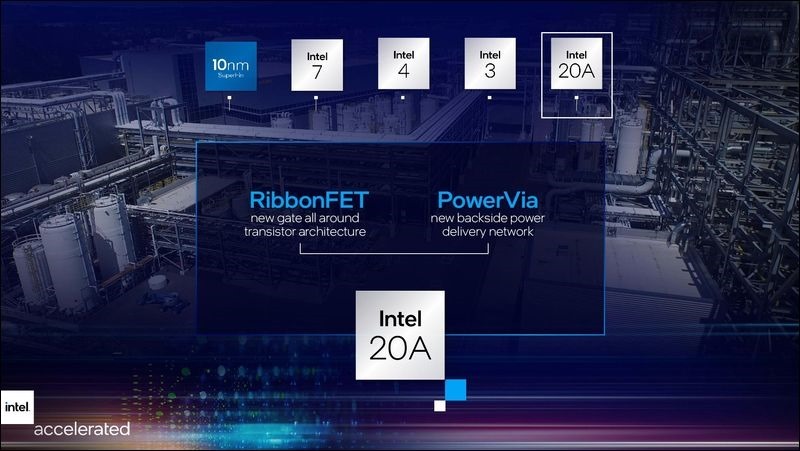
▲Although the angstrom-level process will not be seen for a few years, Intel has already used 20A to name this future new process.
New chips based on the Intel 4 process are expected to debut in 2023. At that time, Meteor Lake processors will be launched first, and Granite Rapids for servers will be launched later. Judging from this exposed roadmap, Intel will only be able to rely on new nomenclature to tell consumers that these processes are comparable to competitors such as TSMC and Samsung until 2023. Until Intel catches up, perhaps these names will at least give marketers more words to praise their products.
Source: KOCPC Chinese