


Xiaomi in China officially launched the brand’s first NAS product on June 24: “Xiaomi Smart Storage”, positioned as a “convenient and efficient storage center for the whole family”, and simultaneously opened crowdfunding reservations on Xiaomi Mall and Xiaomi Youpin. This dual-bay NAS is available in three capacity versions: 4TB, 8TB, and 16TB. The starting price for crowdfunding is RMB 2,299 (approximately NT$10,500), which will be adjusted to RMB 3,499 after the official launch. The launch of this product also means that Xiaomi has officially entered the NAS market that has long been dominated by Synology, QNAP and UGREEN.
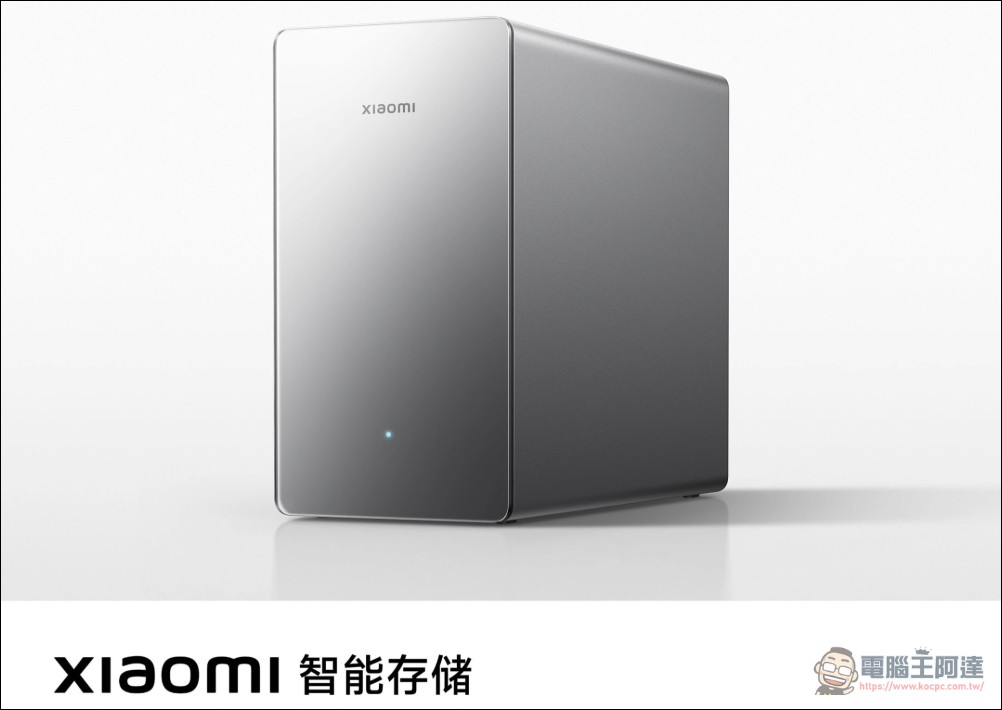
Xiaomi’s first NAS “Xiaomi Smart Storage” officially released
In the past two years, there have been rumors in the market that Xiaomi is developing NAS products. From the first time in 2024, when the person in charge of Xiaomi’s ecological chain disclosed relevant product plans in public, to the beginning of this year when the Xiaomi Smart Storage App was briefly listed on the Apple App Store and then quickly removed from the shelves, this product has always been in the stage of “just hearing the sound of the stairs.” Now it is officially announced that Xiaomi’s strategy for the home data storage market has shifted from wait-and-see to action.
Product specifications: Two bays, three capacities, minimalist appearance design
Xiaomi Smart Storage adopts a dual-bay vertical body design. The outer shell is made of titanium gray fine matte process, and the overall shape is similar to that of a small upright host. The front of the fuselage only retains the Xiaomi Logo and a status indicator light, without any extra buttons or openings, and the visual style is quite simple.
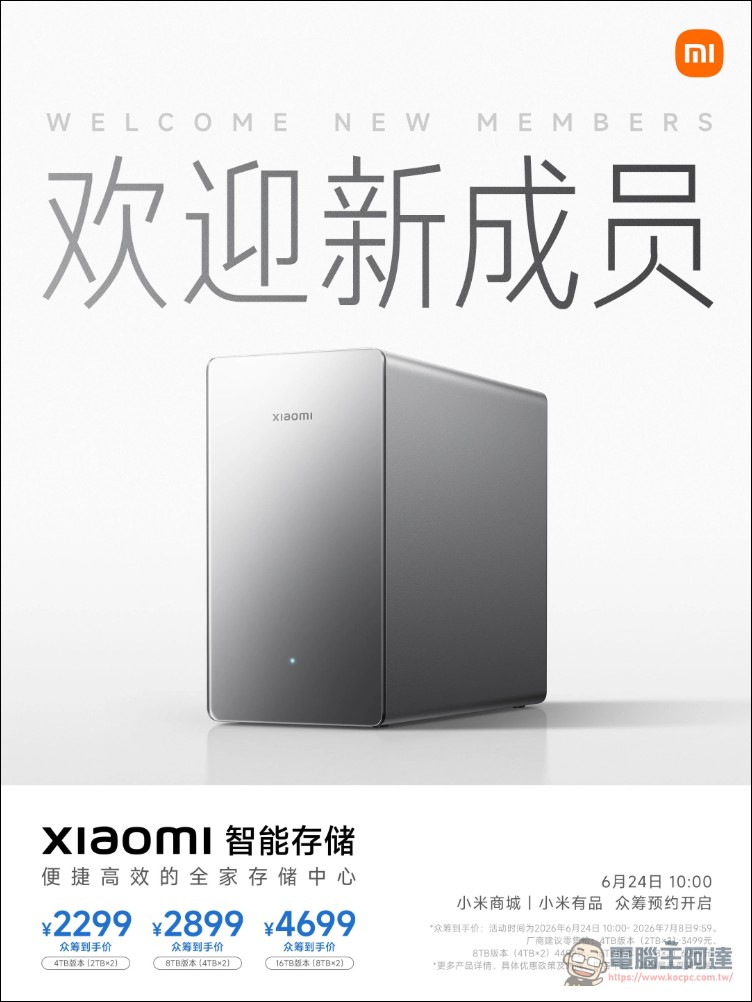
A complete set of hard drives is pre-installed at the factory, eliminating the need for users to install it themselves:
– 4TB version (2TB × 2): crowdfunding price 2,299 yuan (approximately NT$10,500)
– 8TB version (4TB × 2): crowdfunding price 2,899 yuan (approximately NT$13,200)
– 16TB version (8TB × 2): crowdfunding price 4,699 yuan (approximately NT$21,400)
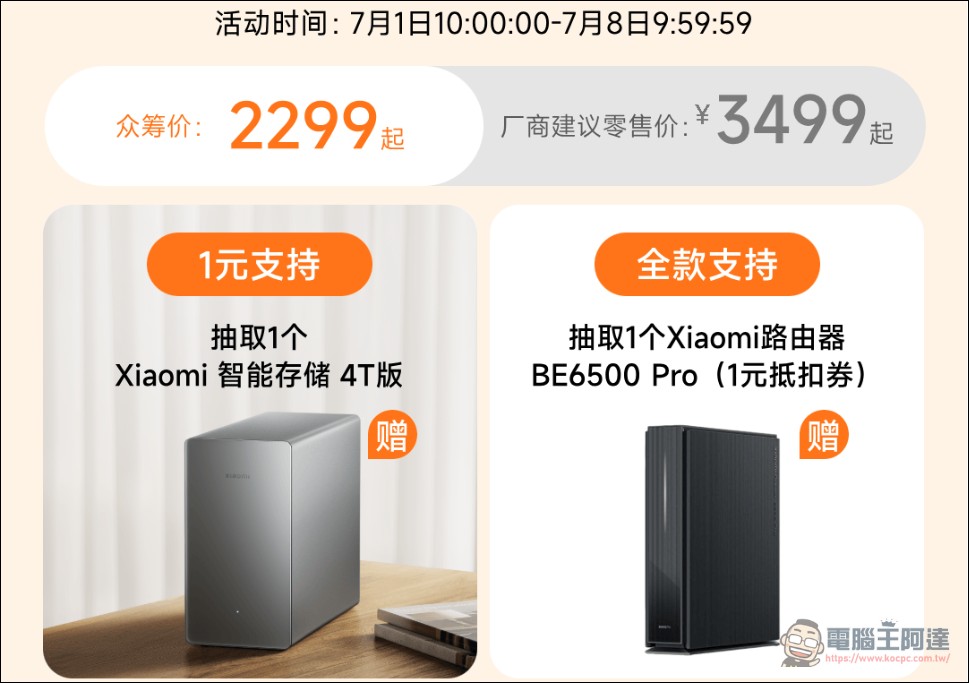
The crowdfunding campaign time is July 1, 10:00 to July 8, 9:59, the products will return to official retail price sales after the event. Taking the 4TB version as an example, there is a price difference of about 1,200 yuan between the crowdfunding price and the official list price (3,499 yuan), and the discount during the crowdfunding period is quite obvious. This pricing strategy also shows that Xiaomi hopes to quickly accumulate a user base in the early stages of product launch, paving the way for subsequent ecological services.
At present, Xiaomi has not announced the complete hardware specifications, including details such as processor model, memory capacity, network port configuration and RAID support mode, which still need to be officially disclosed later. Xiaomi Smart Storage App has been briefly available on the Apple App Store before. From the exposed application interface, it can be seen that the product uses a dedicated operating system based on The Paper OS and supports multiple functional modules such as mobile phone backup, photo album management, file management, and movie library. The interface design of the application is consistent with the style of other Xiaomi products. It is simple and intuitive, reducing the learning cost for ordinary users.
Strategic shift: Don’t be a geek toy, be a family data steward
The product positioning of Xiaomi’s NAS is significantly different from that of traditional NAS manufacturers. The person in charge of the Xiaomi ecological chain has previously revealed that the core target group of Xiaomi smart storage is ordinary home users, not DIY players or enterprise users. From the beginning of the product design, advanced features such as Docker and virtual machines were deliberately removed to minimize the barriers to use.
In other words, this is not a NAS for players to “fiddle with”, but a home appliance that can automatically start backup when plugged into the Internet line and powered on. The core competitiveness of Xiaomi products has always been based on the integration capabilities of the Mijia ecosystem, and this NAS is no exception. Through the underlying layer of ThePaper OS, as long as the phone is connected to home WiFi, photos, videos and files can be silently and automatically backed up to the NAS, without the need to manually click to upload.
The Xiaomi Smart Storage App, which was briefly exposed in the Chinese App Store, shows that it has multiple functions such as mobile phone backup, photo album management, file management, and film and television library. Users can directly read the film and television resources in the NAS on Xiaomi TVs and automatically match poster walls and subtitles. Videos from Mijia cameras and smart doorbells can also be directly stored in the NAS without purchasing additional cloud storage solutions.
Market Significance: NAS moves from computer room equipment to home appliances
In the past, the usage threshold of traditional NAS has been an obstacle that prevented it from entering ordinary households. Although the products of Synology and QNAP are powerful, the setup interfaces such as RAID array configuration, Docker container, and port forwarding are quite complicated for ordinary users. Although emerging brands such as Lulian have made progress in simplifying operations, ecological integration across devices is still a shortcoming.
The biggest significance of Xiaomi’s entry is not that it has another competitor, but that it may force the entire NAS industry to rethink “what do ordinary users need?” You don’t need to understand RAID, you don’t need to learn port mapping, you don’t need to plug in the Internet and power on, your phone automatically backs up, and you can watch movies directly on the TV. These are the real needs of most families for data storage.
From a price point of view, the crowdfunding price of the 4TB version is 2,299 yuan (approximately NT$10,500). Compared with the upgrade price of the iPhone with the same capacity (approximately 3,000-6,000 yuan), or the annual fee for cloud storage (approximately 200-300 yuan per month), a NAS can pay for itself in two or three years, and can be shared by the whole family without ongoing payments.
However, Xiaomi still faces many challenges in the NAS field. In terms of hardware, the complete specifications have not yet been announced, and key performance indicators such as transmission speed, RAID support mode, and hardware encryption engine have yet to be verified. In terms of software, the long-term and stable operation of NAS relies on a mature operating system and data protection mechanism. Xiaomi’s technology accumulation in this field is still shallow. In addition, it is also worth observing whether the 1,200 yuan gap between crowdfunding pricing and official pricing can maintain competitiveness after mass production.
Source: KOCPC Chinese