


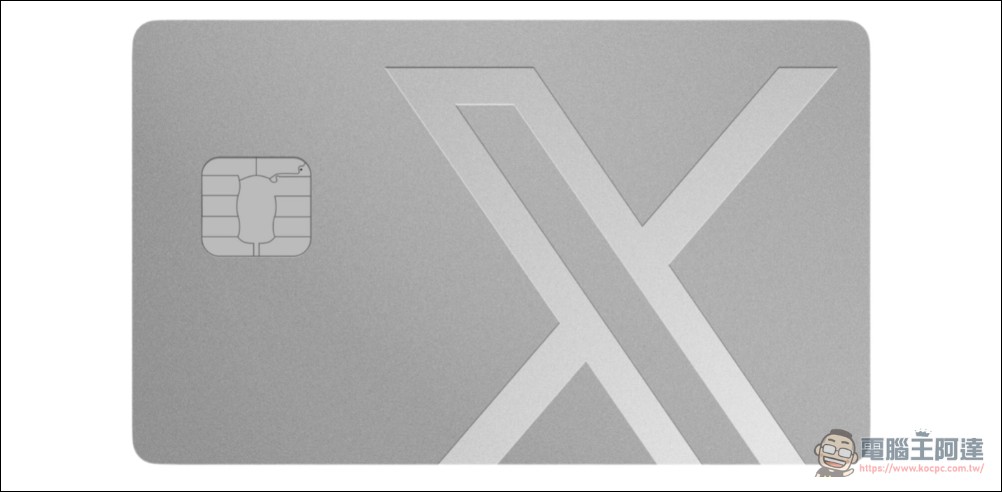
For a long time, Elon Musk has intended to build X into the American version of WeChat—an app that encompasses social networking, messaging, and payment functions. The messaging feature has already been explored through XChat, and the final piece was the financial payment service “X Money.” After years of delays, regulatory reviews, and technical integration, the service finally officially launched for US users at the end of June 2026, directly declaring war on traditional banks and fintech companies with highly aggressive interest rates and reward terms. Recently, many KOLs on X have posted about finally gaining access to X Money, listing the full benefits: 6% APY on savings, up to $10 million in FDIC insurance, unlimited 3% cashback on purchases, a metal Visa debit card, and free transfers and ATM withdrawals.
What does X Money actually offer?
From a functional perspective, X Money is no longer a simple digital wallet—it serves as a complete bank account alternative covering deposits, payments, transfers, and card spending. This also sets it apart clearly from competitors like Venmo, Cash App, and PayPal: most of the latter don’t provide FDIC insurance, or only do so when users actively enable specific savings features, whereas X Money’s deposits are held by insured banks by default.
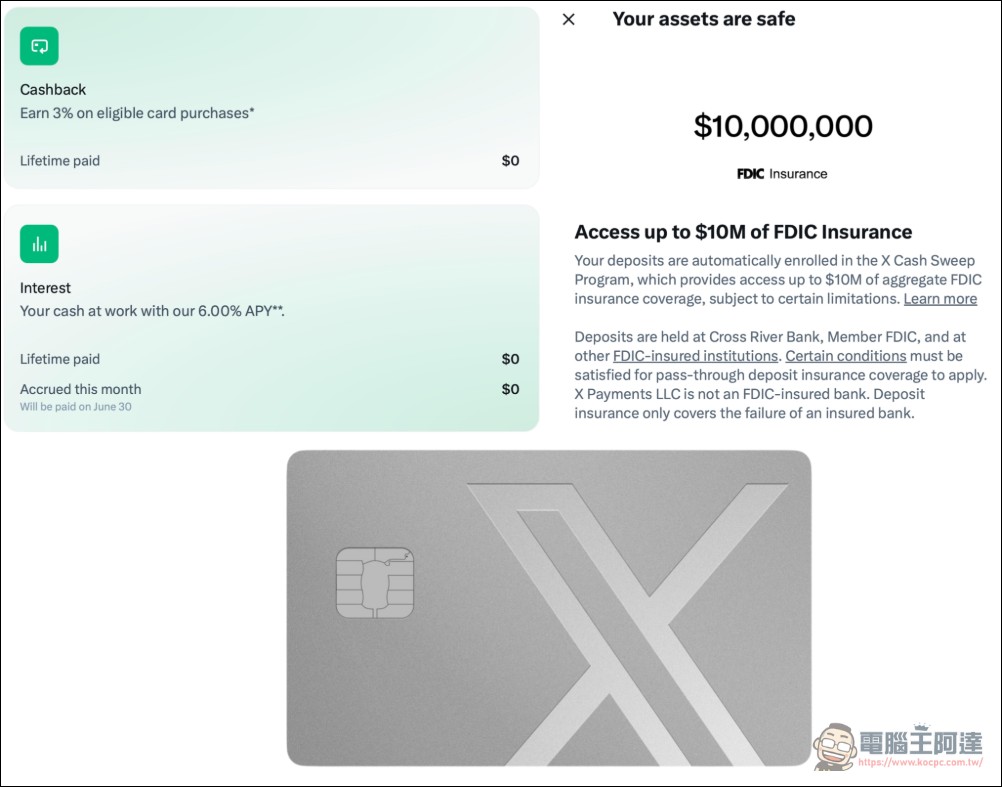
Currently, X Money’s services include:
- 6% APY (Annual Percentage Yield)All cash deposited into X Money is eligible, with no balance cap.
- FDIC insurance up to $10 millionDiversify deposits across multiple banks through a Cash Sweep Program, splitting funds within the single-bank insurance limit to various partner banks.
- Unlimited 3% cash backAll purchases made with the X Money Visa card are eligible for cash back, except for transactions in categories such as gambling, jewelry, and precious metals.
- Metal Visa Debit CardAccepted at any merchant that accepts Visa; also supports Apple Pay
- Free wire transfers, bill payment, and check delivery;
- Free ATM withdrawalFee subsidies are available even for cross-bank transactions
- Instant P2P TransferCan directly send and receive payments to any user via the X platform;
- Early salary depositAfter setting up direct deposit, your salary will be deposited two days early.
Where does the 6% savings rate come from?
This is X Money’s most eye-catching selling point, but also its most controversial one. As of late June 2026, the U.S. federal funds rate was around 4.25% to 4.50%, and high-yield savings accounts from mainstream online banks were mostly offering rates between 4% and 4.5%. The 6% offered by X Money is significantly above market levels, which has led many analysts to question whether its business model is sustainable.
According to the analysis, the 6% interest rate is primarily positioned as a “customer acquisition cost.” Traditional fintech companies must spend large marketing budgets to attract new users, but X itself has approximately 570 million monthly active users, requiring virtually no additional customer acquisition costs. Through its Banking-as-a-Service partnership with Cross River Bank, X can delegate backend compliance and capital requirements to a licensed bank while focusing on the user interface and distribution. This “embedded finance” model allows X Money to offer above-market interest rates at relatively low costs, at least in the short term.
However, as of the end of June, X Money has yet to publish a standardized account agreement or Truth in Savings disclosure document—information that US regulations require depository institutions to provide before account opening. Since X itself is not a bank, these disclosure obligations may fall on Cross River Bank, but consumers currently cannot confirm directly through the X platform whether the 6% rate is a long-term fixed rate, promotional in nature, or subject to balance limits.
The Banking Infrastructure Behind: Cross River Bank and Visa Direct
X Money doesn’t operate as its own bank, but rather is built on a Banking-as-a-Service (BaaS) infrastructure. The backend is provided by Cross River Bank, handling account management, transaction processing, and regulatory compliance. This New Jersey-based bank is one of the pioneers of the BaaS model in the United States and also provides backend support for financial services such as Affirm, Stripe, and Coinbase.
Payment clearing uses Visa Direct, which is Visa’s real-time push payments network. Compared to traditional ACH transfers that take 1 to 3 business days, Visa Direct delivers near-instant transfers. This advantage is particularly significant for creators, freelancers, and gig economy workers. The $10 million FDIC insurance is provided by automatically sweeping deposits exceeding the $250,000 per-bank limit across multiple partner banks each night, so users see a single balance while their funds are actually distributed across multiple insured accounts.
However, Cross River Bank has also drawn regulatory attention in the past. In 2023, the bank received a cease-and-desist order from the FDIC over fair lending compliance issues. This became one of the specific concerns that Senator Elizabeth Warren raised in her April 14, 2026 letter to Musk, questioning whether X Money has sufficient consumer protection, compliance systems, and disciplinary mechanisms in place to operate such products.
Launch timeline and user reactions
The rollout of X Money has been significantly slower than originally planned. Musk originally announced in March 2026 that early public testing would open in April, but the timeline was delayed. On June 25, X Money lead Dhruv Batura announced a small-scale rollout to US Premium+ subscribers first, to collect feedback and address issues. Within hours, users were already showing P2P transactions of $25 being sent to Musk himself, and Musk publicly confirmed receiving the payment. By June 29, multiple prominent accounts, including Sawyer Merritt, had reported gaining access. There were indications that receiving P2P transfers from other users might itself trigger activation, creating a viral-like spread effect.
Check out the brand new metal @XMoney credit card. Thank you @elonmusk 🙏🏽 pic.twitter.com/wPSQr16sj6
— Mike Bolen (@mikebolen) June 29, 2026
User reactions are largely polarized. Some people are excited about the 6% interest rate and 3% cash back, believing this could force traditional banks to raise their rates. Others are concerned about account security issues—for example, if an X account is suspended or compromised, whether users would simultaneously lose access to their funds. There are also comments pointing out that X Money ties financial identity to social media accounts, which presents structural problems in terms of privacy and risk management.
Impact on the financial industry
The threat of X Money lies not just in its interest rates and rewards, but in its ability to leverage a social network with 570 million users for distribution. SoFi, Chime, Venmo, Cash App, and even Apple and Goldman Sachs’s savings account partnership all have to spend significant resources on customer acquisition, whereas X can simply add a new feature to its existing platform to reach hundreds of millions of users. Media reports have directly dubbed X Money a “bank killer super app,” arguing that it poses new competitive pressure on PayPal, Block (Cash App’s parent company), Chime, and major Wall Street banks.
Additionally, although Musk himself has long publicly supported Dogecoin and other cryptocurrencies, X Money’s current design is completely decoupled from crypto assets—a strategic choice worth noting. This means Musk is not in a hurry to tie financial services to digital assets, but rather first using stable, compliant traditional financial products to build trust and a user base.
Limitations and Uncertainty
Currently, X Money is not available nationwide. The service is only offered in 41 states where X Payments LLC holds money transfer licenses, plus Washington D.C. New York and Massachusetts are not included, and it’s not yet available outside the United States. Additionally, users must be at least 18 years old and complete identity verification. These restrictions demonstrate that despite Musk’s powerful media influence and user base, financial regulations remain the primary constraint on expansion speed.
Another issue is: if the X platform itself faces an operational crisis or Musk’s business empire comes under pressure, what would be the legal status of user funds? Since X Money is not a bank, deposits are actually held by Cross River Bank, but if X faces problems as the customer interface and service operator, users’ recourse options remain unclear. This is also an ongoing focus for regulators and consumer protection groups.
Source: KOCPC Chinese