


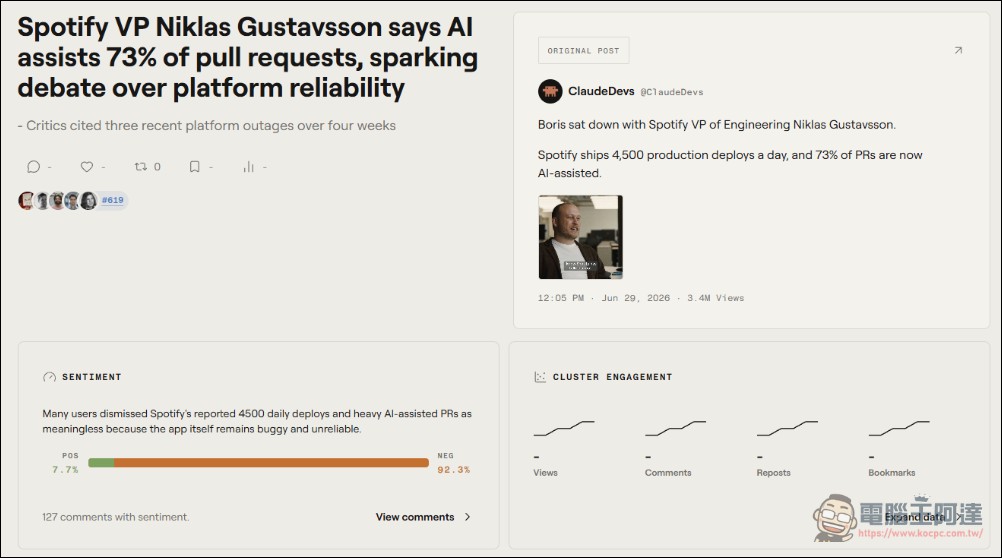
Anthropic’s official account ClaudeDevs posted an interview with Boris Cherny and Spotify’s VP of Engineering Niklas Gustavsson on X on June 29, claiming that Spotify conducts 4,500 production deployments daily, with 73% of Pull Requests already completed with AI assistance. The post quickly sparked heated discussion, receiving over 4,200 likes and over 500 comments, with views exceeding 3.4 million. However, the response was entirely opposite to what Anthropic had anticipated, with the community’s reaction to these figures being overwhelmingly negative, with many users directly saying: “What on earth could warrant updating a music player 4,500 times a day?More developers sarcastically asked:Don’t tell me you deploy every time you add a new song?」

Anthropic’s Campaign: AI-Powered Engineering Marvel
In this interview recorded at the Code with Claude 2026 conference, Gustavsson detailed how Spotify deeply integrated AI coding tools into their engineering workflow. He noted that over 99% of Spotify’s engineers use AI coding tools weekly, 94% reported productivity improvements, and Pull Request frequency increased by 76%.
Boris sat down with Spotify VP of Engineering Niklas Gustavsson.
Spotify ships 4,500 production deploys a day, and 73% of PRs are now AI-assisted. pic.twitter.com/Bc0xPduumG
— ClaudeDevs (@ClaudeDevs) June 29, 2026
Gustavsson also demonstrated a background coding agent called “Honk” – a system that runs on the Claude Agent SDK on Kubernetes and can schedule dozens of parallel sessions to make code changes in a monorepo with over 20 million lines of code. He himself keeps 5 to 10 Claude sessions running simultaneously in tmux, with each session corresponding to a git worktree.
Honk’s predecessor is Spotify’s long-developed Fleet Management system, which has automatically merged over 2.5 million maintenance-related pull requests to date. Gustavsson emphasizes that by incorporating an LLM judge to validate AI-generated code, the PR success rate has increased from approximately 25% to 80%.
Community reaction: The numbers look great, but the app is hard to use.
However, the comments below this post presented a starkly different picture. According to Digg StatisticsNegative sentiment accounts for up to 92.3% of community sentiment.
Well-known engineer and author Gergely Orosz Calling them out: “Coincidentally, 3 out of the past 4 weeks I couldn’t include Spotify links when publishing my podcast because Spotify was down. Twice it was an outage during podcast publishing, and once the entire web player was broken. I haven’t seen Spotify this unreliable in a long time.”
He later added: “I’m not suggesting Spotify’s reliability issues are related to Claude Code. But from my user experience, the reliability is definitely much worse than before. And Spotify has no status page, no postmortem. As a podcast creator and a paying subscriber, this is extremely disappointing.”

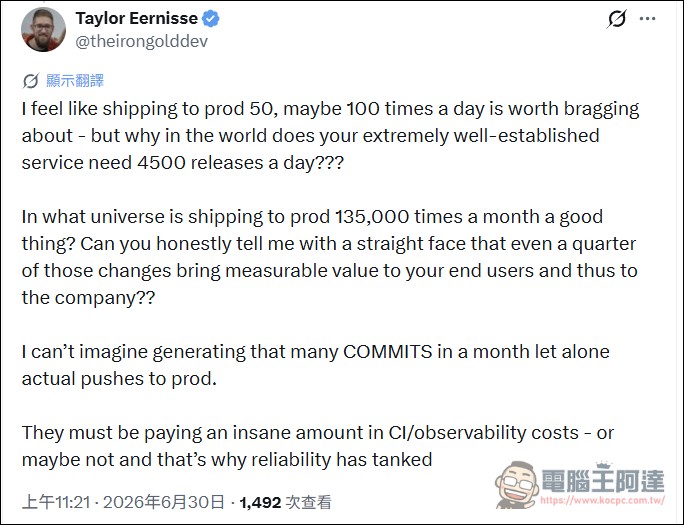
another engineer Taylor Eernisse The comment precisely highlighted the contradiction: “I think deploying 50 to 100 times a day is worth bragging about. ButWhy does an extremely mature service need 4,500 releases per dayCan you really look me in the eye and say that even a quarter of these changes delivered measurable value to end users?
More users’ reactions are even more direct:
- Gio CasinelliThe product has looked exactly the same for 10 years. What are they even deploying?
- hp (Planckbot)They have no new features at all. Even if you rolled Spotify back to a version from 5 years ago, no one would notice.
- Finn Hulse“Spotify is terrible. Their only job is to recommend good music, and they can’t even do that.”
- Daniel (growing_daniel)“Anyone who has actually used the Spotify app knows this is an extremely bearish signal for AI engineering.”
- Vighnesh“Do they deploy every time they add a new song?” 😂
vik (@vikhyatk) then briefly puts it: “Spotify has 10,000 employees, and then boasts about that.”

The Real Problem Behind the Numbers
Delving deeper reveals several fundamental issues. First, the definition of 4,500 deployments itself is quite ambiguous—Spotify may be counting each independent deployment of individual services in their microservices architecture, rather than what users perceive as “app updates.” In a microservices architecture, a single change could involve editing a configuration file or updating a dependency package, which is entirely different from what users see as a Spotify app version update. In other words, this number is meaningful to engineering teams but holds no reference value for general users.
Furthermore, the 73% AI-assisted PRs doesn’t mean AI autonomously wrote 73% of the code. Spotify’s official blog puts it more precisely: “The vast majority of PRs were completed through collaboration between developers and AI Agents.” RuntimeWire’s analysis also points out that this figure reflects acceleration on a highly standardized engineering platform, rather than an AI coding miracle from scratch. Over the years, Spotify has built a highly consistent codebase through the Backstage developer portal, Fleet Management system, and a unified tech stack. The reason Agents perform well is precisely because the code style is consistent and test coverage is high—not because the model itself is particularly powerful.
Third, Gustavsson openly admitted in an interview that relying solely on AI-generated code didn’t work well initially, with a PR success rate of only about 25%. Improvement came from adding an LLM judge verification mechanism—after AI generates the diff, another model compares it against the original requirements—which pushed the success rate to 80%. In other words, if you remove that verification layer, most of these so-called “AI-assisted” outputs are wrong. This also echoes RuntimeWire’s astute observation: “The companies extracting the most value aren’t the ones with the broadest prompt access, but the organizations with the cleanest component catalogs, most comprehensive test coverage, and most consistent tech stacks.”
There’s also a hidden cost behind these high-frequency deployments: CI/CD and observability expenses. This isn’t to say Claude models are bad, but rather reflects how many tech companies are doing AI for the sake of AI, representing meaningless Tokenmaxxing behaviors where engineers chase AI usage KPIs, burning through tons of tokens without getting the corresponding value.
Scale Contrast: Impressive Backend Numbers vs. Real User Experience
This incident essentially exposes a classic cognitive divide between engineers and users. From Anthropic and Spotify’s perspective, 4,500 deployments and 73% AI-assisted PRs are achievements worth boasting about, demonstrating the depth of AI Agent applications in large enterprises. But for everyday users who open Spotify to listen to music, the app still has plenty of bugs, the interface keeps getting worse with redesigns, and the recommendation algorithm hasn’t gotten noticeably smarter—none of these impressive backend metrics have translated into a better product experience.
As mentioned under the tweetAsk a question in the commentsPeople using Spotify—do you think the app experience has gotten better over the past six months? The silence in response says it all.
Source: KOCPC Chinese