


Anthropic officially announced on June 30, 2026 Claude Sonnet 5Officially positioned as “the most agent-capable Sonnet model to date,” it claims to approach the flagship Opus 4.8 level across a wide range of agent tasks, while costing only one-fourth the price of Opus. The company even rolled out a limited-time offer, with API input at just $2 per million tokens before August 31, 2026, attempting to attract developers to adopt it at scale with its high cost-performance ratio. However, the benchmark results from the GitHub personal private evaluation project “LLM Benchmark Dashboard” show that Sonnet 5 Not only did it fail to dominate the competition, but it exposed a glaringly poor value proposition, with testing costs exceeding six times that of Chinese open-source models.

Official Data vs Real Feedback: Three Factions Debate
Anthropic The official benchmark results are indeed impressive. Sonnet 5 scored 82.1% on SWE-bench Verified, becoming the first model to break through the 80% ceiling, surpassing Gemini 3.1 Pro’s 80.6% and GPT-5.4’s approximately 80%. On GPQA Diamond, the PhD-level science Q&A benchmark, it set a new record with 96.2%. On OSWorld-Verified, the computer operation test, it also led significantly with 88.3%, far ahead of GPT-5.4’s 75.0%.
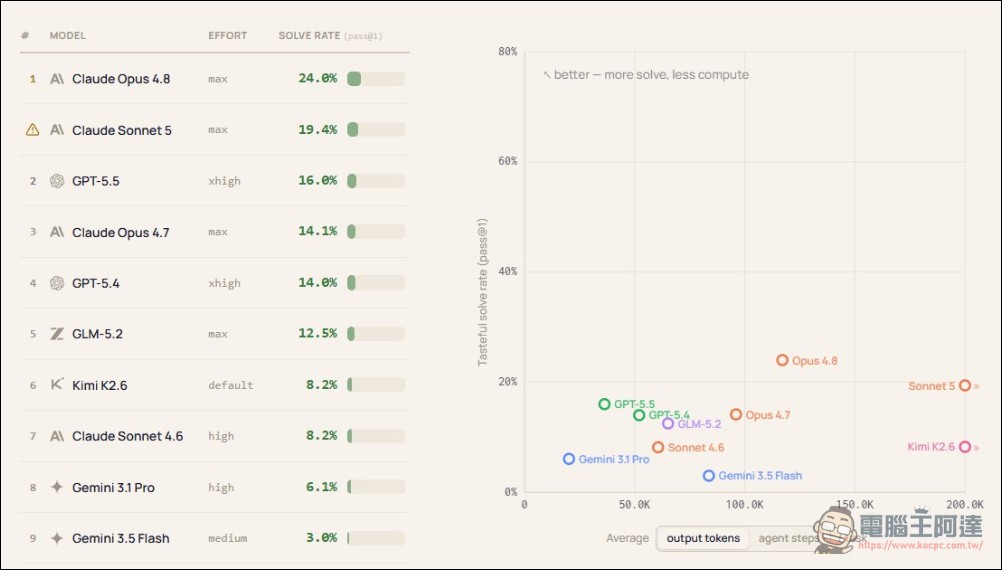
However, the global developer community’s reactions split into three distinctly divided camps:
The hype squadPowered by the Reddit developer community, countless programmers are marveling at Sonnet 5’s dominance in complex backend development and multi-file refactoring. One highly upvoted comment reads: “It took just a moment to fix a serious bug that had blocked Opus 4.8 for days—it got Opus’s intelligence but only charges Sonnet’s price.” In Cursor’s real-world tests, Sonnet 5’s score on CursorBench surged from the previous generation Sonnet 4.6’s 49% to 57%, meaning it can now independently complete over half of complex multi-file refactoring tasks without any human intervention.
Roast SquadFirepower is concentrated on Sonnet 5’s Max inference mode, with developers labeling it a “bill killer.” The official intent behind designing Max mode was to enable deeper model reasoning, but real-world testing reveals this mode easily falls into costly “over-thinking.” One user sarcastically remarked: “It thought for an entire century, burned through all my credits, and finally spat out just that one short sentence.” In Agent autonomous planning scenarios, Sonnet 5’s call turns tripled compared to the previous generation, with output tokens expanding by 40%. What has enterprise users even more livid is that Anthropic quietly swapped out the tokenizer, causing token counts for the same text to balloon by up to 35%.
Wait-and-see campdirectly comparing Sonnet 5 with Chinese open-source models such as GLM-5.2, MiniMax-M3, and DeepSeek V4 Pro. The conclusion was that the capabilities are on par, yet the price difference reaches 56 times. The founder of LisanBench, which focuses on AI benchmarking, stated bluntly on X: “Sonnet 5 should be thrown in the trash—it’s a full 57 times more expensive than DeepSeek.” The post quickly surpassed 770,000 views.
Sonnet 5 goes straight into the garbage bin
> 1.2x more expensive than Opus 4.8 Max
> 2x more expensive than GPT-5.5-xhigh
> 5x more expensive than GLM-5.2
> 7x more expensive than Kimi-K2.6
> 57x more expensive than DeepSeek-V4-Pro pic.twitter.com/J8rH06Zty3— Lisan al Gaib (@scaling01) June 30, 2026
Private Review Exposes the Harsh Truth: 6x the Price, Same Score
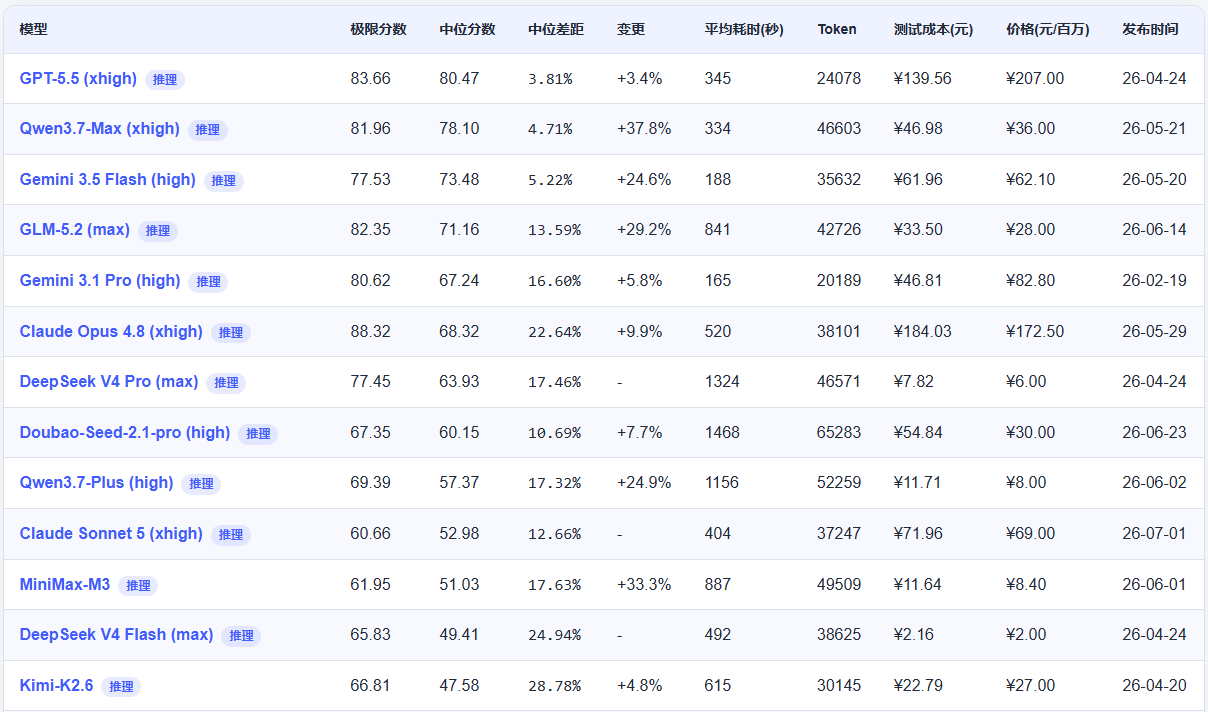
The spark that ignited this controversy is the LLM Benchmark Dashboard project on GitHub. This privately maintained question bank focuses on challenging reasoning problems in logic, mathematics, programming, and human intuition to test models’ deep thinking and long chain-of-thought reasoning performance.Test ResultsRevealed three harsh truths:
First, on ceiling scores, Sonnet 5 has lost its absolute dominance. In this set of hardcore logic questions, MiniMax-M3 topped the chart with a score of 61.95, while Qwen3.7-Plus tied with Sonnet 5 on ceiling scores. This means that Chinese reasoning LLMs now have the capability to stand shoulder to shoulder with Silicon Valley’s top players in pure logic competition.
Second, the testing costs are on an entirely different scale. Running the full test suite on Sonnet 5 cost 71.96 RMB, while Qwen came in at just 11.71 RMB and MiniMax at 11.64 RMB — Sonnet 5’s bill is over six times that of Chinese models. At that ratio for large-scale API calls, enterprises would find the commercial deployment costs simply unsustainable.
Third, Sonnet 5 averages only 404 seconds, much faster than Qwen’s 1,156 seconds and MiniMax’s 887 seconds, so its token throughput is indeed quick. However, when facing extremely difficult logic problems, “fast” often means insufficient deep thinking. Sonnet 5’s Chain of Thought (CoT) doesn’t stack deep enough, and its self-correction budget is limited, which prevents it from using sheer computational power to pull ahead on the hardest scores where truly grueling effort is needed.
Overly strict safety alignment sparks developer backlash
Beyond the performance and pricing controversies, Sonnet 5’s overly conservative safety alignment has also become a major pain point drawing集中吐槽 from developers. Anthropic not only publicly acknowledged this shortcoming, revealing that the model was forcibly equipped with a “moral审查器” to prevent potential misuse, but also enthusiastically promoted at the launch event that Sonnet 5 scored a zero in tests of “writing Firefox exploit code.”
Netizens scoffed in response: “It’s like a security company proudly announcing, look, we intentionally made this model dumb and crippled, so it definitely won’t cause any trouble.” For white hat engineers who need to conduct cybersecurity attack/defense drills and black-box testing, this kind of over-alignment doesn’t protect anyone—instead, it directly strips the tool of the practical value it was supposed to have.
Conclusion
So did Claude Sonnet 5 actually fail? The answer depends on what you’re using it for and whether you’re willing to pay the steep bills. If your main pain points are agentic coding, complex backend engineering refactoring, or long-running multi-file collaboration, it’ll still blow you away. But if you’re just running some hardcore logic puzzles, doing everyday knowledge Q&A, or chasing the best bang for your buck on a tight budget, its performance combined with the token bill burning a hole in your pocket might leave some people feeling like it’s not worth the price tag.
Over the past two years, everyone was competing on “who’s smarter, who has higher benchmark scores.” Now in the tech world and business community, everyone’s crunching the numbers to figure out “what’s more cost-effective, which has lower commercial deployment costs.” When DeepSeek-level advanced reasoning tasks cost just $0.04 while Sonnet 5 in Max mode runs $2.29, that tiny one- or two-point gap on the leaderboard may no longer justify a staggering 56x price difference. So, would you choose a cheaper Chinese model with comparable capabilities for the sake of cost-effectiveness? Or go with Sonnet 5, which costs far less than Fable 5 while still delivering solid performance?
Source: KOCPC Chinese