


In the past, homeowners who wanted professional 3D VR property tour pages created for their homes typically required professional teams with high-end 3D modeling equipment, costing significant money and resources. But now, with just a smartphone and an afternoon, anyone—no professional expertise needed—can scan a property and upload it to a website, allowing anyone to freely walk through a listing in a browser tab without installing any app, without a VR headset, and without a real estate agent present. This technology is not a sci-fi movie plot, but rather something called “3D Gaussian Splatting(Gaussian Splatter / 3DGS3D reconstruction technology is making the leap from academic papers to commercial applications at an astonishing rate.
SOMEONE JUST KILLED THE REAL ESTATE INDUSTRY
A guy scanned an entire house with his phone. Uploaded it.
Now anyone on Earth can walk through it in a browser tab. No app. No VR. No agent. No appointment.
Click → you’re inside. Every room. Every angle. Every shadow. Photoreal.… https://t.co/mpc1kmQmiD pic.twitter.com/uSnnDxgSZn
— AdiiX (@adiix_official) May 7, 2026
What is 3D Gaussian Splatting?
Traditional 3D modeling relies on polygons to construct object surfaces—game characters and buildings are all created this way. But 3D Gaussian Splatting is completely different: it doesn’t use polygons. Instead, it uses millions of tiny, semi-transparent colored “splats” floating in space, where each splat carries its own position, size, opacity, and color information.
After capturing video or photos of a room using a phone, the AI calculates the position of each image, then continuously adjusts these light spots until the rendered view from any angle reproduces the effect of the original photos. The result is photorealistic 3D scenes with file sizes much smaller than traditional 3D models, and they can render smoothly in any modern browser.
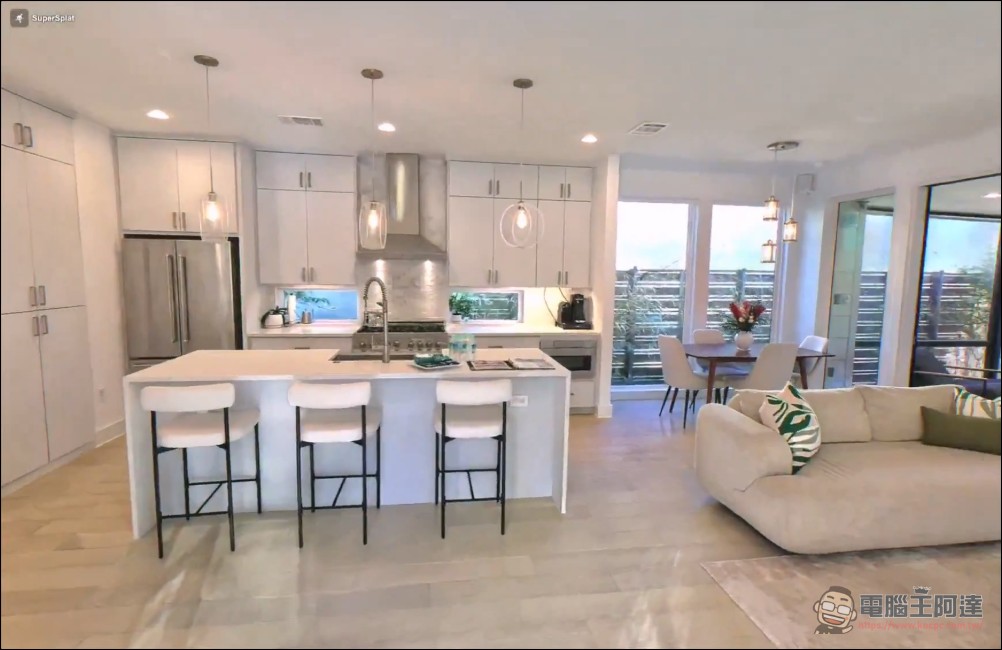
This technology was first published in a paper by INRIA (the French National Institute for Research in Digital Science and Technology) in mid-2023, and within just two years, it has evolved from a curiosity in computer graphics research into a mainstream consumer product. Currently, in foreign real estate VR tour applications, it has already surpassed traditional 3D panoramic photo stitching techniques due to its superior immersion and lower technical barriers and equipment requirements. Recently, it has gained even more attention following an X post about being able to earn $200 extra by scanning a house.
SOMEONE JUST KILLED THE REAL ESTATE INDUSTRY
A guy scanned an entire house with his phone. Uploaded it.
Now anyone on Earth can walk through it in a browser tab. No app. No VR. No agent. No appointment.
Click → you’re inside. Every room. Every angle. Every shadow. Photoreal.… https://t.co/mpc1kmQmiD pic.twitter.com/uSnnDxgSZn
— AdiiX (@adiix_official) May 7, 2026
Complete Mobile Scanning Workflow
To create your own 3D Gaussian Splat of a house, you only need a smartphone released within the past four years (iPhone 11 or newer, or an Android flagship) and about an afternoon of time. The entire process is divided into three steps:
Step 1: Scan the space using your phone app
The most recommended free app right now is one released by Niantic. ScaniverseIt processes everything on the phone without uploading to the cloud, taking about 60 to 90 seconds to generate a Splat scene. The scanning technique involves walking around the room three times at a steady pace: the first round faces the center of the room while capturing the surroundings, the second round faces the walls to capture the ceiling and floor, and the third round walks around the center of the room to capture furniture details. A typical room takes about 5 to 8 minutes to scan.

If Scaniverse performs poorly in a specific room, the alternative is PolycamThe paid plan is $30 per month, and it excels at handling white walls and dark corners because it uses the iPhone Pro’s LiDAR depth sensor as an assist.
Step 2: Clean up in the SuperSplat editor
After scanning is complete, export the file as PLY format, then drag it into SuperSplat EditorA free and open-source editor developed by PlayCanvas with over 9,400 stars on GitHub. SuperSplat runs entirely in the browser—no software installation required. You can use it to remove floating noise artifacts, trim scene boundaries, and publish as a shareable link with one click.
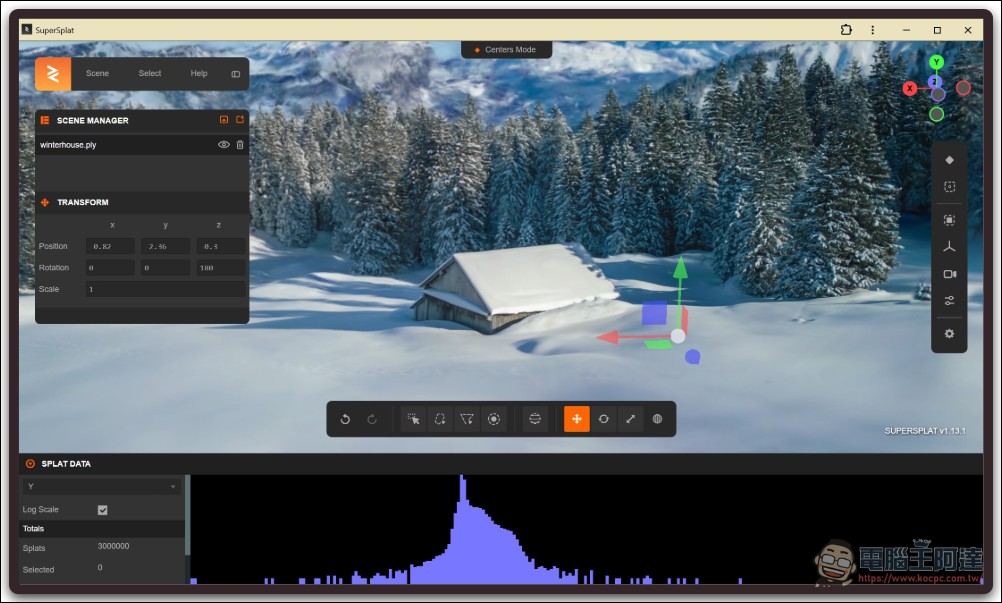
SuperSplat In March 2026, it added “Walk Mode” and streaming LOD functionality, allowing large scenes to load smoothly on mobile devices. Published scenes use PlayCanvas’s SOG (Spatially Ordered Gaussians) format, with file sizes only one-third to one-half of compressed PLY, smaller than typical Douyin videos.the scene belowYou can just walk right in and look around
Step 3: Share Link
After publishing, you’ll get a shareable URL that anyone can open in any browser to enter this 3D space directly. Supports iMessage, WhatsApp, Signal, Slack, Email, and more — just click the link to experience it, no plugins or apps required.
Real 3D home viewing websites
If you want to see what this technology actually looks like, the following websites let you try it directly in your browser:
SuperSplat Explore(superspl.atIt is currently the largest 3D Gaussian Splat community platform, featuring hundreds of user-uploaded real-world scene scans that can all be directly explored and interacted with in the browser. Here are a few notable examples:
- Amity Street Apartment(Link“): An apartment interior scene reconstructed from 2,500 photos with rich details, serving as the best demonstration for real estate 3D property tours.
- Garage – High Detail Test(LinkHigh-resolution scan of the garage interior, showcasing 3DGS’s ability to reconstruct complex indoor spaces
- Collectables Cafe(LinkVintage coffee shop in Cape Town, South Africa, with a space packed full of items still clearly on display
- Resort Hotel – DJI M3E(Link) A resort hotel panorama reconstructed from 1,769 drone-captured photos
- Hala Magazynowa(Link): Commercial-grade scanning case study of a warehouse space in Poland, produced by professional team SKANOSFERA
SplatMart(splatmart.comIt is a marketplace platform for 3D Gaussian Splat, with categories covering architecture, interior spaces, vehicles, characters, and more. It offers both free and paid scene downloads, as well as comprehensive learning resources and job matching services.
Additionally, major real estate platforms have fully embraced this technology. Zillow launched in July 2025 SkyTourSplat scenes that capture home exteriors using drones, and reported that listings using this feature saw 79% more views, 76% more saves, and 91% more shares. Realtor.com launched this in October 2025. FlyAround Features. CoStar integrates Matterport 3D Exterior into Apartments.com.
The real estate industry is being disrupted
3D virtual home tours actually aren’t really a new concept. Matterport has built a $1.6 billion industry over the past 15 years, and when it was acquired by CoStar Group for $1.6 billion in February 2025, Matterport had already managed 14.1 million spaces, 507 billion square feet of property, and had over 1.2 million subscribers.
But Gaussian Splatting is rapidly replacing the old format. Its advantages are quite clear:
- PhotorealisticThe lighting, materials, and shadows all come from real photographs, unlike the fake-looking rendering from game engines.
- Free movementHouse viewers can freely walk through the space, rather than jumping between fixed 360-degree viewpoints.
- Real-time depth perceptionThe parallax effect as you move makes the actual size of the room instantly apparent
- No App RequiredCan be opened in any browser, and even supports VR browsing on Quest 3
- Extremely low costA smartphone + free software = approximately $200 in scanning costs, compared to a $15,000 real estate agent fee for a $500,000 house — a huge disparity.
The emerging “Splat gig” economy
Just as Matterport once spawned a global 3D scanning service ecosystem, Gaussian Splatting is creating brand new freelance opportunities. Currently, freelancers charge between $300 and $800 per property scan, serving real estate agents, Airbnb hosts, event venues, car dealerships, and museums.
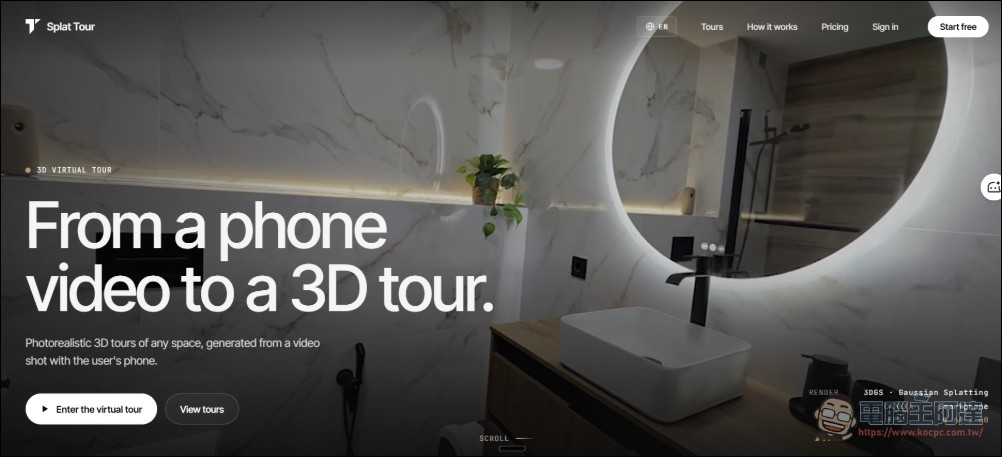
On platforms like SplatMart, dedicated “Splatter” marketplaces have emerged, where real estate agents can post scanning requests and contractors can submit quotes, with payment handled through third-party escrow. For a typical three-bedroom house, the entire process from scanning to publishing takes about 3 to 5 hours, and all you need is a smartphone with free software.
This means: one person + one smartphone + one weekend = a whole new business model.
The limitations of this technology
Of course, 3D Gaussian Splatting is not a panacea. There are still several obvious pain points with current consumer-grade apps:
- Glare and mirror surfaces are killersMirrors, TV screens, and glass tabletops produce strange geometric distortions and need to be covered or turned off before scanning.
- Moving objects cause noisePets or moving people will become floating blurry light spots.
- Transition between rooms: Current consumer apps still cannot reliably stitch multiple rooms together into one continuous scene; the more practical approach is to scan each room independently and then present them using a linked list.
- White walls and dark cornersTextureless surfaces pose a challenge for algorithms, requiring more scan coverage to handle properly
Additionally, in hot real estate markets where homes sell within a week, 3D tours offer limited impact on final sale prices. The true value of this technology lies in high-value listings, remote buyers, vacation rentals, pre-construction properties, and architectural documentation.
From 2023 academic papers to 2026 mobile apps, 3D Gaussian Splatting took just three years to make the journey from the lab to the living room. When platforms like Zillow, Realtor.com, and CoStar fully embraced this technology, when a single phone can produce photorealistic 3D spaces, the real estate industry’s presentation methods may be undergoing a fundamental transformation (Editor’s note: It seems no real estate agents in Taiwan are currently using Gaussian Splatting technology?).
Source: KOCPC Chinese