


In less than three months,DeepSeek Recently made another splash in the visual language model (VLM) field by officially releasing its adoption of a brand new upgraded optical character recognition (OCR)DeepSeek OCR 2This technology completely overturns traditional AI’s mechanical image scanning approach of processing “left to right, top to bottom,” instead adopting a flexible processing method that mimics human visual logic. It not only claims to surpass Google’s Gemini 3 Pro in document parsing accuracy, but also achieves unprecedented computational efficiency.
DeepSeek OCR 2 Core Technology: DeepEncoder V2 and “Visual Causal Flow”
What makes DeepSeek OCR 2 so powerful lies in the revolutionary design of its underlying architecture, DeepEncoder V2: “Visual Causal Flow” (Visual Causal Flow):
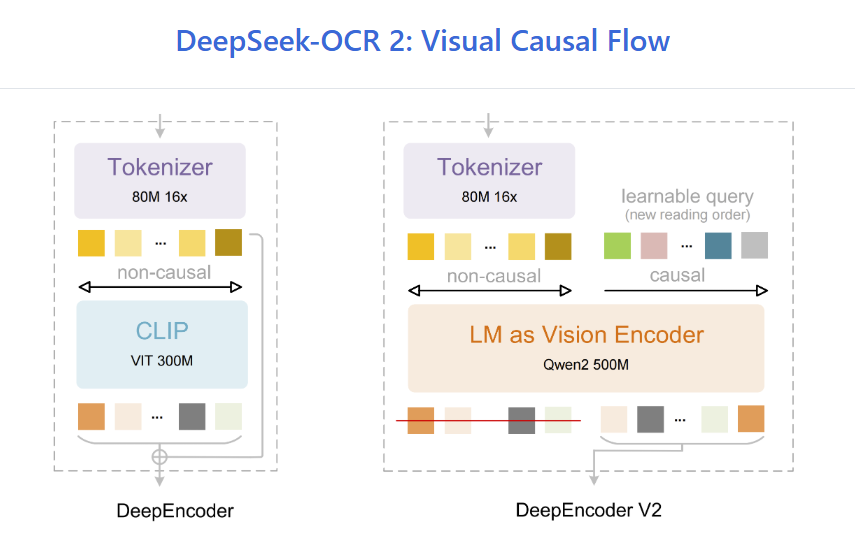
- Abandoning traditional components: The R&D team replaced the industry-standard CLIP component with a small language model based on Qwen2 0.5B, enhancing the system’s initial understanding of details.
- Emulating Human Vision: Introducing the Original “Visual Causal Flow”. These learnable query tokens reorganize visual information based on image context before formal processing by large language models. This means the system first “comprehends” the relationships within 2D imagery, rather than simple pixel scanning, giving it a significant advantage when handling documents with messy typography and complex layouts.
Stunning efficiency: achieving more with just 20% of the computing power
In benchmark tests, DeepSeek OCR 2 demonstrated astonishing energy efficiency:
- Extremely Low Token Consumption: Typical similar models typically require over 6,000 tokens to process a single image, but DeepSeek OCR 2 only needs 256 to 1,120 visual tokens. This means it can save approximately 80% of computational resources (token usage) for the same task.
- Benchmarking Beats Flagship Models: According to OmniDocBench v1.5 benchmarks, DeepSeek OCR 2 achieved an overall score of 91.09%. In document parsing tasks, its accuracy and ability to prevent hallucinated text generation even outperformed Google Gemini 3 Pro, which has a massive computational budget.
Although DeepSeek OCR 2 still has room for improvement in handling extreme scenarios with high text density (such as newspapers with micro-sized fonts), its DeepEncoder V2 architecture is seen as a crucial stepping stone toward “unified multimodal processing.” The research team notes that this architecture could eventually seamlessly integrate text, speech, and imagery to enable truly omnidimensional content understanding.
Currently, DeepSeek, as usual, has released the model’s code and weights on GitHub and Hugging Face ComprehensiveOpen sourceThis not only provides developers with extremely efficient tools, but is also expected to accelerate the generation speed of high-quality AI training datasets globally.
Conclusion: A Turning Point in the AI Compute Race?
The emergence of DeepSeek OCR 2 once again demonstrates that, much like the original DeepSeek V3, AI evolution doesn’t necessarily have to rely on stacking computational power. Through more elegant algorithms and architecture design, it’s entirely possible to achieve or even surpass top-tier flagship performance. For enterprises and developers seeking high efficiency with low-cost deployment, this is undoubtedly the most significant gift of early 2026.
Source: KOCPC Chinese