


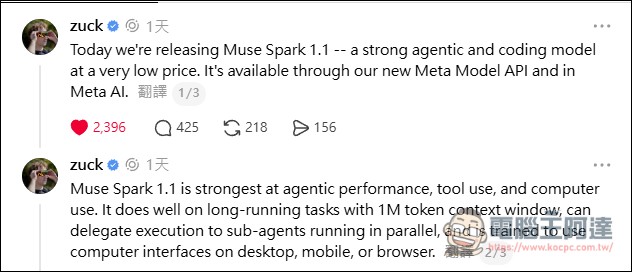
Meta officially unveiled Muse Spark 1.1 on July 10, a major upgrade to the original Muse Spark launched in April this year. Meta simultaneously launched the public preview of Meta Model API, marking the first time in Meta’s history to offer paid model inference services externally. CEO Mark Zuckerberg broke his three-year social media silence to Threads and X He posted that Muse Spark 1.1 is “a powerful agent and code model at a very low price.” His last post on X was in July 2023, demonstrating how seriously Meta is taking this launch.
Pricing strategy: enter the market at a quarter of competitors’ prices
The Meta Model API is priced at $1.25 per million input tokens (approximately NT$41) and $4.25 per million output tokens (approximately NT$138), with each new account receiving $20 (approximately NT$650) in free credits. This pricing is approximately one-quarter of comparable models from Anthropic and OpenAI. The price is similar to Anthropic Claude Haiku 4.5 and OpenAI GPT-5.6 Luna, but slightly higher.
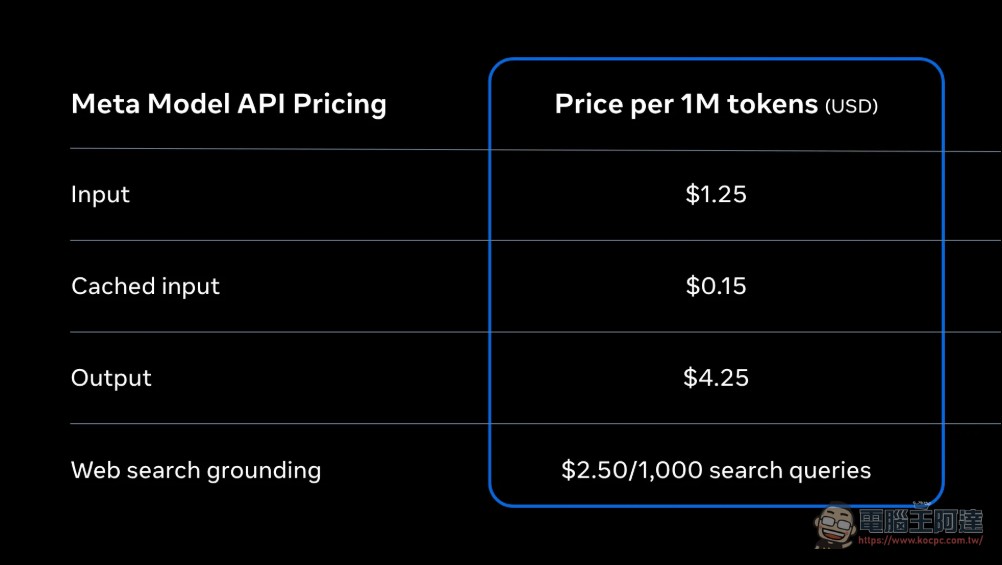
Currently, the API public preview is limited to US developers. The API is compatible with the OpenAI format, supporting structured output and parallel tool calls. On Hacker News, users noted that the cached input rate is approximately $0.15 per million tokens, which is quite attractive for agent applications requiring a lot of repetitive context.
Model Capabilities: Agent Tasks Reign Supreme, Coding Ability Catching Up
Muse Spark 1.1 is a multimodal reasoning model that supports text, image, video, PDF, and audio input, with a context window of up to 1 million tokens and built-in context compression. Compared to the original Muse Spark’s context length of approximately 260,000 tokens, this represents nearly a fourfold increase.
Muse Spark 1.1 has shown impressive performance on agentic task benchmarks. Alexandr Wang, head of Meta’s Super Intelligence Lab, stated on X that Muse Spark 1.1 is on par with GPT-5.5 and Opus 4.8 across multiple agentic evaluations.
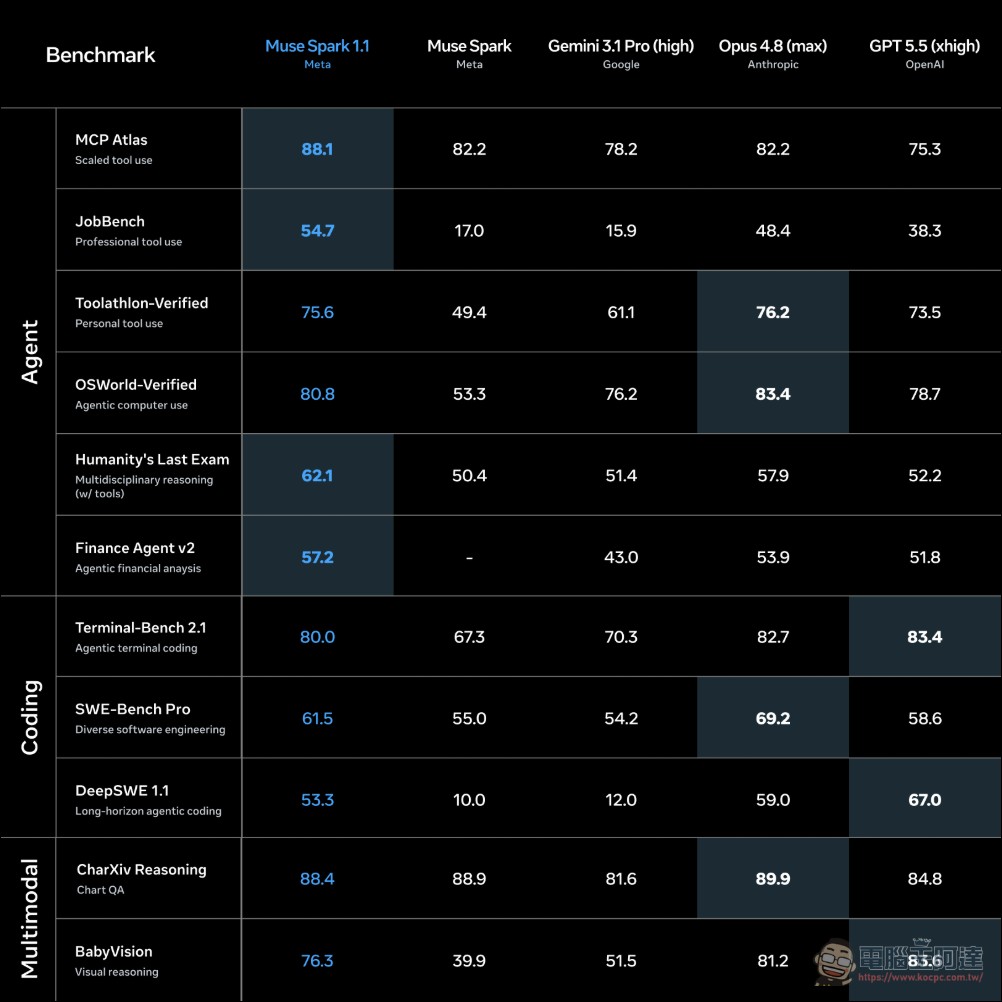
According to Alexadr Wang’s publicly released benchmark comparison charts, Muse Spark 1.1 achieved the best results in 4 out of 11 benchmarks:
- MCP Atlas (Large-Scale Tool Usage)88.1 points, beating Opus 4.8 (82.2) and GPT-5.5 (75.3)
- JobBench (Professional Tool Usage)54.7 points, substantially ahead of Opus 4.8 (48.4) and GPT-5.5 (38.3)
- Humanity’s Last Exam (Multidisciplinary Reasoning, Tool-Augmented)62.1 points, beating Opus 4.8 (57.9) and GPT-5.5 (52.2)
- Finance Agent v2 (Financial Analysis Agent): 57.2 points, surpassing Opus 4.8 (53.9) and GPT-5.5 (51.8)
However, on coding tasks, Muse Spark 1.1 still lags behind the top competitors. It scores 61.5 on SWE-Bench Pro, while Opus 4.8 scores 69.2; on the DeepSWE long-context coding task, version 1.1 scores 53.3, compared to GPT-5.5’s 67.0. But in terms of improvement, the original Muse Spark only scored 10.0 on DeepSWE, while version 1.1 jumped to 53.3—a remarkable leap.
Multi-Agent Orchestration: The Core Design Philosophy of Muse Spark 1.1
The core architectural design of Muse Spark 1.1 revolves around an “orchestrator” role. The model natively supports multi-agent systems, capable of serving as the primary agent that delegates tasks to sub-agents, or acting as a sub-agent callable by other models. In computer use scenarios, the model autonomously decides whether to write scripts or perform operations through UI interactions.
Meta’s developer blog positions Muse Spark 1.1 as a solution for “end-to-end agentic workflows,” emphasizing improved multi-turn memory and long-context coherence. Meta stated: “Muse Spark 1.1 delivers exceptional performance in personal agent tasks that require planning and orchestration across external applications and services.”
Is the Llama Era Over? Meta’s Shift from Open Source to Closed-Source Pricing
Muse Spark 1.1’s release marks a fundamental shift in Meta’s AI strategy. Over the past three years, Meta has been known for its Llama series of open-weight models, freely available to the developer community. Now, Muse Spark 1.1 is a closed-source model offered through a paid API with non-public weights. Meta revealed that Muse Spark 1.1 will gradually replace the Llama models powering WhatsApp, Instagram, Facebook, and Meta smart glasses. Currently, the Meta AI app and meta.ai have already integrated this model in “Thinking” mode.
The same week Muse Spark 1.1 was released, the AI scene was bustling with activity. SpaceXAI launched a new version. Grok 4.5OpenAI also released GPT-5.6 Model family. For developers already accustomed to the OpenAI API format, Meta’s compatible design makes switching costs extremely low. If Muse Spark 1.1 establishes itself in independent code benchmarks, cost-sensitive teams will have an affordable alternative from a hyperscaler for the first time.
Conclusion
Muse Spark 1.1’s agent task benchmark scores are indeed impressive, but there’s still a gap in coding capability. Combined with opacity concerns around model architecture and evaluation methodology, it’s too early to declare it has “surpassed the competition.” What deserves attention is Meta’s strategic intent: the company is no longer content with giving models away for free. Instead, it aims to carve out a path in the paid AI model market through rock-bottom pricing, massive consumer distribution channels, and OpenAI-compatible API formats. For Anthropic and OpenAI, a competitor capable of sustaining zero-profit pricing is the real challenge they need to face.
Source: KOCPC Chinese