


Apple’s relationship with OpenAI has officially shifted from cooperation to confrontation. On July 10, Apple officially filed a lawsuit in the U.S. District Court for the Northern District of California, accusing OpenAI and its head of hardware Tang Tan, along with former Apple electrical engineer Chang Liu, of systematically stealing trade secrets involving over 400 former Apple employees who jumped to OpenAI. This lawsuit marks a significant turning point in the relationship between the two companies, which could potentially cast a shadow over OpenAI’s ongoing IPO preparations and hardware product plans. AppleComplaintChina accuses OpenAI’s hardware business in harsh languageFundamentally corrupt because it illegally relies on stolen trade secretsand demanded that the court prohibit OpenAI from using the stolen confidential information, while also applying for evidence preservation.
Apple officially sues OpenAI! Accuses company of systematic trade secret theft
Apple and OpenAI: From Partners to Courtroom Showdown
Looking back at the relationship between the two companies, in 2024 Apple announced its partnership with OpenAI, integrating ChatGPT into the iPhone’s Siri system as part of Apple Intelligence. At the time, this partnership was seen as a key move for Apple to catch up in the AI field.
However, as OpenAI shifted from a nonprofit to a for-profit model and actively prepared for an IPO, the relationship between the two gradually deteriorated. OpenAI aggressively recruited Apple’s hardware talent, and in 2025 announced a partnership with former Apple Chief Design Officer Jony Ive to develop AI hardware devices, acquiring io Products, the company co-founded by Ive and Don Tann, among others, for approximately $6.5 billion.
In its complaint, Apple stated that it had raised the issue of confidential information leakage discovered during its investigation with OpenAI as early as February 2026, but OpenAI never responded. This prompted Apple to ultimately decide to take legal action.
Tang Tan and Liu Chang: The Two Named Key Figures
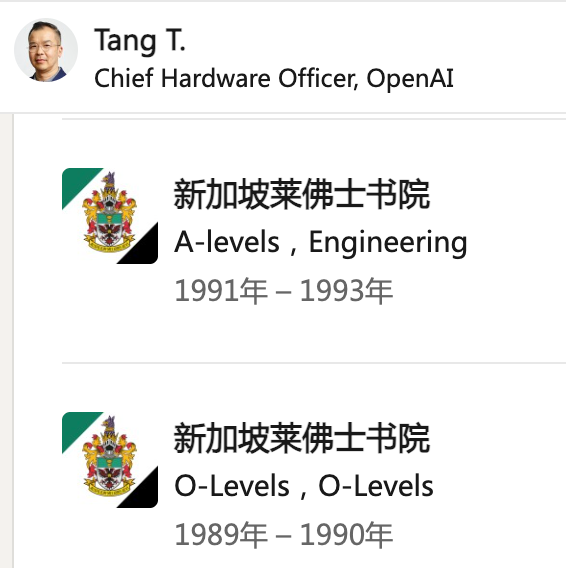
In addition to OpenAI itself, the defendants in this lawsuit include two former Apple employees. The first is Tang Tan, who spent over 20 years at Apple, served as Apple’s Vice President, and contributed to the design and development of the iPhone, Apple Watch, and iPod. He currently serves as OpenAI’s Chief Hardware Officer.
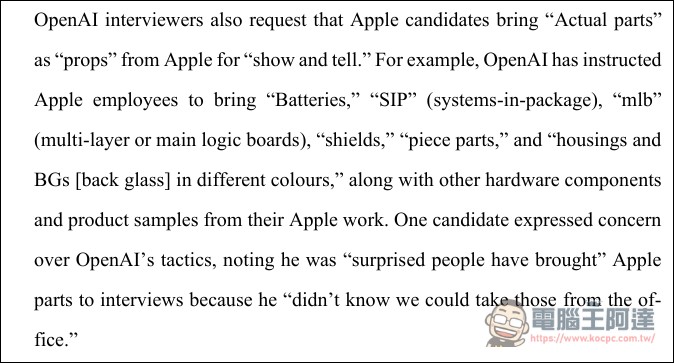
Apple accuses Deng Tan of, prior to his departure, encouraging job candidates still employed at Apple to share information about Apple’s unreleased products during OpenAI interviews, even asking them to bring “actual parts” to the interview site for demonstration. Apple described this behavior as “an organized, systematic theft scheme.”
Another defendant, Chang Liu, was a former Apple electrical engineer who worked at Apple for 8 years and had access to the company’s most sensitive product development information. Apple alleges that Liu downloaded dozens of hardware-related confidential documents before leaving the company and continued to retain an Apple-issued laptop after his departure. More seriously, Apple claims Liu also stole an Apple laptop.
OpenAI’s Hardware Ambitions and Controversies
OpenAI has never explicitly stated what type of hardware device it is developing, but the company has repeatedly expressed that it is exploring entirely new forms of human-computer interaction that “go beyond traditional products and interfaces.” OpenAI CFO Sarah Friar revealed in an interview with the Associated Press in April this year: “We will launch a consumer hardware product by the end of this year.”
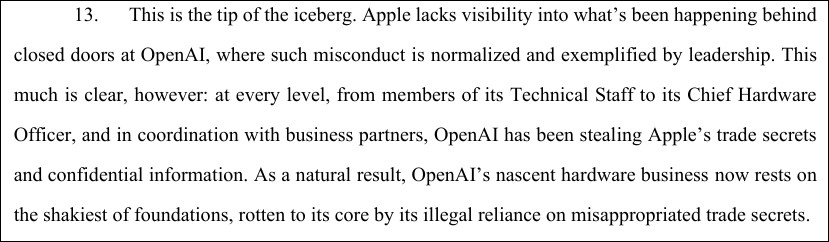
Apple stated directly in the complaint that OpenAI’s hardware business “is built on the most unstable foundation, fundamentally corrupt because it illegally relies on stolen trade secrets.” Apple further accused OpenAI of “taking illegal shortcuts” to launch a hardware product before its IPO.
Looking at the timeline, OpenAI announced its partnership with Jony Ive to develop an AI device in 2025 and acquired io Products, followed by the CFO revealing in April of this year that hardware products would launch by year-end, and then Apple’s formal lawsuit in July. This timeline shows that OpenAI’s hardware development pace has been extremely aggressive. Apple clearly believes that without the confidential information brought by talent poached from Apple, OpenAI could not have completed preparations for hardware product development in such a short time.
This is not the first time Tang Dan has been involved in a trade secrets lawsuit. Previously, a startup called iyO Inc. had filed a trademark infringement lawsuit against Jony Ive and OpenAI CEO Sam Altman, later adding trade secret theft charges against Tang Dan. IyO alleged that its former employee leaked confidential design plans of the company’s unreleased products to OpenAI.
A talent-poaching storm affecting over 400 employees
According to Apple in its complaint, OpenAI has poached more than 400 employees from Apple. What makes Apple even more unhappy is that OpenAI provides “coaching” to Apple employees who are about to jump ship, teaching them not to reveal they’re going to OpenAI before they leave and to download as much of Apple’s internal confidential information as possible before departure. Apple wrote in its complaint: “The core of this case is Apple’s former employees stealing Apple’s trade secrets for OpenAI’s benefit. Apple brings this lawsuit to put an end to all of this.” An Apple spokesperson also stated: “We will always defend our team’s hard work and innovation, and take all appropriate measures to do so.”
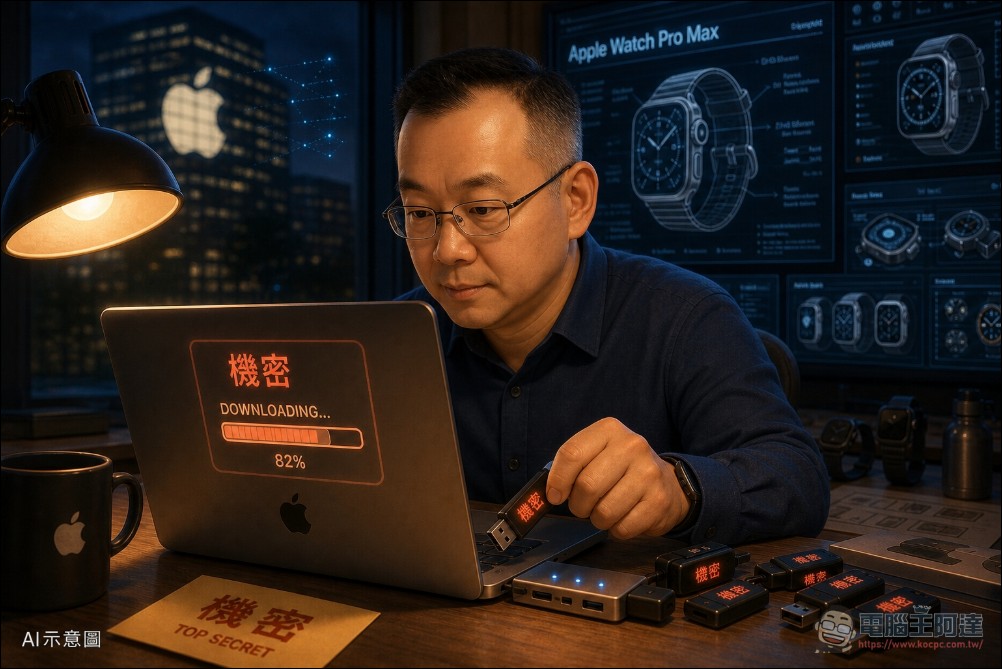
OpenAI spokesperson Drew Pusateri responded: “We have no interest in other companies’ trade secrets. We remain focused on building innovative technology that empowers everyone.” OpenAI said it is still reviewing the complaint and has not yet filed a formal response.
This lawsuit has also sparked widespread discussion in the tech industry. Hacker News Above, many developers were shocked by the accusations against Apple, especially the allegations that Liu Chang retained the Apple-issued laptop after leaving the company, as well as details that Tang Dan required job candidates to bring Apple “actual parts” to the interview. If the allegations in this lawsuit are proven true, they would go far beyond ordinary talent competition, reaching the level of criminal commercial secret theft.
Conclusion
This lawsuit comes at an extremely sensitive time, with OpenAI evaluating whether to go public on Wall Street while facing fierce competition from rivals like Anthropic and Google. Apple’s lawsuit could affect OpenAI’s IPO valuation and directly impact the launch timeline of its hardware products. On the other hand, this also reflects how the AI industry’s talent war has escalated from behind-the-scenes poaching to public legal battles. From the 2024 announcement of Apple and OpenAI’s partnership to integrate ChatGPT into the iPhone, to now facing each other in court, the relationship has taken a dramatic turn in just two years. For OpenAI, balancing hardware innovation with maintaining ethical business practices will be a severe test it must face on the eve of its IPO.