


Driven by the AI boom, the global memory market has been climbing steadily from late 2025 to mid-2026, with Samsung, SK Hynix, and Micron’s stock prices all hitting record highs, while DRAM, NAND Flash, and HBM quotes have also surged. Bloomberg Intelligence analyst Shuli Ren recently published a report titled “Memory Shortage Won’t Last Forever,” explicitly stating that this round of shortages will peak in Q2 2026, begin stabilizing in Q1 2027, and could see overcapacity as early as 2028. This stance puts her in direct conflict with executives at several major memory makers and Wall Street bulls, adding fresh uncertainty to memory stocks that have pulled back significantly in recent sessions.
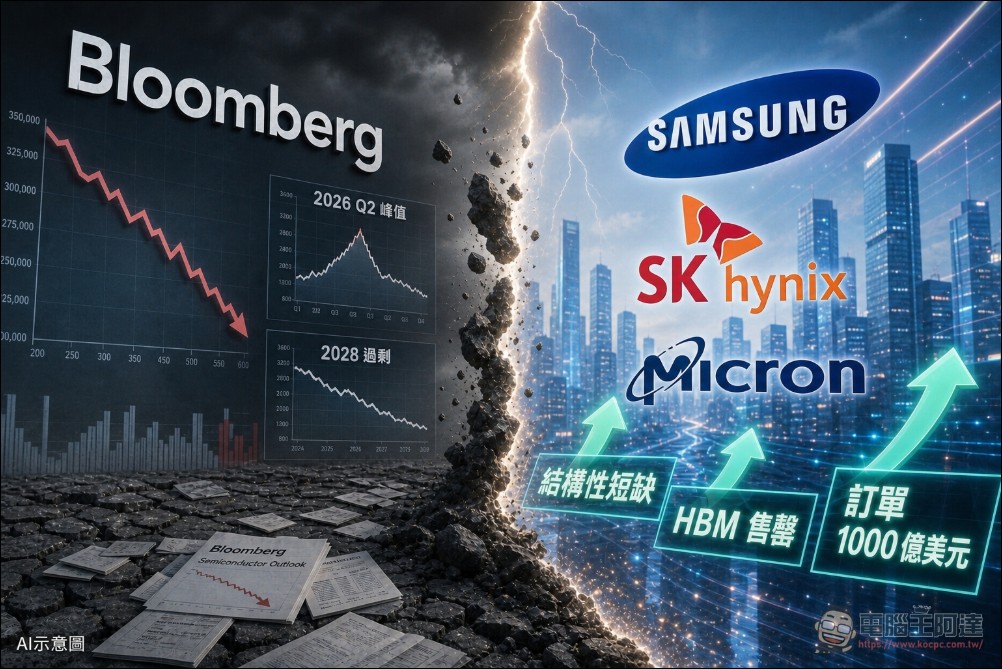
Bloomberg pours cold water: Memory chip shortage won’t last forever, set to stabilize in 2027, oversupply risk in 2028
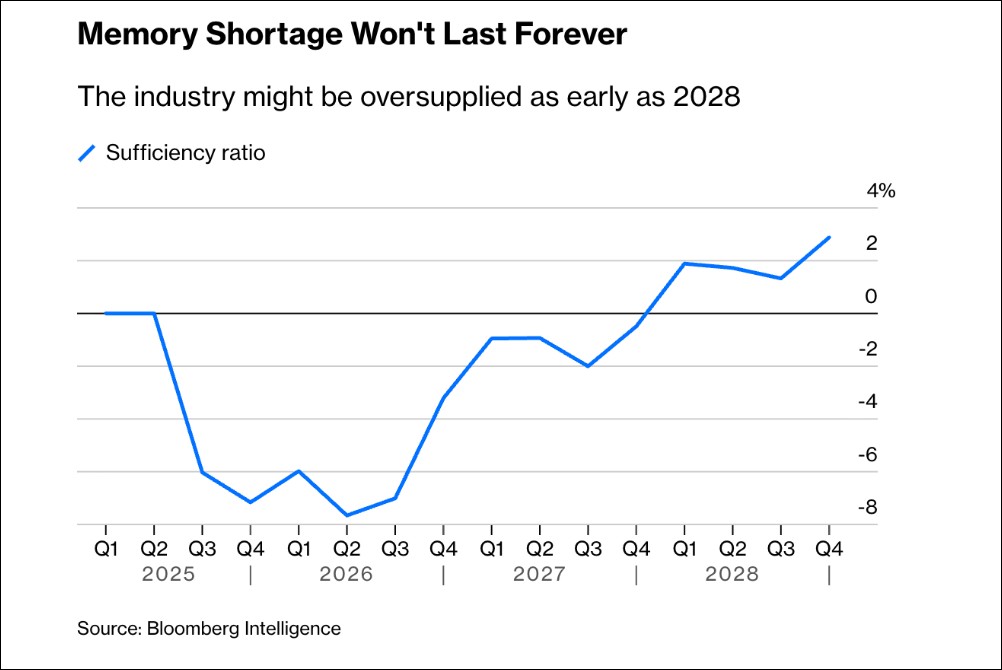
In her report, Shuli Ren emphasizes that the memory industry’s fundamental nature hasn’t changed due to AI—it remains a classic “Boom and Bust” cyclical industry. She argues that while DRAM, NAND Flash, and high-bandwidth memory (HBM) are currently simultaneously constrained, with prices continuing to surge, this round of supply tightness has already reached its peak in Q2 2026. As new production capacity gradually comes online from H2 2026 through H1 2027, market supply pressure will ease at an extremely rapid pace. Bloomberg’s “Sufficiency Ratio” curve indicates that supply-demand balance is expected to be achieved in Q4 2027, potentially shifting to oversupply in 2028.
The timing of this report’s release is quite precise. In early July, Michael Burry—the protagonist of “The Big Short”—disclosed on Substack that he had shorted Micron Technology, citing the unchangeable cyclical nature of the memory industry. Shuli Ren also directly responded to Burry’s view in her article, arguing that memory stocks’ tendency to be “overhyped during booms and oversold during busts” will likely prove true once again.
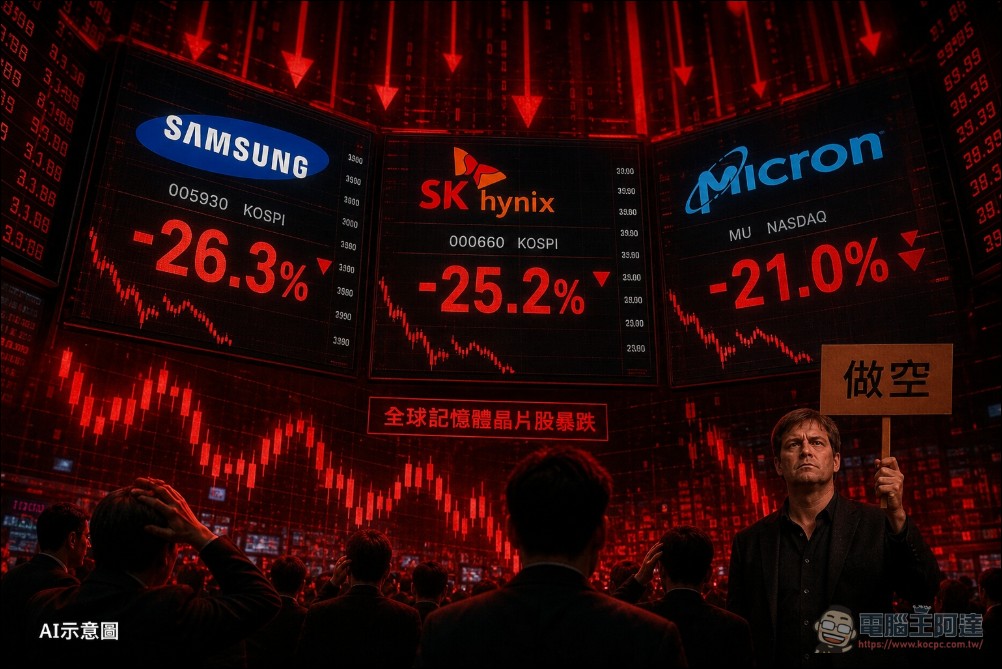
Market Votes with Its Feet: Memory Stocks Plunge Into Technical Bear Market
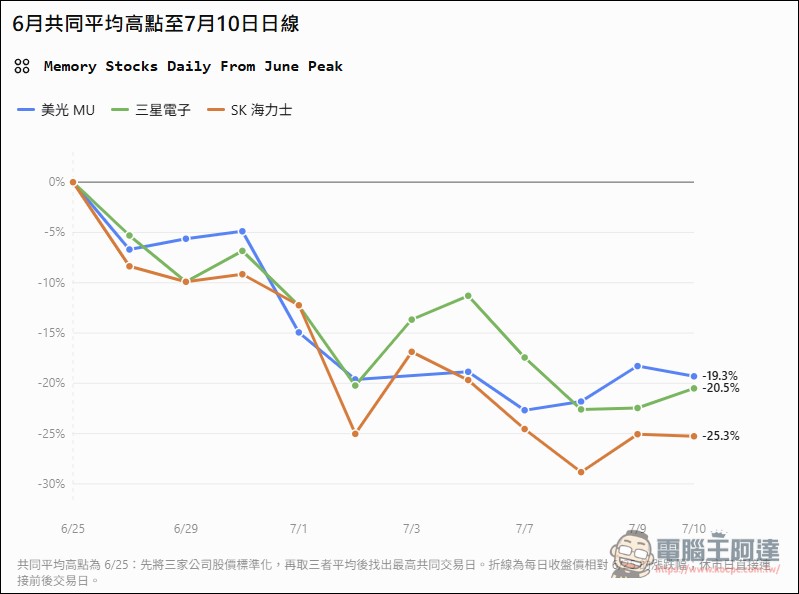
Investor concerns about a cyclical reversal have already been priced into the stock prices. As of early July 2026, Micron, Samsung Electronics, and SK Hynix have all fallen more than 20% from their recent highs, officially entering technical bear market territory. SK Hynix has pulled back about 26.3% from its peak, Micron has dropped 25.2%, and Samsung Electronics has declined 21.0%. In just seven trading days since June 25, the semiconductor sector’s total market capitalization evaporated by approximately $1.5 trillion (about NT$48 trillion), with Micron alone seeing its market cap shrink by nearly $350 billion (about NT$11.2 trillion).
This selloff wasn’t triggered by an earnings miss. Samsung Electronics’ Q2 operating profit is estimated at $59 billion (about NT$1.9 trillion) and sales at $113 billion (about NT$3.6 trillion), yet the data release actually sparked profit-taking pressure. Historically, memory stock pullbacks would quickly attract dip buyers, but this decline has been longer and deeper, with market valuation standards for AI themes having shifted.
Big Tech and Wall Street Bulls: Structural Shortage Expected to Persist
Compared to Bloomberg’s conservative forecasts, memory suppliers and some analysts continue to insist on a “structural shortage” narrative. Micron CEO Sanjay Mehrotra stated during the company’s June 2026 earnings call that it has signed 16 strategic customer agreements (SCAs), with an order backlog of approximately $10 billion (approximately NT$32 trillion), and that HBM capacity is nearly sold out, with memory supply tightness expected to persist beyond 2027. Intel CEO Lip-Bu Tan stated publicly in February 2026 that after speaking with executives from two major memory makers, his conclusion was: “As far as I know, there are no signs of relief before 2028.” SK Group Chairman Chey Tae-won also noted in March that the global chip shortage could persist until 2030.
UBS’s “Memory Chip Monthly Report” published in July also holds a bullish outlook, projecting that global memory market monthly sales will reach a record high of $74.6 billion (approximately NT$24 trillion) in June 2026, with structural supply shortages not expected to ease until mid-2028 at the earliest. UBS forecasts that global memory industry revenue will reach $992 billion (approximately NT$31.7 trillion) in 2026, and surge to approximately $1.76 trillion (approximately NT$56.3 trillion) in 2027. HBM demand is projected to grow 90% year-over-year in 2026, followed by another 77% increase in 2027.
Capacity Expansion: 2027–2028 Is When Supply Will Actually Be Released
Regardless of cycle assessments, the industry consensus is that significant new capacity is on the way, but production timelines are concentrated in 2027 to 2028. The South Korean government announced at the end of June that Samsung and SK hynix would jointly invest 800 trillion won (approximately $518 billion, approximately NT$165.8 trillion) to build a semiconductor cluster in southwestern South Korea, with the goal of doubling DRAM production capacity by 2030. Micron announced in early July a 1.5 trillion yen (approximately $9.3 billion, approximately NT$298 billion) investment for HBM expansion at its Hiroshima, Japan facility, with production expected to start in summer 2028. The new Idaho, USA fab is projected to begin production by mid-2027, while the New York site will not contribute to capacity until 2028–2030. SK hynix’s new fabs in Cheongju, South Korea and Indiana, USA are also expected to be completed by the end of 2028.
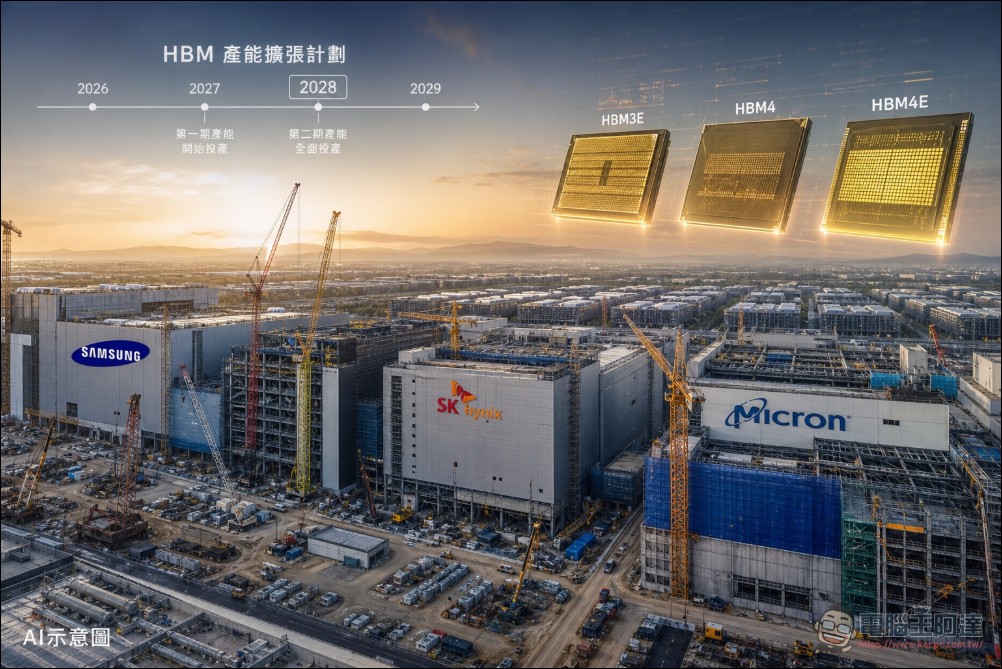
Looking at the timeline, this new capacity falls right into Bloomberg’s predicted window of “stabilization in 2027, oversupply in 2028.” Shuli Ren’s assessment is that high prices have already significantly stimulated capital expenditure. Although fab construction cycles run three to five years, previously planned projects will gradually contribute output in 2027-2028. At the same time, the initial explosive buildout of AI infrastructure may also slow down on a阶段性 basis.
Conclusion: Bulls and bears are locked in a fierce battle, and the showdown between cycles and structures is only just beginning.
Bloomberg’s report has injected a “cycle reality check” into the market, reminding investors that the memory industry has never been one of “eternal shortage” or “eternal oversupply.” On the other hand, rigid AI demand for HBM, the lock-in effects of long-term supply agreements from the three major manufacturers, and the reality that large-scale new production capacity has yet to come online also make the “structural shortage” narrative hard to overturn in the short term. For PC gamers and general consumers, memory and SSD prices are unlikely to decline in the near term. Most of the new production capacity from Micron, Samsung, and SK Hynix is aimed at AI-used HBM rather than traditional PC DRAM, meaning relief for consumer-grade memory prices may not arrive until 2028 or even later.
Source: KOCPC Chinese