


Recently (February 2026), a revolutionary research achievement from a Chinese academic team has stunned the AI image generation field. Developed jointly by researchers including Yuang Ai and Jiaming Han, among others, BitDanceis an open-source autoregressive image generation model with 14 billion parameters. Through its innovative “binary visual token” technology, the model not only achieved an outstanding score of 88.28 on the DPG-Bench benchmark, but also achieved up to 30x generation accelerationpaving the way for efficient, high-quality visual content creation.

Core Technology Breakthrough: Three Major Innovations in Binary Token
BitDance’s technical architecture is built on three key innovations that collectively address the long-standing bottlenecks faced by traditional discrete autoregressive models in visual generation:
1. Large-Vocabulary Binary Tokenizer
Traditional visual generation models (such as VQ-GAN) typically rely on a massive vocabulary of over 16,000 indices to represent image tokens, which is not only computationally expensive but also slow to generate. BitDance adopts a novel binary representation approach that compresses visual information into binary codes.
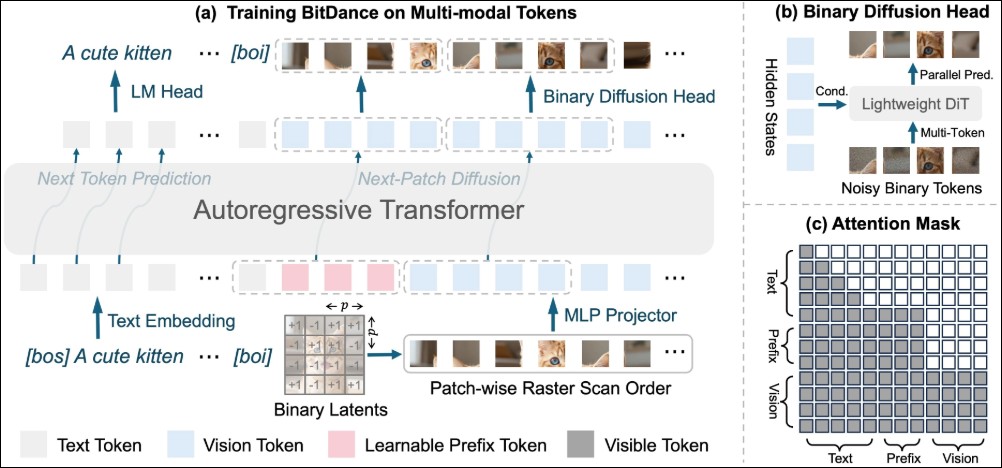
This design allows each Token to represent up to 2256 This state creates a discrete representation that is both compact and highly expressive. The research team likens it to going “from a heavy oil painting to rapid Morse code”: preserving semantic information while dramatically reducing the “weight” of the data.
2. Binary Diffusion Head
Sampling from such a vast discrete space poses significant challenges for traditional classification methods (softmax). BitDance innovatively adoptsBinary diffusion headInstead of trying to predict floating-point values, it generates binary tokens through continuous-space diffusion techniques.
This approach enables the model to efficiently handle discrete binary states, transforming the originally complex sampling problem into a series of fast binary decisions, significantly improving generation efficiency.
3. Next-Patch Diffusion Paradigm
This is the key to BitDance achieving 30x acceleration. Traditional autoregressive models use sequential generation and can only predict one token at a time, whereas BitDance’s next-block diffusion technology allows the modelAt each step, predict up to 64 visual tokens in parallel.。
This kind of parallel prediction capability completely shatters the sequential bottleneck of autoregressive models. Taking the generation of 1024×1024 resolution images as an example, traditional models may require thousands of generation steps, whereas the BitDance-14B-64x version completes the task in just 64 steps—a qualitative leap.
Performance: Beyond the Industry Benchmark
BitDance has demonstrated exceptional generative capabilities across multiple authoritative benchmarks:
- DPG-BenchObtain 88.28 pointssurpassing mainstream open-source models such as FLUX.1 Dev (83.84 points), and even approaching commercial closed-source models such as GPT Image 1 (85.15 points) and Seedream 3.0 (88.27 points)
- GenEvalAchieved a score of 0.86, demonstrating excellent text alignment capability.
- ImageNet 256×256The FID score reached 1.24, representing the best performance among all autoregressive models.
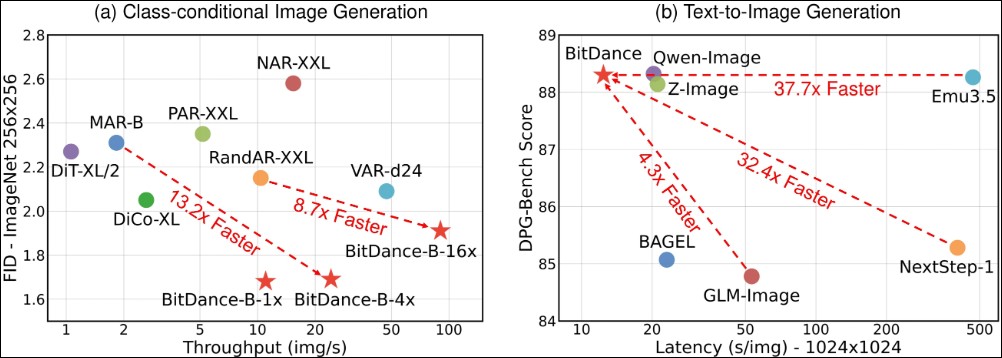
More notably, BitDance achieves top-tier performance while maintaining extremely high parameter efficiency. Studies show that when using next-block diffusion technology, BitDance requires only 260 million parameters (260M) to surpass parallel autoregressive models using 1.4 billion parameters (1.4B), while also delivering an 8.7x speed improvement.
According to the officially released examples, the model can generate images of very high quality and varied styles (realistic, anime, …), and can correctly generate text including Chinese:
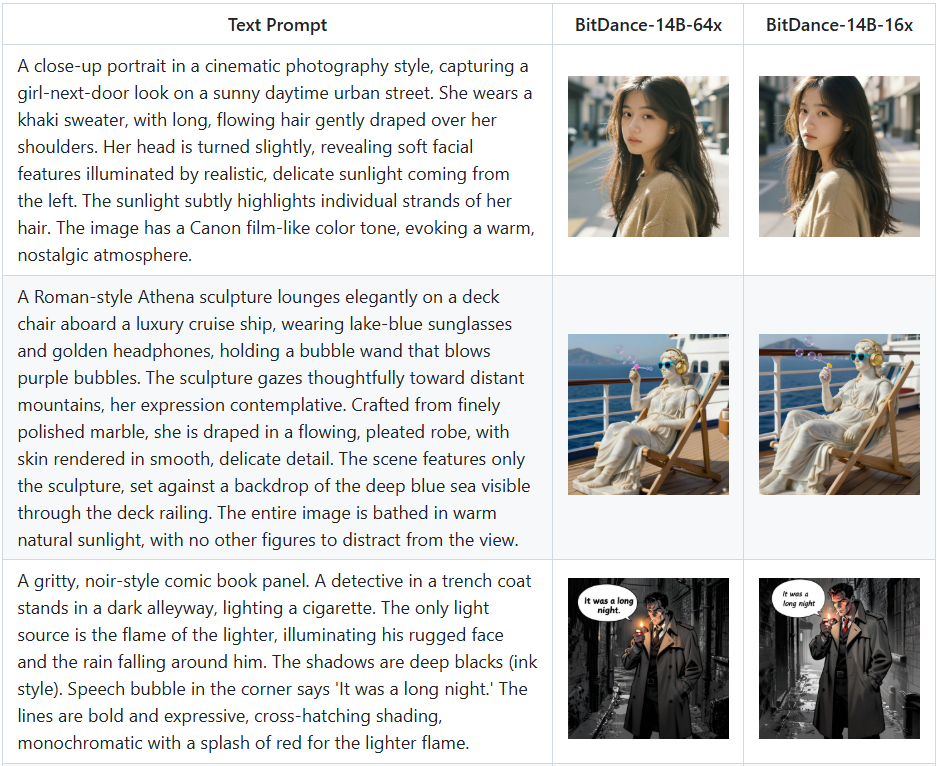
Official example:
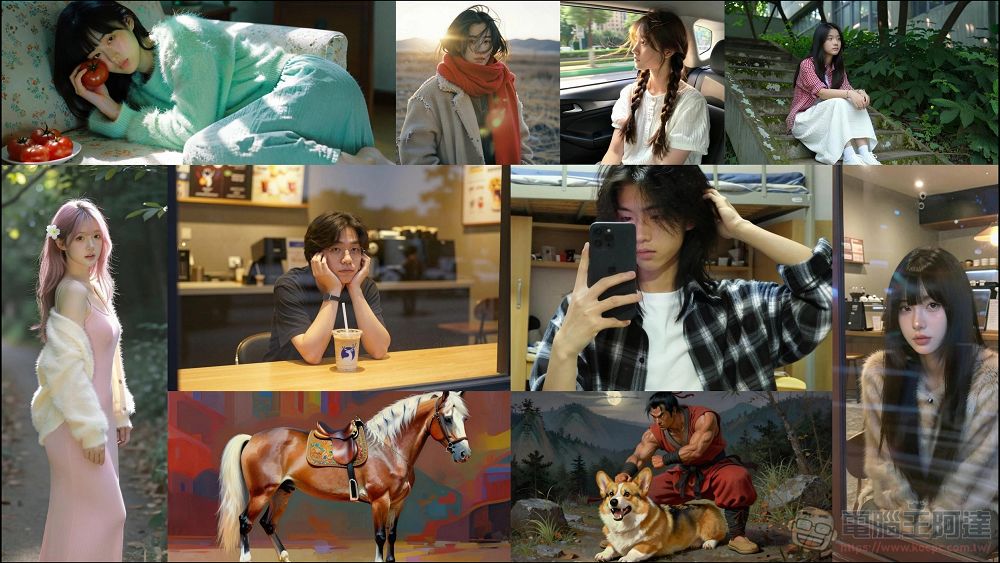


Open-Source Ecosystem: Apache 2.0 Licensing Drives Community Development
BitDance adopts Apache 2.0 open-source license, the research team has already Hugging Face and GitHub It has fully released the model weights, training code, and inference examples. Two main versions are currently available:
- BitDance-14B-64xPredicting 64 tokens per step, generating a 1024×1024 image requires only 64 steps.
- BitDance-14B-16xEach step predicts 16 tokens; generating a 1024×1024 image requires 256 steps, and supports 512px and 1024px resolutions.
Developers can deploy this full 14-billion-parameter model locally on standard consumer-grade GPUs such as the RTX 3090/4090, thanks to the memory bandwidth optimization brought by its binary tokens.
Industry Significance: A New Dawn for Edge AI
The emergence of BitDance marks a new stage in the AI efficiency revolution. While the industry is focused on quantizing large language model weights down to 1-bit (such as Microsoft’s BitNet b1.58), BitDance extends this “minimalist philosophy” to the data representation layer: the visual tokens themselves.
This binary-native design significantly reduces memory bandwidth requirements, not only dramatically lowering cloud server computing costs but also laying the groundwork for running high-quality multimodal AI agents on laptops and even smartphones. When 1-bit weights, binary tokens, and sparse attention mechanisms come together, we may be witnessing the embryonic form of the next generation of AI architectures.
Conclusion
BitDance is not only a high-performance image generation model, but also a fundamental rethinking of the traditional autoregressive visual generation paradigm. By embracing the simplicity of binary representation, the research team demonstrated the massive efficiency waste inherent in “standard” methods and opened a new era in which extremely fast generation can be achieved without specialized hardware.
For developers, BitDance’s code is now open, the model is available for download, and the speed gains are real and measurable. This visual generation revolution driven by binary tokens has only just begun—anyone with the interest and capability can download and test it for themselves.
Source: KOCPC Chinese