


Google CEO Sundar Pichai recently dropped a bombshell at the “AI Impact Summit” in New Delhi: officially launching an infrastructure initiative named “America-India Connect.” The plan will invest a staggering amount between 2026 and 2030. US$15 billion (approximately NT$480 billion)The goal is to establish an unprecedented “digital corridor” in the Southern Hemisphere, thereby narrowing the global “AI divide.”
At the AI impact summit our message is clear: we believe India is going to have an extraordinary trajectory with AI, and we want to be a partner.
To help, we have launched new America-India Connect subsea cable routes building on our $15B investment in India’s infrastructure,… pic.twitter.com/pb0xH9XbgX
— Sundar Pichai (@sundarpichai) February 18, 2026
Core Highlight of US-India Connectivity: Gigawatt-Scale AI Data Center Parks
What has drawn the most attention this time is not just the undersea cables, but rather Google’s collaboration with the Indian telecom giant. Bharti Airtel Infrastructure built together:
- gigawatt-scale hubGoogle plans to build its first global large-scale AI data center campus in Visakhapatnam (Vizag), eastern India.
- Cross-sea computing power transmissionTo support this massive compute center, Google will add three new subsea cables connecting India with Singapore, South Africa, and Australia. This will make Vizag the third internationally resilient digital gateway in India, after Mumbai and Chennai.
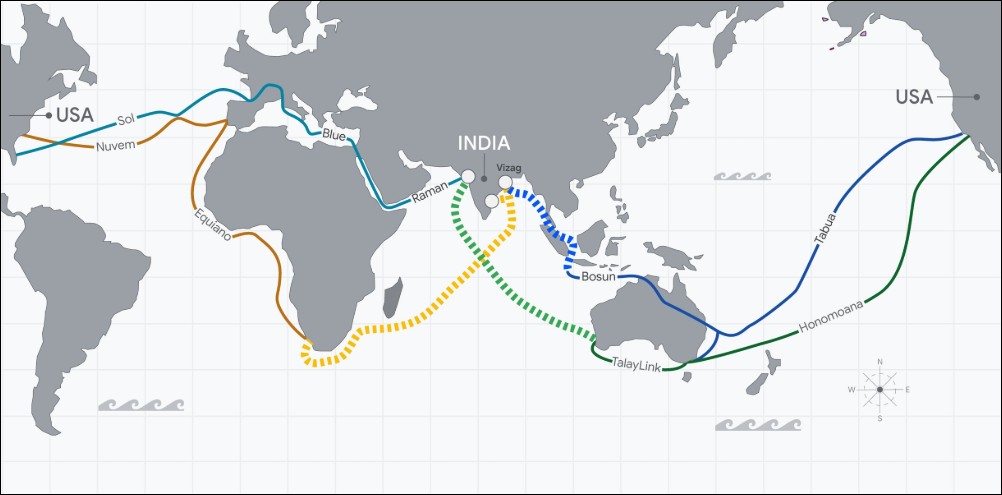
The Southern Hemisphere’s “Data Detour”: Avoiding Geopolitical Risks
The undersea cable route design for this project is of great strategic significance:
- Africa redundant lineA route from the US East Coast that bypasses Africa (combining the Equiano and Nuvem systems) to reach India directly, effectively avoiding the sensitive Red Sea or Middle East regions.
- South Pacific Data CorridorCombining the Bosun and Tabua subsea cable systems creates a direct route from the U.S. West Coast through Australia to India. This layout means Google is building a “Southern Hemisphere backup network” that does not rely on traditional Northern Hemisphere routing paths.
In addition to hardware investments, Google announced a partnership with the Indian government to bring its AI technology into the “Karmayogi Bharat” training platform. Using AI to support 18 Indian native languages, the initiative will provide digital skills training to more than 20 million government workers nationwide, and is seen as a long-term investment by Google to deepen its presence in the Indian market and build an AI ecosystem. Given that Google CEO Sundar Pichai himself is Indian, the move is also widely viewed as a natural one.
point of view / perspective / viewpoint
Google’s latest move signals that it is shifting the center of gravity for AI computing power southward. In the past, the global internet data backbone was mainly concentrated in Europe, the United States, and the northern Asia-Pacific route, but with the explosive growth of AI demand in Southeast Asia and India, building a highly resilient Southern Hemisphere backbone spanning four continents has become inevitable. The $15 billion investment is not just about buying submarine cables—it is about securing the “transit rights” for global AI computing power over the next decade, and preparing for India’s future AI applications and growth by claiming an early ticket to that explosive expansion.
Source: KOCPC Chinese