


One of AI’s greatest significances may be helping humanity solve difficult mathematical problems and conjectures. OpenAI recently announced that its latest model, GPT-5.6 Sol Ultra, working with 64 subagents running in parallel, completed the full proof of the Cycle Double Cover Conjecture in less than an hour. This graph theory problem, proposed in 1973, has remained unsolved for more than half a century. OpenAI researcher Ethan Knight announced the achievement on the X platform, simultaneously releasing the full proof text and the prompt PDF used to generate the proof. However, this proof has not yet undergone formal peer review, and the mathematics community is maintaining a cautious attitude.
Yesterday, we made GPT-5.6 Sol Ultra generally available. Today, we’re sharing that it produced a proof of the 50-year-old Cycle Double Cover Conjecture using 64 subagents in just under one hour. We’re sharing the prompt and proof below. We’re excited to see what you all do with…
— Ethan Knight (@__eknight__) July 10, 2026
What is the cyclic double cover conjecture?
The Circular Cycle Double Cover Conjecture was independently proposed by mathematicians George Szekeres in 1973 and Paul Seymour in 1979. The central question of this conjecture is: for any bridgeless graph (a graph that does not become disconnected by removing any single edge), does there always exist a collection of cycles such that every edge in the graph appears in exactly two of these cycles?
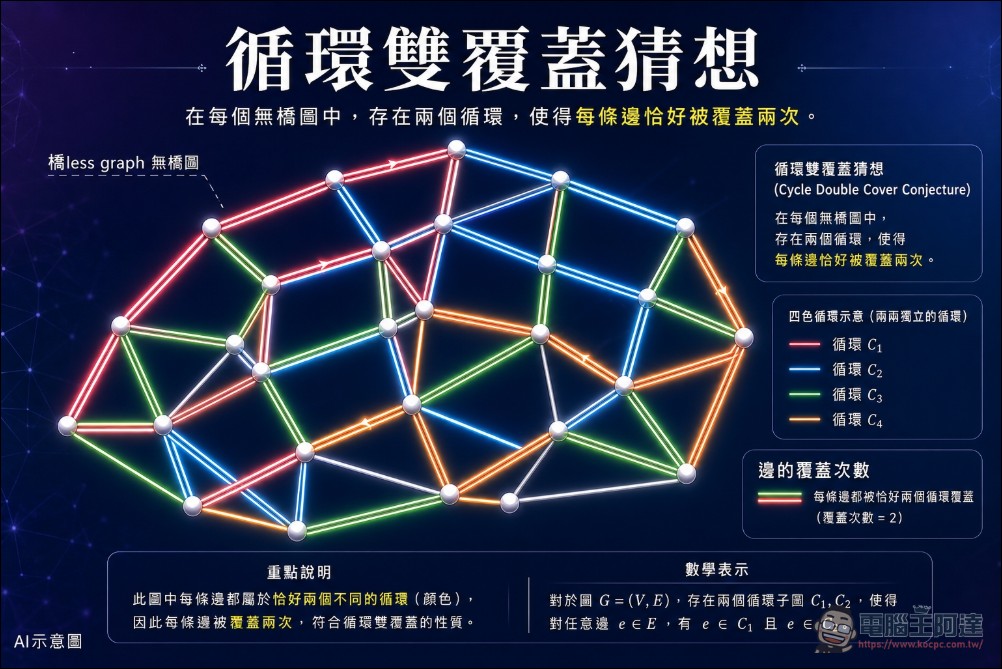
In simpler terms: In a network of nodes and edges, can we find a set of cycles such that each edge is traversed exactly twice? This might sound straightforward, but it has stumped mathematicians for over 50 years.
Over the past several decades, mathematicians have made partial progress on special cases, such as planar graphs, 3-edge-colorable cubic graphs, and graphs without Petersen subdivisions, but the general case has remained completely unsolved. Open Problem Garden lists this conjecture as one of the most important unsolved problems in graph theory.
The key steps of the proof
According to what OpenAI has published, the verification of GPT-5.6 Sol Ultra primarily involves the following steps:
- Reducing the original conjecture to a cubic graph problem
- Using the 8-flow theorem
- Constructing Edge Labelings via Linear Algebra over GF(3)
- Finally, it is proved that every edge can belong to exactly two cycles.
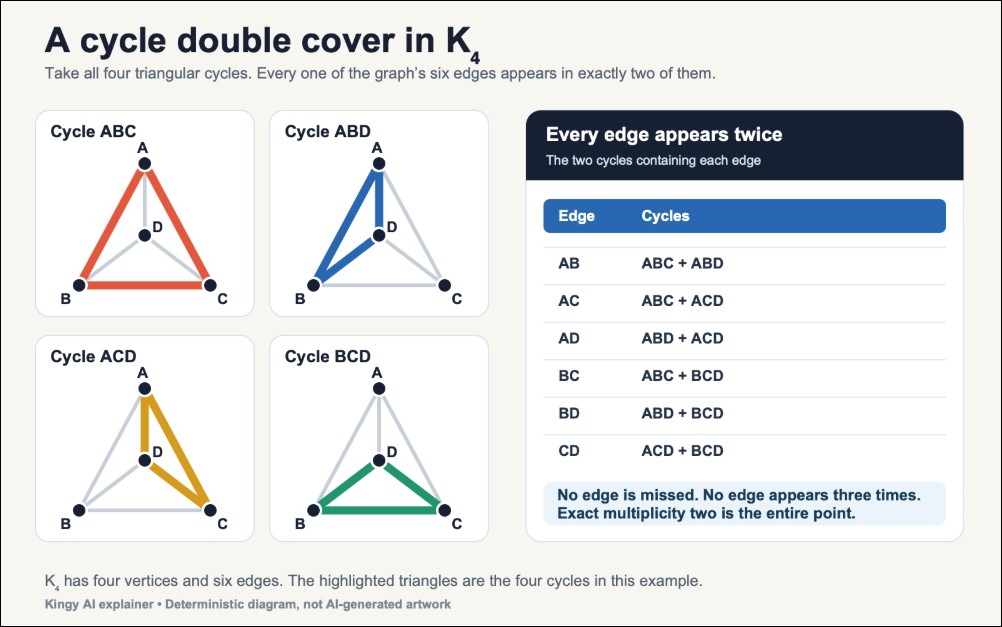
Full certificateIt’s only three pages, and the mathematical tools used are mostly classical methods that have existed for decades. British mathematician Thomas Bloom at the University of Manchester was the first scholar to publicly evaluate this proof. He considered it “a very beautiful proof”—concise, fundamental, and using methods that are not complicated. “If someone had thought of this back then, it could have been proven in the 1980s.”
How do 64 sub-agents collaborate
The most striking thing about this demonstration is not just the result, but also the prompt design behind it. OpenAI has releasedPromptsModel requirements:
- Up to 64 parallel sub-agents can be invoked simultaneously
- Dynamically manage the tasks of each intelligent agent without fixed role assignments
- During the early stages, maintain diverse research directions, allowing different intelligent agents to explore different mathematical representation methods, algebraic approaches, and structural induction techniques respectively.
- Deploy dedicated adversarial agents responsible for uncovering vulnerabilities, edge cases, and potential errors
- Prohibit internet searches for information
- Reject proof of only special circumstances or incomplete proof
- Must use adversarial validation to check for common mathematical errors
The prompt explicitly required the model to run for at least 8 hours before giving up, but it ultimately completed in only about 1 hour. Human mathematicians typically try a natural approach and would likely give up after failing, but AI doesn’t get discouraged and continues trying various small variations until it finds a viable path.
Reactions and Concerns from the Mathematics Community
Although Bloom gave a positive evaluation, he also pointed out several obvious problems. First, the entire proof doesn’t cite any existing literature. The classic 1983 paper by Bermond, Jackson, and Jaeger made significant contributions to this field and should have been cited, yet it doesn’t appear at all. Bloom believes this is a common flaw in AI-generated math papers: they use ideas and proof strategies from the literature but don’t provide proper citations.
The more fundamental issue is that this proof has not yet undergone formal peer review. The Circular Double Cover Conjecture has seen numerous purported “proofs” in the past, and there have been many papers on arXiv claiming to have completed the proof, only for flaws to be later discovered, with some ultimately retracted. Additionally, this proof has not been machine-verified using formal proof assistants such as Lean. Experts note that the current formal mathematical libraries related to graph theory are still insufficient to support such complex research-level theorems.
Uploading a PDF to a company’s CDN and formally publishing a peer-reviewed mathematical paper are two entirely different things. Graph theory experts are expected to rigorously scrutinize every step of the proof over the coming days to weeks.
Inference Cost and Technical Details
According to industry estimates, the computational resource cost consumed for completing this inference is approximately:
- According to OpenAI’s official pricing: approximately $275 to $485 (approximately NT$8,900 to NT$15,700)
- When using the Cerebras platform: up to $13,000 USD (approximately NT$420,000)
The system originally allocated 8 hours of computation time, but ultimately took only about 1 hour. The proof writing was assisted by Codex working with GPT-5.6 Sol, while the mathematical content is entirely credited to GPT-5.6 Sol Ultra.
The Significance of AI’s Mathematical Abilities
If ultimately verified, this would mean that large language models have independently solved for the first time an important problem on Wikipedia’s “Unsolved Mathematical Problems” list. Previous significant achievements of AI in mathematics, such as DeepMind’s research on the Cap Set Problem and breakthroughs in Knot Theory, were all completed through human-AI collaboration, rather than the AI independently completing a full proof.
Bloom compares this result to OpenAI’s recent solution to the unit distance conjecture—both are open problems where “the answer turned out to be much simpler than expected.” Neither requires entirely new mathematical theories, just existing mature tools combined with substantial patience and perseverance. He expects AI systems to continue cracking more similar conjectures, “those problems that only need existing mature theory plus lots of patience and belief.” But this “probably only accounts for a small fraction of unsolved problems, and we can’t know in advance which ones they’ll be.”
This has also sparked a fundamental debate: Is AI merely “recombining” existing knowledge, or is it truly “creating” new mathematics? Bloom leans toward the former, but regardless, the persistent trial-and-error ability AI displays genuinely surpasses the tolerance limits of human mathematicians when faced with failure.
Conclusion
GPT-5.6 Sol Ultra’s proof of the Circular Double Cover Conjecture marks a significant milestone for AI in pure mathematical reasoning. Whether this proof ultimately passes peer review or not, it has already demonstrated the potential of multi-agent collaborative systems in solving long-standing mathematical problems. The mathematical community is currently subjecting the proof to rigorous scrutiny, with initial results expected within a few weeks. Until then, the status of this proof remains “worth watching but not yet confirmed.”