


Apple launches NT$19,900 MacBook Neo After that, it quickly aroused a lot of discussion. One of the most frequently mentioned issues is that this laptop only offers 8GB of memory, and there is no upgrade option. For many users who are accustomed to high memory configurations, such specifications are inevitably confusing, and some even question them. Apple Is it deliberately “shrinking” in order to reduce costs?
However, foreign media pointed out that things are not that simple. The memory limitations of MacBook Neo have a lot to do with the packaging design of the A18 Pro chip, from chip architecture to DRAM cost to product development schedule, all affecting the final specifications. What seems like a simple memory capacity actually involves multiple factors such as chip engineering and supply chain, making this entry-level Mac even more worthy of in-depth discussion.

▲Picture source:Apple
Why does MacBook Neo only have 8GB of memory? Foreign media reveals the real reason behind A18 Pro’s architectural limitations
When Apple officially launched the MacBook Neo, one of the biggest draws was the price. This oneLaptopFocusing on the entry-level market, the starting price is only NT$19,900, which is significantly cheaper than the MacBook Air and has attracted many people’s attention again. Mac entry threshold.
However, after the specifications were released, many users quickly discovered a problem. The MacBook Neo only has 8GB of memory, and there’s no upgrade option. For today’s increasingly memory-hungry application environments, 8GB seems a bit conservative, which has triggered a lot of discussion.
According to foreign media wccftech According to analysis, this limitation is not actually Apple’s simple desire to save costs, but is closely related to the design of the A18 Pro chip.

▲Picture source:Apple
A18 Pro adopts special packaging design
A18 Pro is a mobile chip launched by Apple in 2024. It will initially be mainly used in the iPhone 16 Pro series. This chip uses TSMC’s InFO-POP packaging technology, whose full name is Integrated Fan-Out Package on Package.
Simply put, this design stacks DRAM memory directly on top of the chip, allowing the processor and memory to form an integrated package. This design can make the overall size smaller, while also improving signal efficiency and power consumption performance, so it is very suitable for devices with limited space such as mobile phones.
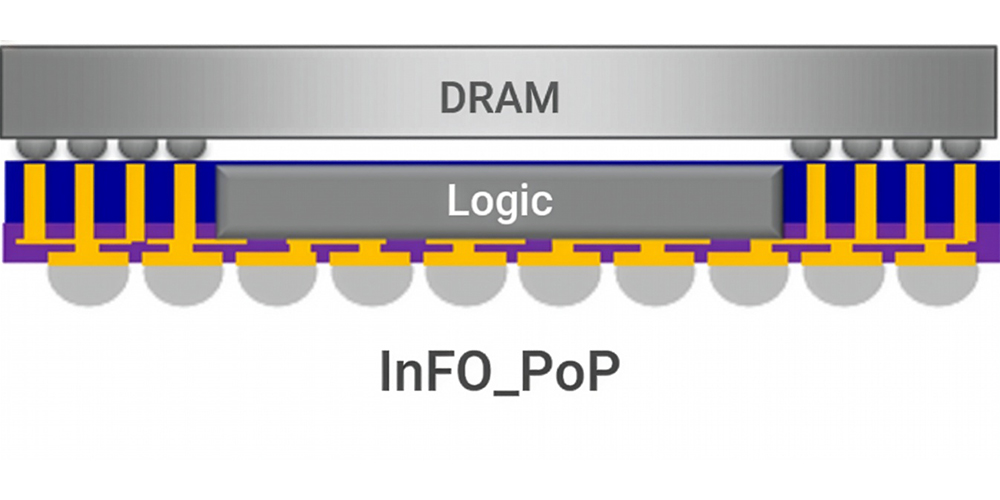
▲Picture source:High Yield (X/ @highyieldYT)
However, this design also brings a result, that is, the memory does not exist independently on the motherboard like traditional computers, but is almost integrated with the chip. In other words, once the chip packaging is completed, the memory capacity is basically fixed and it is difficult to adjust it later in the product design.
Why can’t it be changed to 12GB memory?
Many people will be curious, if it is just a capacity issue, can Apple directly replace 8GB with 12GB? In theory it is possible, but the problem is the cost.
Some analysts pointed out that if Apple chooses to match 12GB of memory in the A18 Pro package, the price of MacBook Neo may not be maintained at NT$19,900. For a product that focuses on the entry-level market, price is actually one of the most important competitiveness.

▲Picture source:Apple
In addition, the DRAM market supply has not been loose in recent years. Estimates suggest that a 12GB set of LPDDR5X memory costs around $70. If such a configuration is imported into MacBook Neo, it will not only increase the overall cost, but may also affect the market positioning of the entire product. Therefore, from a product strategy perspective, 8GB memory is actually the result of a balance between cost and performance.
Why not A19 Pro?
Another question often asked is, since the A19 Pro already comes with 12GB of memory, why doesn’t Apple just use this chip? The reason is actually related to the product development schedule.
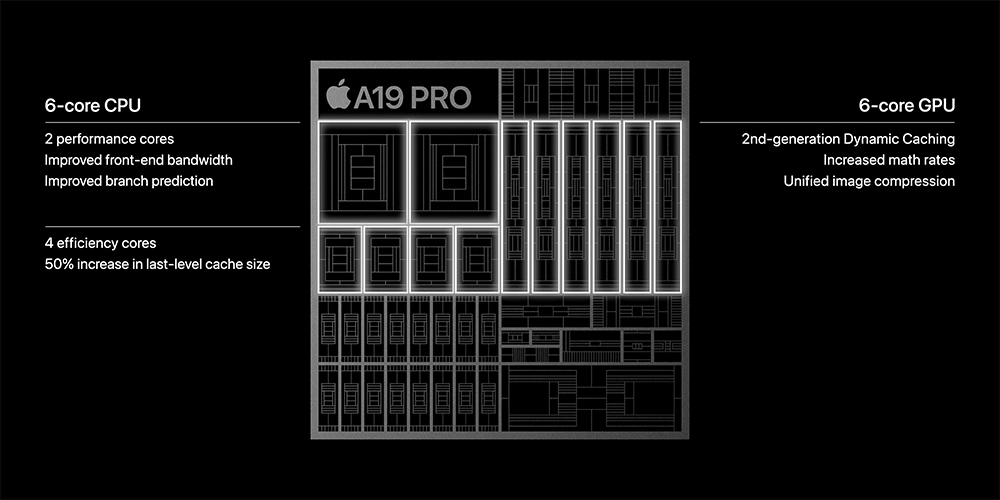
▲Picture source:Apple
The design of notebook products usually requires planning months or even years in advance, including chip procurement, motherboard design, cooling architecture and supply chain arrangements. The development time of MacBook Neo is likely to have been determined before the A19 Pro has been mass-produced.
In other words, when the product design is completed, the chip option available to Apple will still be the A18 Pro. Therefore, from an engineering and supply chain perspective, using existing chips and repositioning them as notebook platforms is actually a very reasonable choice.
GPU is actually limited by software
There is also an interesting detail. Some eagle-eyed users have noticed that the versions used by MacBook Neo’s A18 Pro and iPhone 16 Pro seem to be slightly different. Originally, the A18 Pro GPU was a 6-core design, but only 5 cores were enabled on the MacBook Neo.
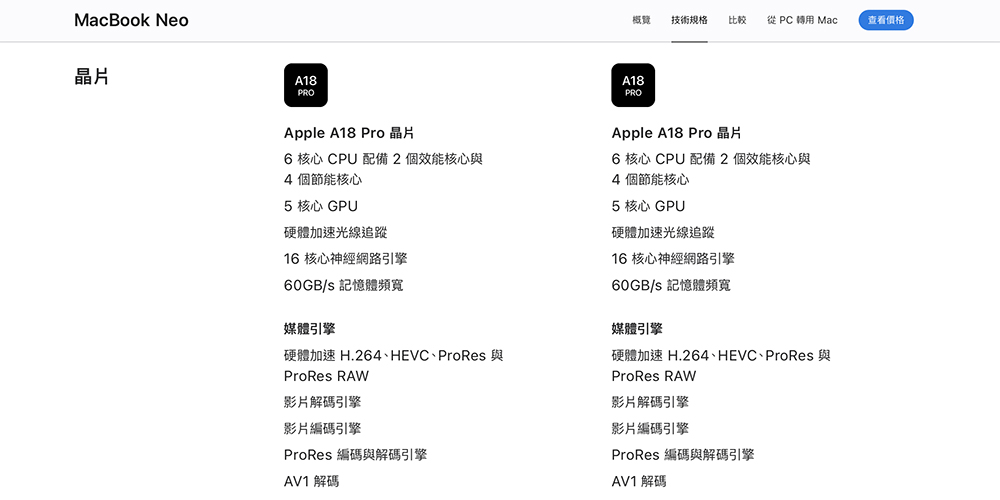
▲Picture source:Apple
However, foreign media pointed out that the chip is actually still a 6-core GPU, but one of the cores is locked by Apple through software. This practice is actually quite common in the semiconductor industry and is called Binning.
To put it simply, there may be slight differences in the chip production process, and manufacturers will ensure stability by shutting down some cores, while also improving the overall yield. For Apple, this approach can improve chip utilization without increasing costs while maintaining product positioning.
8GB RAM actually fits the product positioning
If you look at the overall product strategy, the target group of MacBook Neo is actually quite clear. It is mainly targeted at students, light users, and entry-level users who are coming into contact with Mac for the first time.
For word processing, web browsing, streaming video, and basic productivity tools, 8GB of memory is still enough to meet most daily needs. With the A18 Pro’s high-performance CPU and GPU architecture, MacBook Neo can still provide a good experience in light work situations.
In other words, this laptop is not designed to replace MacBook Air or MacBook Pro, but to allow more people to enter the Mac ecosystem at a lower price.

▲Picture source:Apple
Conclusion
The 8GB memory configuration of MacBook Neo may seem a bit conservative at first glance, but from the perspective of chip design and product strategy, it is not actually Apple’s deliberate reduction of specifications. A18 Pro’s packaging method, DRAM cost and product development schedule all play an important role in this. For a Mac that is mainly priced in the NT$19,900 price range, Apple obviously wants to strike a balance between cost, performance and market positioning.
For most daily users, this configuration can still meet the basic needs, while also making the entry barrier to Mac lower. If Apple launches the next generation of entry-level Macs in the future, it may see higher memory configurations, but the current MacBook Neo is actually more like a product born specifically to popularize the Mac ecosystem.
Further reading:
Source: KOCPC Chinese