


After iOS 26.4.2 was officially launched, many iPhone What users are most concerned about is still not the new features, but the updated batteryBattery lifePerformance. The well-known YouTube channel iAppleBytes also conducted the Geekbench battery stress test on multiple iPhones for the first time, comparing the battery life differences of different models under the same conditions.
Originally, everyone thought that the new system should bring better stability and power consumption control, but unexpected results occurred this time. Among them, the battery life performance of the iPhone 16 actually deteriorated significantly, becoming the focus of this update.
▲Picture source:iAppleBytes
iOS 26.4.2 battery life test results are out! This iPhone has actually regressed
Every time the iPhone updates iOS, what everyone cares about most is not the new features, but the most practical question: Will it consume more power? After all, for people who use mobile phones for long periods of time every day, battery life almost directly affects the entire day’s use experience. Apple recently released iOS 26.4.2, and many people have begun to wait and see whether they should update. This time, the well-known YouTube channel iAppleBytes also conducted actual testing as usual, testing the battery life performance of multiple iPhones under unified conditions. The result was a bit surprising. One of the new models performed even worse than the previous version.
Apple recently officially launched iOS 26.4.2, version number 23E261. Although this update mainly focuses on system corrections and stability optimization, for most users, the biggest concern is still whether battery life performance is affected.
After all, in many iOS updates in the past, there have been situations where “some people think that the change saves power, and some people think that the change consumes power.” Therefore, every time a new version is launched, battery life testing has almost become a fixed focus of observation.
▲Picture source:iAppleBytes
This time iAppleBytes adopted a consistent standardized process. After all devices were updated, they were left for about 26 hours to allow the system to complete background indexing and synchronization operations, and to confirm that CPU activity was reduced to a minimum to prevent background programs from affecting the test results. This step is actually very important, because when the system is just updated, the mobile phone usually has a short period of high power consumption. If the test is started too early, the data is easily distorted.
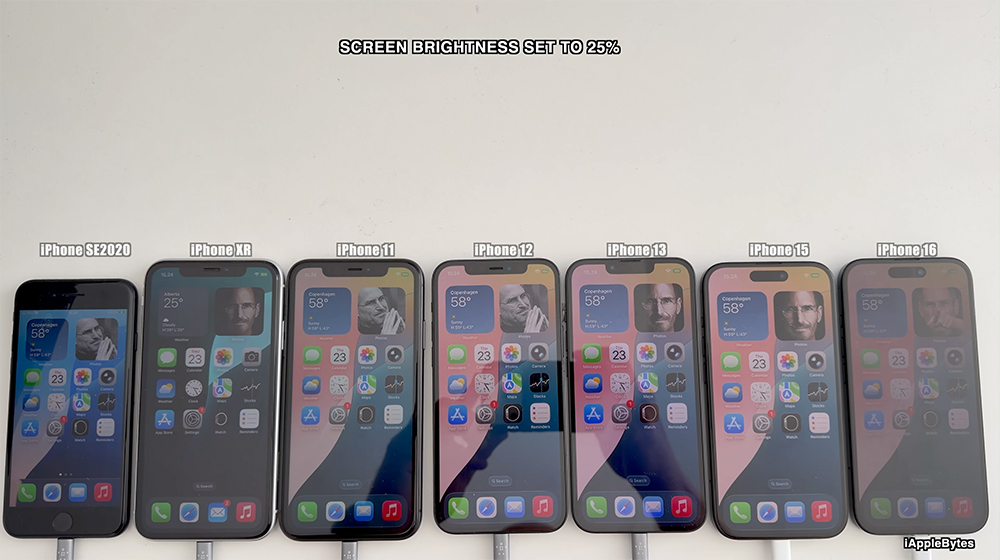
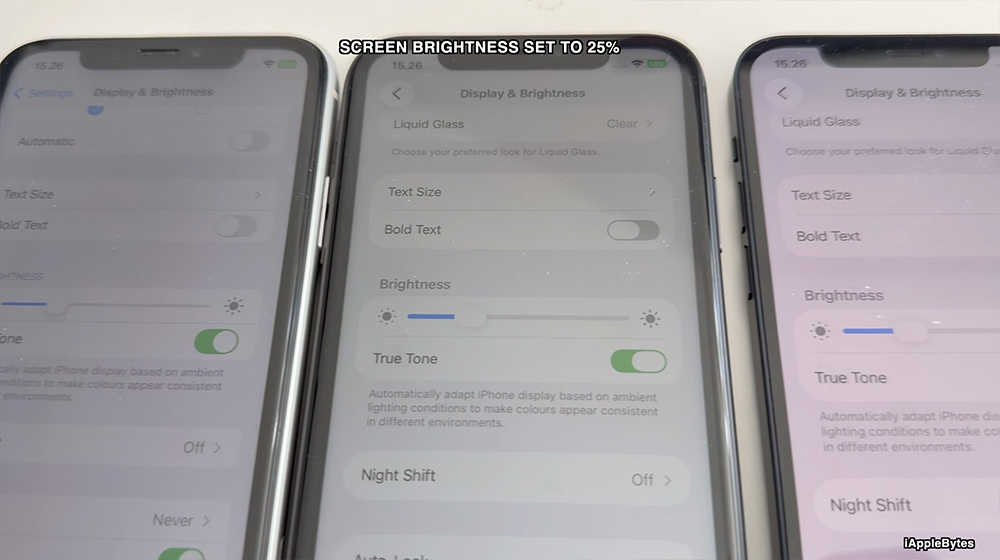
The test environment also remains completely consistent. The screen brightness of all iPhones is fixed at 25%, and the automatic brightness adjustment function is turned off. They are connected to the same Wi-Fi network at the same time to eliminate external variables as much as possible and make comparisons between different models more valuable.
▲Picture source:iAppleBytes
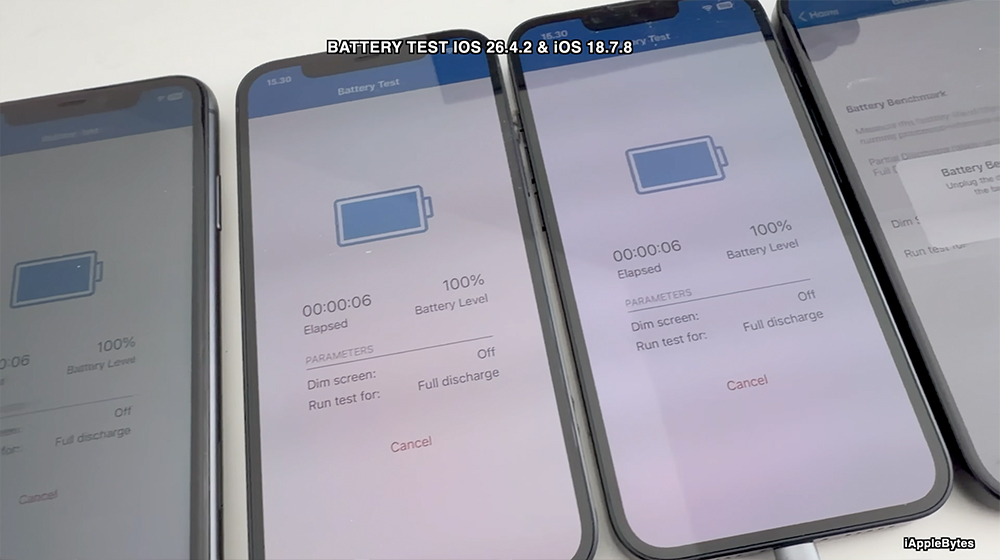
The tool used this time is the Geekbench 4 battery test, also known to many as the Geekbench battery stress test. Its principle is not to simulate daily social networking or watching videos, but to continuously perform high-load operations, such as a large amount of processor work and keeping the screen on for a long time, which quickly consumes power, and then calculates battery life based on the discharge time and the amount of work completed.
Although this method is different from the general usage situation, the biggest advantage is fairness. Because each phone is subjected to the same workload, it is more suitable to compare the differences between different iOS versions.
Geekbench battery testing is mainly divided into two modes, one is the complete discharge mode, which is measured all the way from 100% to 0%; the other is estimation after a short time test. This time, the complete discharge mode is used, so the credibility is relatively higher, and it is more suitable as a reference before and after the update.
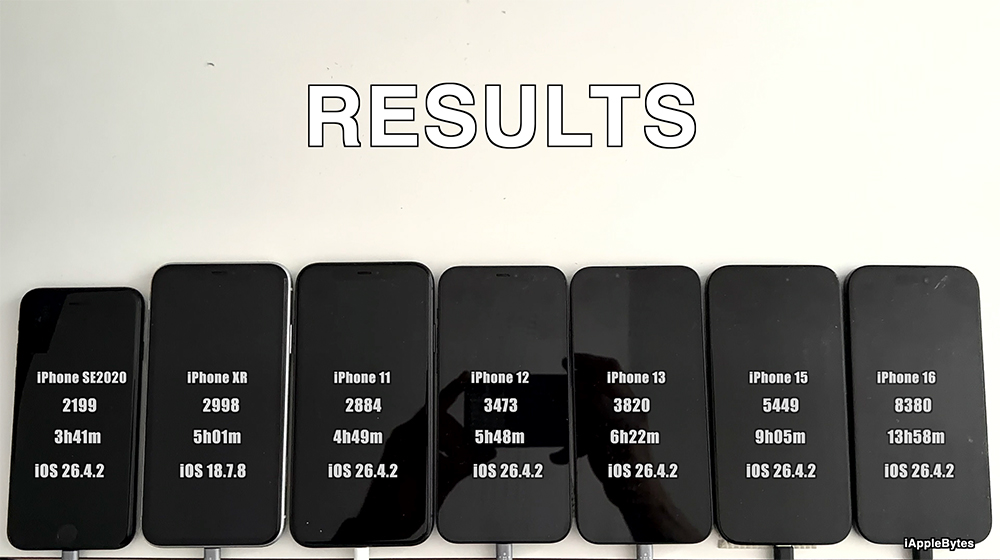
According to the test results of iOS 26.4.2, the battery life of the six iPhone models is as follows:
- iPhone SE (2nd generation): 3 hours, 41 minutes
- iPhone 11: 4 hours 49 minutes
- iPhone 12: 5 hours 48 minutes
- iPhone 13: 6 hours 22 minutes
- iPhone 15: 9 hours 05 minutes
- iPhone 16: 13 hours 58 minutes
In addition, as a control group, the iPhone XR, which is still stuck on iOS 18.7.8, has a battery life of 5 hours and 01 minutes.
▲Picture source:iAppleBytes
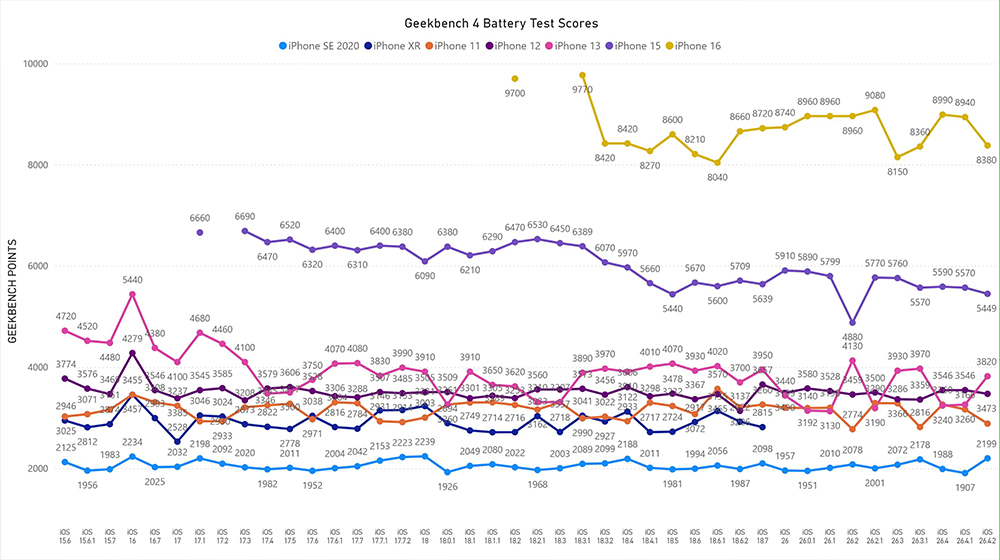
In terms of absolute numbers, the iPhone 16 is still the model with the strongest overall battery life, and the result of nearly 14 hours is still quite good. But what’s really surprising is not the overall score, but the comparison with the previous version of iOS 26.4.1.
According to the previous test, the battery life of the iPhone 16 was better in iOS 26.4.1. After upgrading to iOS 26.4.2 this time, it regressed by nearly an hour, becoming the most obvious case of battery life decline in this update.
Although it is not a catastrophic increase in power consumption, for flagship phone users, the loss of nearly an hour of battery life is actually quite direct. Especially if you are a heavy user, this difference is likely to be the dividing point between whether you need to recharge at night.
In addition to battery life, Geekbench also provides a battery score to evaluate how much computing work the phone completes during discharge. The higher the score, the better the balance between overall battery life and performance.
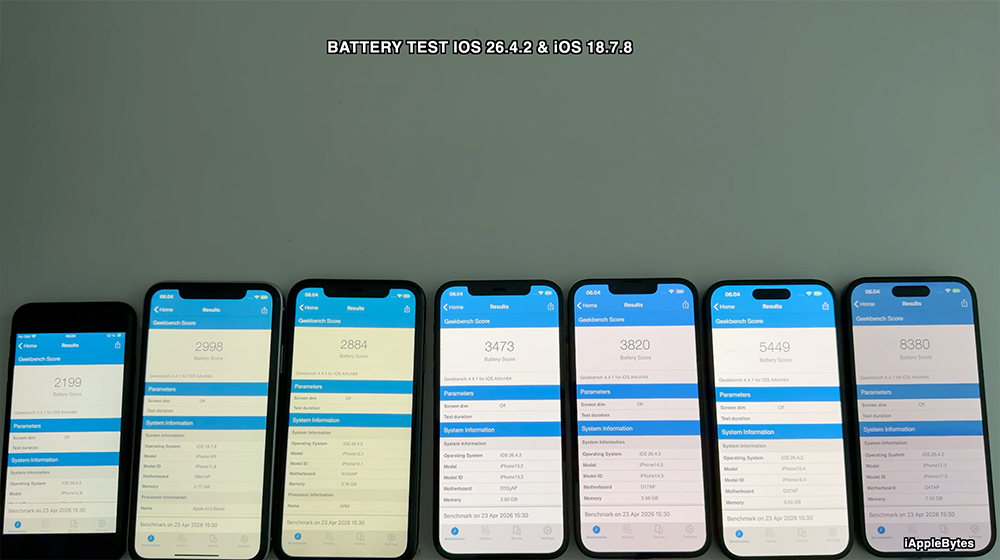
The Geekbench battery scores of each model are as follows:
- iPhone SE (2nd generation): 2199 points
- iPhone 11: 2884 points
- iPhone 12: 3473 points
- iPhone 13: 3820 points
- iPhone 15: 5449 points
- iPhone 16: 8380 points
- The comparison score of iPhone XR is 2998 points
▲Picture source:iAppleBytes
Judging from the scores, although the battery life of the iPhone 16 has declined slightly, its overall performance still ranks first, clearly widening the gap with other models. This also means that the energy efficiency advantage of the new hardware itself is still very obvious, but this system update does not seem to bring further battery life bonus points.
As for older models, such as iPhone 11, iPhone 12, and iPhone 13, the overall performance is relatively stable and there are no particularly exaggerated changes. For these users, the risk of updating to iOS 26.4.2 is relatively low.
▲Picture source:iAppleBytes
Overall, iOS 26.4.2 did not cause a comprehensive battery life disaster, and most models still maintained stable levels. However, the regression of iPhone 16 is indeed a bit surprising, especially as the latest generation flagship, everyone originally expected optimization rather than decline.
Of course, there are still differences between laboratory testing and daily use, and the actual experience will also be affected by usage habits, app status, signal environment, and battery health. However, the greatest value of this type of standardized testing is to provide a relatively objective benchmark for comparison.
If you are currently using an iPhone 15 or earlier, you basically don’t have to worry too much about updating iOS 26.4.2; but if you are an iPhone 16 user and are particularly concerned about battery life, you may want to observe the feedback from other users for a few days before deciding whether to update immediately. After all, for many people, whether the battery is enough to last the whole day is often more important than having a new function.
Further reading:
Source: KOCPC Chinese