


GPT-5.3-Codex and GPT-5.3 Instant After [they] started rolling out one after another, I had expected GPT-5.3 to come along too, but unexpectedly this time OpenAI Skip ahead to the more substantial upgrade of “GPT-5.4″—from autonomous computer control capabilities, to context windows breaking through one million tokens, and then to significantly reducing hallucination error rates, making it arguably the most comprehensive upgrade of the GPT-5 series yet.ChatGPT Subscribers can use it now.
The GPT-5.4 series is officially here, featuring two versions.
GPT-5.4 is the latest flagship model released by OpenAI under the GPT-5 series architecture, integrating the coding capabilities of the previous GPT-5.3 Codex while significantly enhancing three major aspects: reasoning, computer use, and knowledge work. There are two versions:
- GPT-5.4
- GPT-5.4 Pro
In ChatGPT, GPT-5.4 Thinking is simply GPT-5.4. Here are some key features worth noting this time.
First up is the native computer control capabilities, one of GPT-5.4’s most notable new features.
Previously, OpenAI’s computer operation capabilities relied on other models, but GPT-5.4 is OpenAI’s first general-purpose model with native computer usage capabilities. It can directly control computers through screenshots, mouse, and keyboard, eliminating the need for developers to integrate separate specialized models. This means developers can directly use GPT-5.4 to build AI Agents that automatically browse websites, operate software, and execute multi-step tasks—going far beyond just “generating text.”
Next is the “Million Token Ultra-Large Context Window.” On the API and Codex platforms, GPT-5.4 supports a context window of up to 1 million tokens—the largest capacity OpenAI has ever offered. This allows AI Agents to continuously track every previous step throughout extremely long workflows, minimizing errors caused by forgetting earlier content.
However, note that any usage beyond the standard 272,000 tokens will be counted as double toward your quota/limit, so be sure to account for this when planning your costs.
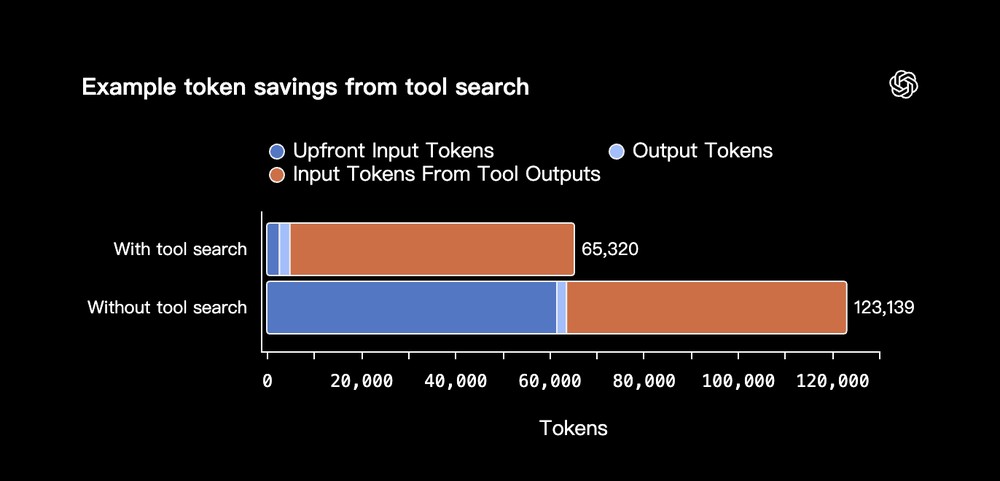
Beyond the larger tokens, OpenAI also emphasized that efficiency has significantly improved. In Scale’s MCP Atlas benchmark, enabling the Tool Search feature reduced overall token usage by approximately 47%, while maintaining the same accuracy.
For image recognition, GPT-5.4 adds support for “original quality” input mode, capable of processing high-resolution images up to 10.24 megapixels or 6000 pixels on the longer side, whichever is smaller. OpenAI states that this shows significant improvements in areas such as image localization capabilities and click precision.
Additionally, when ChatGGPT uses GPT-5.4 Thinking to tackle complex problems, the model now first explains its approach, allowing users to review it and even adjust instructions mid-way.
GPT-5.4’s real-world performance: How does it compare to the previous generation and competitors?
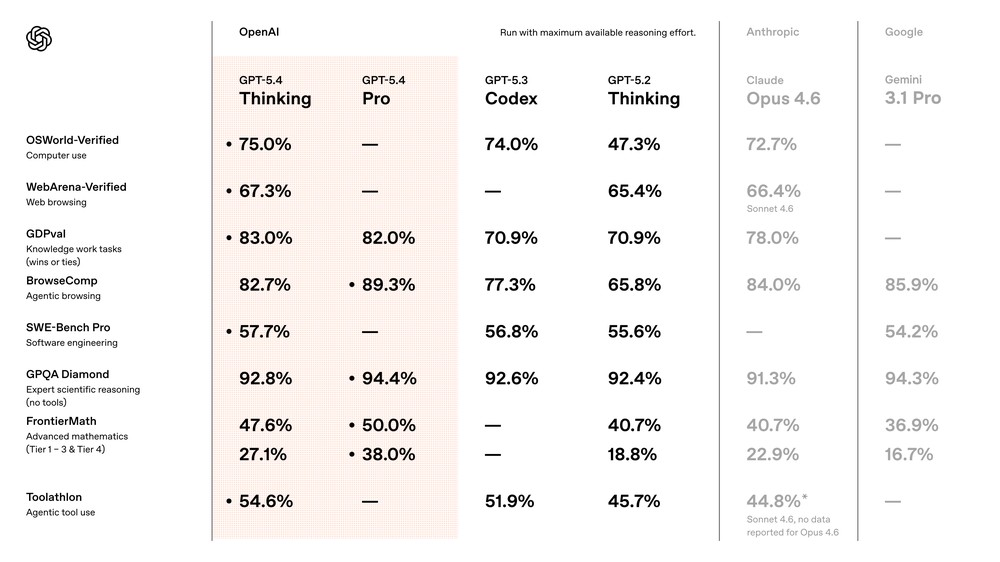
OpenAI has released a series of benchmark results this time, with improvements that are quite significant compared to both the previous generation GPT-5.2 and competitors. Here are some of the more notable ones.
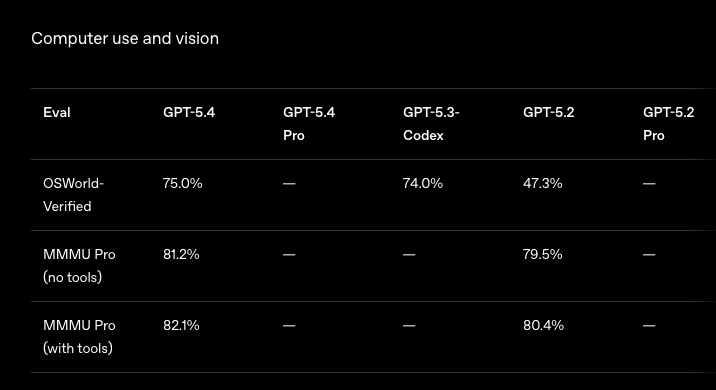
Computer desktop operation (OSWorld-Verified), a benchmark measuring a model’s ability to interact with real desktop environments through screenshots and keyboard/mouse controls.
- GPT-5.4: 75.0% (new high)
- Human Performance: 72.4%
- Claude Opus 4.6:72.7%
- GPT-5.2:47.3%
GPT-5.4 not only surpassed the previous generation by nearly 28 percentage points, but is also the first model to exceed average human performance.
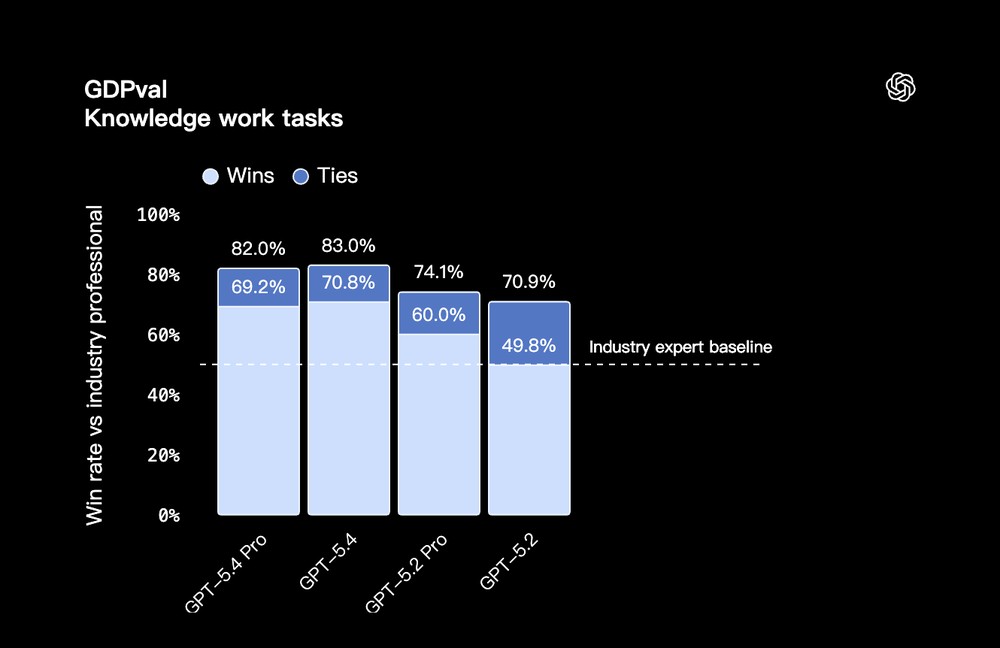
A comprehensive knowledge work assessment spanning 44 occupational categories (GDPval):
- GPT-5.4: 83.0% (new high)
- GPT-5.4 Pro:82.0%
- GPT-5.2:70.9%
- GPT-5.2 Pro:74.1%
- Claude Opus 4.6:78%
In terms of hallucination error rates, compared to GPT-5.2, the probability of single factual claims being incorrect decreased by 33%, and the probability of overall responses containing errors decreased by 18%.
OpenAI’s various benchmark results compared to Claude Opus 4.6 and Gemini 3.1 Pro:
How to use GPT-5.4?
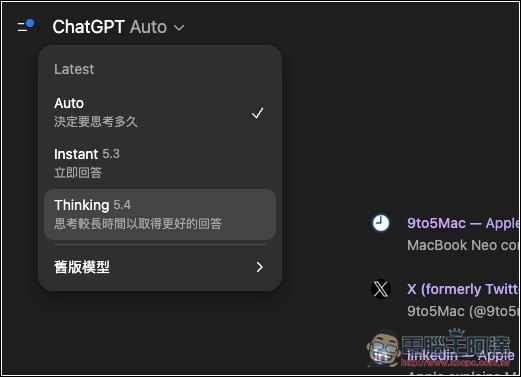
The GPT-5.4 model is now available across ChatGPT, Codex, and API. GPT-5.4 Thinking will be rolling out gradually to ChatGPT Plus, Team, and Pro subscribers, replacing GPT-5.2 Thinking. GPT-5.2 Thinking will be retired on June 5, 2026.
Beyond the model itself, OpenAI also rolled out several enterprise-oriented features this time:
- ChatGPT for Excel and Google Sheets (Beta): Seamlessly integrated into spreadsheets to build and analyze complex financial models
- New Financial Data Integration: Featuring integration with financial data providers such as FactSet, MSCI, and Moody’s
Source: KOCPC Chinese