


Recently Mac mini It can increasingly be seen locally AI、OpenClawIn discussions about proxy tools and similar utilities, the reasons are simple: compact size, low power consumption, plus most AI tools have the best macOS compatibility. However, since the Mac mini is so small,AI Computing power can’t be that high, so most people buy them to run cloud models. However, this computing limitation may be solved in the near future. Recently, a foreign AI startup demonstrated successfully connecting an external GPU to a Mac mini, supporting both NVIDIA and AMD, instantly turning it into a machine capable of running local LLM models.
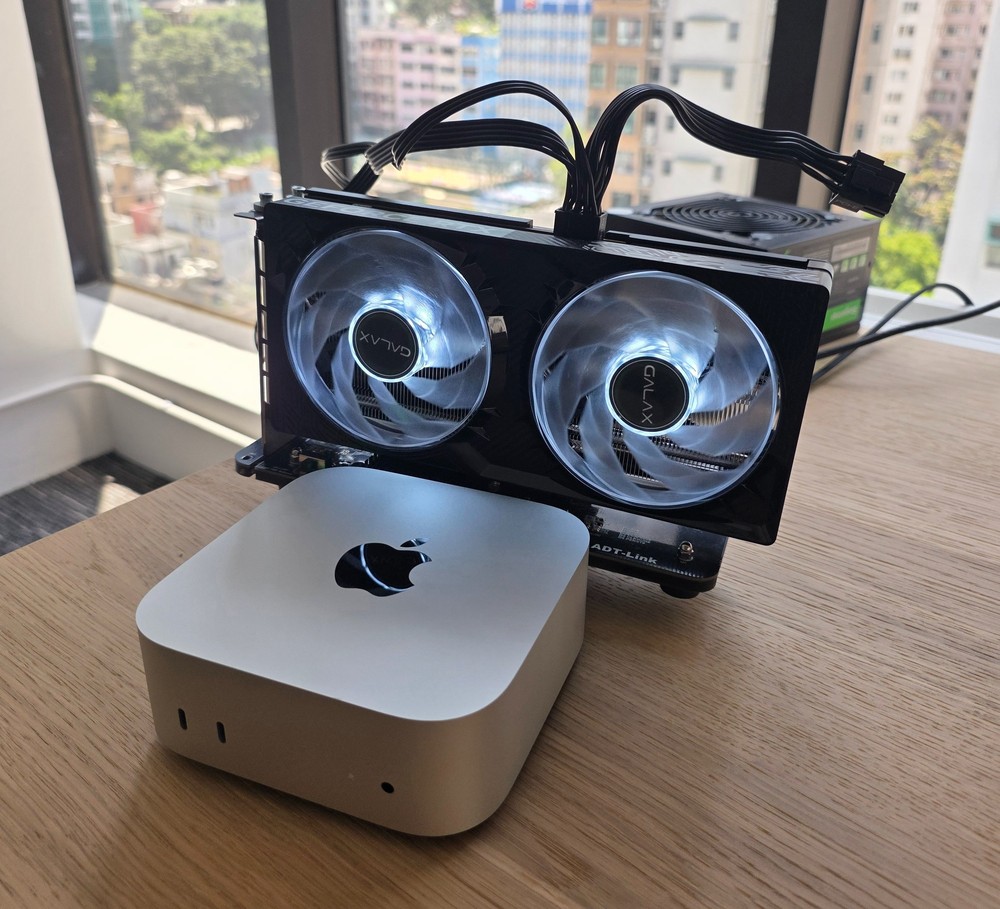
TinyCorp Bypasses Apple Silicon Restrictions, Enabling Mac mini AI Compute to Soar
Back when Apple still used Intel processors, Macs actually supported eGPUs. By connecting an external GPU enclosure via Thunderbolt 3, you could use AMD discrete graphics cards to accelerate graphics processing (NVIDIA graphics cards were never supported).
But since Apple launched its own M1 chip in 2020, all Macs with Apple Silicon—including the M1, M2, M3, M4, and the latest M5 series—no longer support eGPUs. The reason isn’t hardware limitations with the Thunderbolt interface, but rather a “software-level” issue. Apple Silicon integrates the CPU, GPU, and memory onto a single chip (unified memory architecture), and macOS’s graphics API “Metal” wasn’t designed to distribute workloads to external non-Apple GPUs.
So normally, if your Mac is powered by an Apple Silicon chip, you won’t be able to connect an external graphics card.
However, this limitation has been broken by a foreign AI startup called TinyCorp. TinyCorp is a company founded by renowned hacker George Hotz (online nickname geohot), who developed a neural network framework called “tinygrad,” focused on making AI computing simpler and more efficient.
According to foreign media Wccftech, TinyCorp’s engineers used an adapter called “ADT-Link” (model ADT-UT3G) to convert the Mac Mini’s Thunderbolt 4 interface into a PCIe bus, which is the interface typically used for graphics cards in desktop computers. They then wrote their own Python userspace driver that bypasses macOS’s lack of support, allowing the system to directly communicate with NVIDIA and AMD graphics cards.
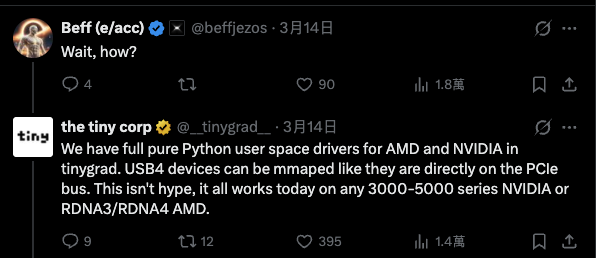
For GPU support, NVIDIA covers the RTX 30, 40, and 50 series graphics cards, while AMD supports graphics cards with RDNA 2, RDNA 3, and RDNA 4 architectures. The graphics card shown by TinyCorp appears to be a GALAX GeForce RTX 5060. The connection bandwidth is 40 Gbps (5 GB/s bidirectional in each direction), which is roughly equivalent to PCIe 3.0 x4 speed, making it adequate for AI inference tasks.
However, it’s important to note that this solution can only be used for AI computing, as the external graphics card has no video output. It cannot be used for gaming, nor can it accelerate macOS’s graphical interface—it’s purely an AI computing accelerator.
As for actual performance test data, TinyCorp has not yet released detailed benchmark scores. However, based on hardware specifications, it can be estimated that if you use a graphics card with more VRAM, you should be able to fully run a 7-8B parameter model locally (8-bit quantization), or a 13-14B parameter model (4-bit quantization).
As for whether they’ll release related products afterward, according to TinyCorp’s plans, they expect to launch a dedicated eGPU expansion board in Q2 2026. This board will feature built-in hardware power management, allowing the GPU to save power when idle, along with a GPU reset mechanism so if the graphics card crashes, you won’t need to restart the entire computer. However, specific pricing information hasn’t been announced yet.
They also shared their experience of successfully using an external GPU with a MacBook last year:
Source: KOCPC Chinese