


In the flourishing era of generative AI, the memory bottleneck of large language models has been a core challenge plaguing the industry. As model scales continue to expand and context windows grow, the memory resources consumed by KV Cache have become a critical barrier limiting the widespread adoption of AI applications. While traditional vector quantization techniques can compress data, they often come with additional memory overhead and precision loss, making it difficult to achieve ideal results in practical deployment. However, a new compression algorithm released by Google Research on March 25 is completely transforming this landscape: this technology, called TurboQuant, can compress KV Cache down to just 3 bits while achieving over 6x memory reduction with zero precision loss and inference speed improvements of up to 8x. Google’s release of this technology even triggered a broad sell-off in US memory stocks last night.

TurboQuant: Redefining AI Efficiency with Extreme Compression Technology
Released by Google Research TurboQuant It’s a brand-new extreme compression algorithm specifically designed to address memory bottleneck issues during the operation of large language models (LLMs). The core objective of this technology is to solve the memory pressure caused by KV Cache, which is the most common performance bottleneck that AI models face when processing long texts or large-scale searches.

While traditional high-dimensional vector quantization techniques can compress data, they typically require computing and storing quantization constants for each tiny data chunk, and this additional memory overhead often negates the benefits that compression originally provides. TurboQuant’s innovation lies in its ability to significantly reduce KV Cache memory footprint without sacrificing any AI model prediction performance, while avoiding the extra burdens associated with traditional methods.
Two-Stage Technical Architecture: Perfect Collaboration Between PolarQuant and QJL
TurboQuant’s operation mechanism consists of two key steps, combining two core underlying technologies: PolarQuant and QJL (quantized Johnson-Lindenstrauss).
Phase 1: PolarQuant High-Quality Subject Compression
PolarQuant adopts a breakthrough approach, abandoning the traditional Cartesian coordinate system in favor of converting data vectors to polar coordinates. This transformation maps data onto a fixed “circular” grid with known boundaries, eliminating the costly data normalization step and completely removing the memory overhead that traditional quantization methods must carry.
More specifically, PolarQuant separates each vector into radius (representing data intensity) and angle (representing data direction or meaning). Since the angular distribution is predictable and highly concentrated, this method eliminates the expensive per-block normalization step required by traditional quantizers, enabling high-quality compression with zero memory overhead.
Stage 2: QJL Residual Error Elimination
After PolarQuant completes the main compression, TurboQuant uses the QJL algorithm to handle any remaining tiny errors. QJL requires only 1 bit of residual compression computation to eliminate deviations like a mathematical error corrector, ensuring the model computes precise attention scores.
QJL uses a mathematical technique called Johnson-Lindenstrauss transformation to compress complex high-dimensional data while preserving the fundamental distances and relationships between data points. It reduces each resulting vector to a single sign bit (+1 or -1), creating a high-speed shorthand system with zero memory overhead.
Measured data: 6x memory compression, 8x speed boost
The research team conducted rigorous benchmarking on open-source large models such as Gemma and Mistral, covering standard long-context benchmarks including LongBench, Needle In A Haystack, ZeroSCROLLS, RULER, and L-Eval.
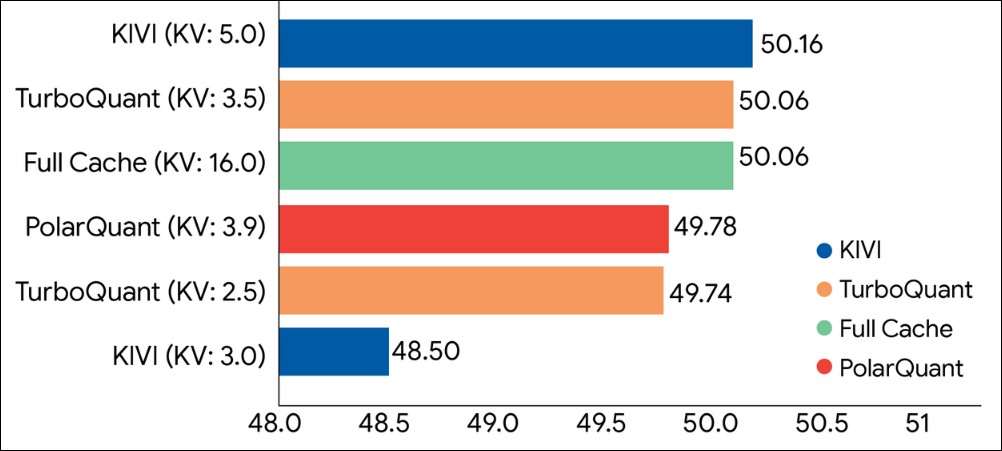
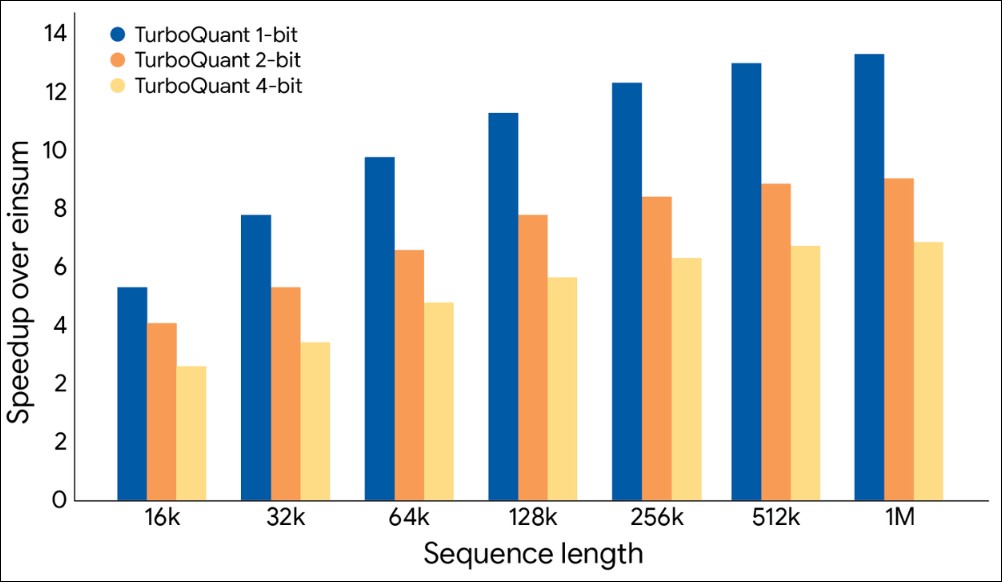
Experimental data shows that TurboQuant can extremely efficiently compress KV Cache to 3 bits without any pre-training or fine-tuning, achieving zero precision loss in long-context tests such as the “needle in a haystack” test, while reducing memory usage to 1/6. On H100 GPU accelerators, 4-bit TurboQuant runs up to 8 times faster than the unquantized 32-bit baseline.
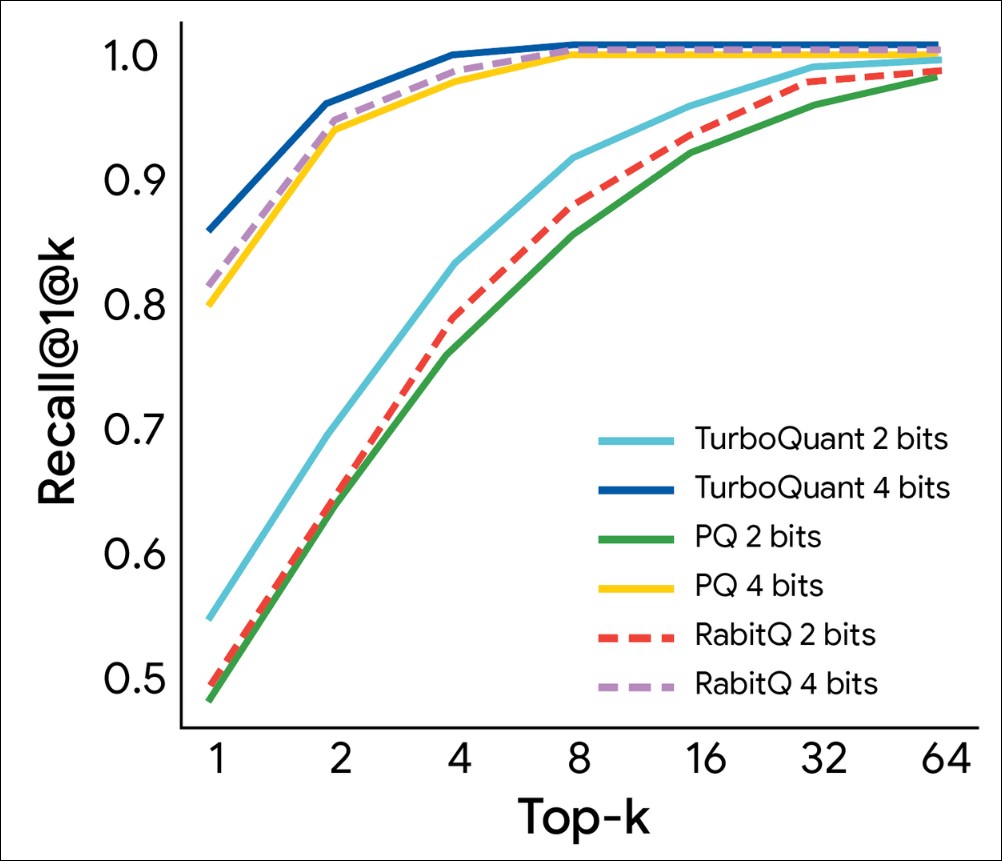
In the LongBench benchmark (covering tasks such as question answering, code generation, and summarization), TurboQuant achieved or exceeded KIVI baseline performance across all tasks. In vector search, TurboQuant achieved the highest 1@k recall on the GloVe dataset compared to Product Quantization and RabbiQ methods, even though these baseline methods relied on larger codebooks and dataset-specific tuning.
Industry Impact: Memory Chip Stocks Plunge Across the Board
TurboQuant’s release not only drew attention at the technical level but also sent shockwaves through the capital markets. As the technology can significantly reduce AI applications’ demand for memory capacity, investors are concerned this could impact the long-term demand outlook for memory chips. Following the announcement, shares of major storage chip companies fell across the board. By market close, Micron dropped 4%, Western Digital fell 4.4%, Seagate declined 5.6%, and SanDisk plummeted 6.5%.

This sell-off reflects market concerns about a potential fundamental shift in AI memory demand structure. If technologies like TurboQuant are widely adopted, future demand growth for high-capacity memory in AI data centers may fall below previous expectations. (Great!!)
Viewpoint
The emergence of TurboQuant marks a new stage in AI infrastructure optimization. The value of this technology lies not only in its remarkable compression ratios and speed improvements, but also in its ability to be applied to existing models without pre-training or fine-tuning. This means Google can deploy it immediately in production environments like Gemini, and other AI companies and developers can quickly benefit without bearing the expensive costs of model retraining.
From an industry perspective, this technology could accelerate the adoption of AI applications. Lower memory requirements mean lower deployment costs, which is great news for developers looking to run large language models on local or edge devices. At the same time, for cloud AI service providers, higher computational efficiency will directly translate into cost advantages and improved service capabilities.
However, the collective decline in memory chip stocks also reminds us that technological innovation is often accompanied by industry restructuring. Traditional hardware suppliers may need to rethink their product strategies, looking beyond capacity growth to find new value creation points, such as higher bandwidth, lower latency, or more specialized application scenarios.
Source: KOCPC Chinese