


Possibly due to OpenClaw sparking a global AI agent craze or conflicting interests, US AI company Anthropic announced it will officially terminate Claude subscription support for all third-party agent platforms, including OpenClaw (using OAuth authentication), on April 4, 2026 at 12:00 PM Pacific Time. Boris Cherny, lead of Claude Code, on the X platformpersonally posted to confirmpromptly sent notifications to users worldwide. For developers and tech enthusiasts who paid a fixed monthly subscription to run AI agents like OpenClaw, they not only lost their original access (it was going to be locked anyway, but there were workarounds), but were forced to choose between switching to a potentially unlimited-spend API plan or completely abandoning their established workflows.
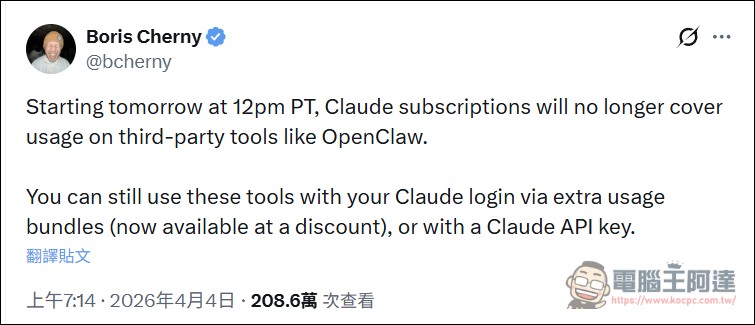
Anthropic Officially Announces Ending Support for OpenClaw and Other Third-Party Platforms
The official reason: the subscription model can’t sustain 24-hour computing costs
This policy reversal came with the official explanation that third-party tools placed “outsized strain” on Anthropic’s infrastructure. In a notification email to users, Anthropic acknowledged that AI agent tools like OpenClaw can run 24/7, a usage pattern that far exceeded what the subscription model was designed to handle.
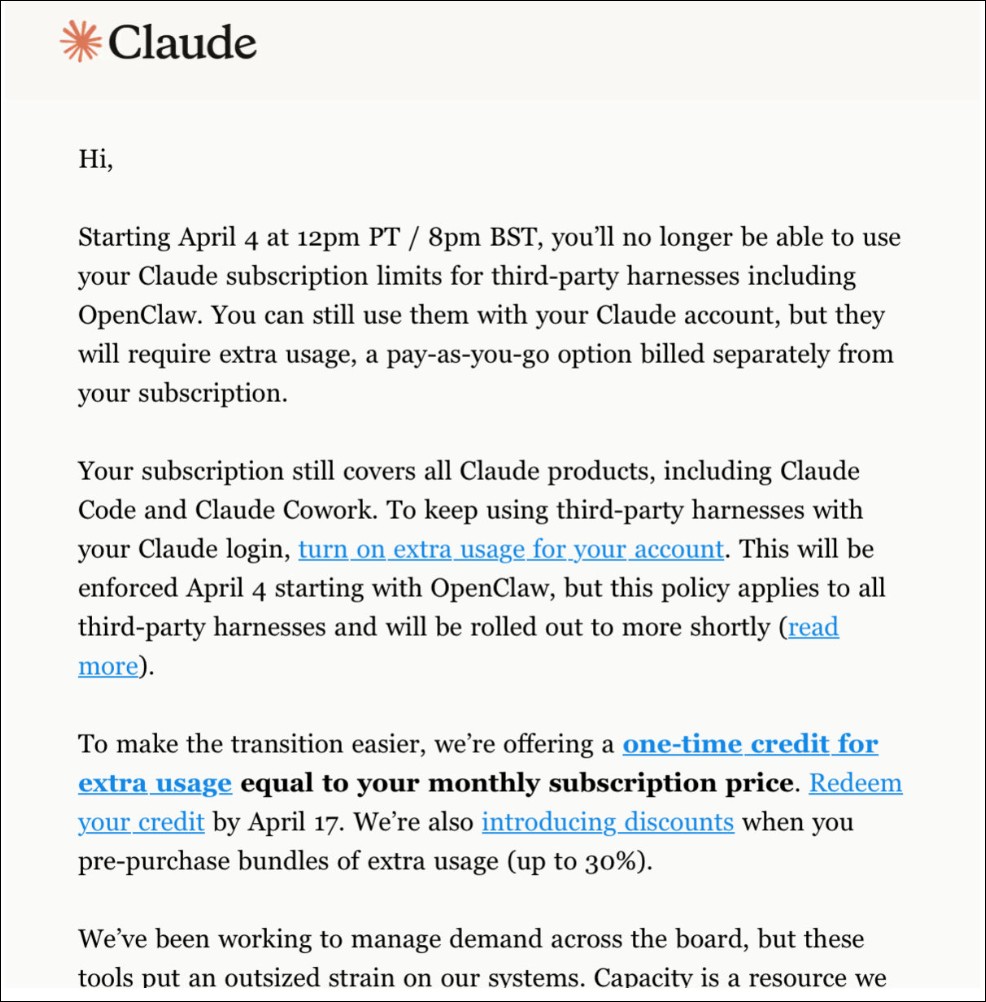
Specifically, if the actual compute consumption of these third-party tools is back-calculated according to API billing rates, a single active user’s weekly usage could reach thousands or even tens of thousands of dollars. This represents a glaring difference compared to the subscription model’s meager $100/200 per month fee. Anthropic clearly believes this structural imbalance cannot be resolved by adjusting prices or usage limits (simply put, they’re hemorrhaging money). Under the revised subscription model, usage is limited to Claude.ai, Claude Code, and Cowork. Other services like OpenClaw and Opencode… are all considered third-party.
Compensation Plans Decoded: What Will Users Actually Get?
When policy strikes, subsidies must follow. Anthropic simultaneously announced multiple transition compensation measures in their termination notice, aiming to ease community backlash while cutting user experience. Below is a complete breakdown of the compensation plan for regular subscribers:
Option 1: One-time credit
All affected subscribers will receive a one-time credit equivalent to their monthly subscription fee. This amount can be used to offset future API usage costs or other paid services on official platforms. Notably, this credit must be redeemed by April 17, 2026 — the deadline is very short, and users who fail to act in time will forfeit their rights automatically (to claim it, go to Settings > Usage in the dashboard).
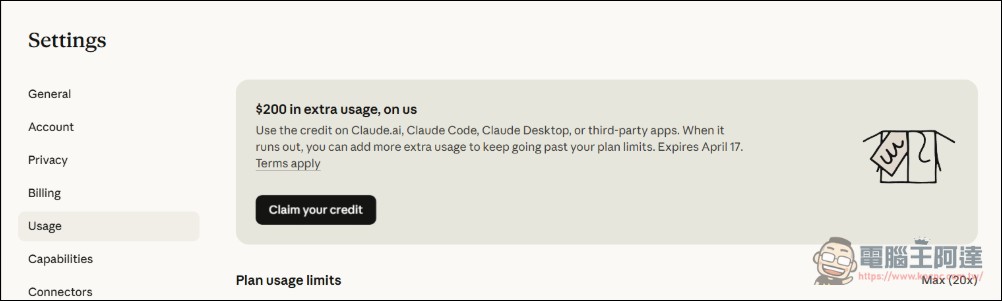
Option 2: Discounted Data Package
Users can still access Claude services through third-party tools like OpenClaw, but they’ll have to give up the subscription model and switch to purchasing discounted usage bundles offered by Anthropic instead. While these bundles are cheaper per unit than standard API billing, they still don’t match the cost-effectiveness of the subscription, making them a transitional compromise option.
Option 3: Full refund
For users unwilling to accept the aforementioned alternatives, Anthropic also offered an option to apply for a full refund in the email. Users can submit their refund request through the exclusive link provided in the email, and the company will process applications in order. The emergence of this option demonstrates Anthropic’s attempt to adopt a relatively amicable closing approach to minimize the damage to the brand’s reputation caused by this policy shift.
Option 4: Direct API Key Access
Even after losing subscription plan discounts, users can still choose to continue using third-party tools like OpenClaw by obtaining their own Claude API keys. The advantage of this approach is greater flexibility in usage, paying as you go; but the downside is the lack of plan discounts, making long-term costs significantly higher. For developers with heavy usage needs, this may be the unavoidable final option.
Developer Community Reacts: Questions and Doubts Surface
After the policy announcement, the developer community’s reaction was both swift and intense. Many users expressed dissatisfaction with Anthropic’s approach, viewing it as an act of “biting the hand that feeds.” Over the past several months, OpenClaw helped numerous users engage with and use Claude AI’s capabilities in a more intuitive way (the Openclaw running Opus 4.6 is just smarter, after all), effectively conducting extensive market education and user expansion for Anthropic—only to end up having its support cut.
OpenClaw author Peter Steinberger also said he tried to communicate with Anthropic, but it only delayed the blocking by a week, and the timing is just so convenient—they added some features to their closed architecture, then blocked the open source software (OpenClaw):
woke up and my mentions are full of these
Both me and @davemorin tried to talk sense into Anthropic, best we managed was delaying this for a week.
Funny how timings match up, first they copy some popular features into their closed harness, then they lock out open source. https://t.co/Mgmv6YmW2B
— Peter Steinberger 🦞 (@steipete) April 3, 2026
Steinberger regrets Anthropic’s potentially ecologically impactful decision, though he still praised Boris for doing his best to minimize the consequences. He also mentioned that an update would be released today to reduce costs for API users (in reality, most players only switch to Opus when planning important missions—like Openclaw, it’s a model used sparingly for critical tasks, and not many wealthy users actually use Claude’s AI as their primary).
While I think what Anthropic does is sad for the ecosystem, I wanna give Boris credit for doing what he can to soften the fallout.
Today’s release will include some fixes for better cache use, to lower cost for API users. https://t.co/DUZNMjKlJ6
— Peter Steinberger 🦞 (@steipete) April 4, 2026
The shadow of Anthropic’s own product Claude Cowork
In this incident, another widely discussed topic is Anthropic’s recently launched proprietary collaboration tool Claude Cowork (along with rumors about an upcoming Conway). The target user group for this product has a significant overlap with OpenClaw’s core users: both focus on use cases like AI agents, automated workflows, and developer collaboration. The timing of Anthropic closing off third-party tool support channels while aggressively promoting its own similar alternative products makes it difficult for observers not to see a causal connection.
Some critics argue that Anthropic’s move may raise concerns about violating fair competition principles: using policy tools to suppress potential competitors’ ecosystems, then filling the gap with official products. However, Anthropic has yet to formally respond to this accusation. This “referee and player” criticism, if left unexplained, will likely continue to trouble Anthropic’s public image going forward.
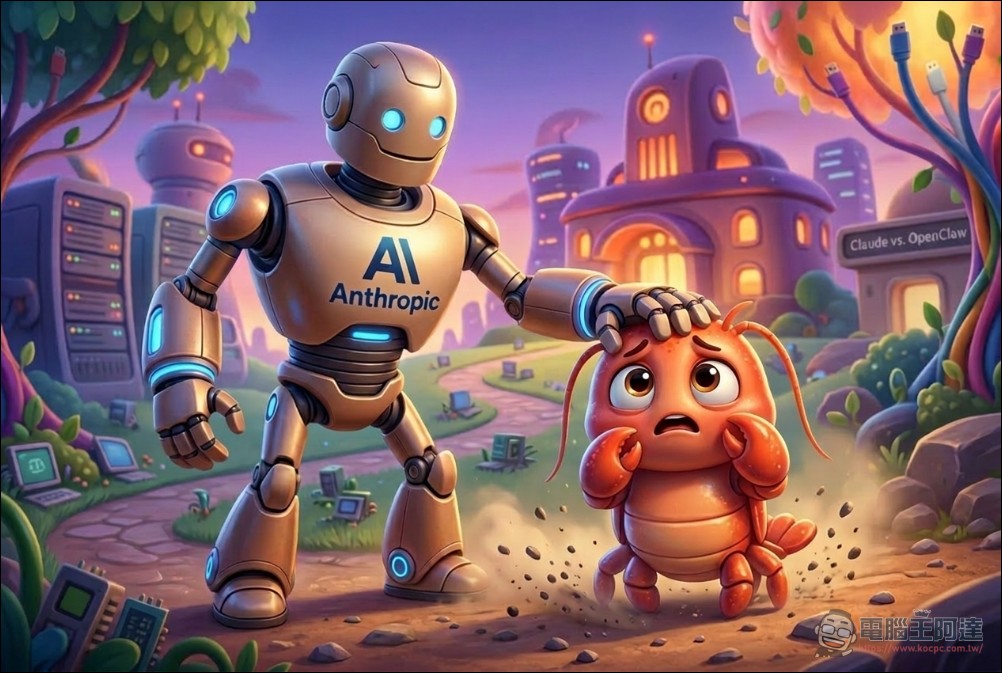
Summary
However, I want to be fair here—if we look at the token consumption of subscription-based Coding Plans, Claude’s decision this time is actually quite reasonable. After all, GPUs consume an astonishing amount of tokens (which is why Jensen loves them so much, and why many Chinese AI model companies have risen to prominence thanks to them). But looking at it from another angle, for Claude Max subscribers (Pro subscribers don’t count), they would normally use Claude Code to exhaust their quota in every way possible within the time limit (then wait for the cooldown). It’s just that now the target has shifted from Claude Code to OpenClaw, which somewhat undermines that argument.
Though there’s a rumor that Claude’s Coding Plan was already running at a loss, it’s completely reasonable that they don’t want other third parties to freeload. I’m personally looking forward to Anthropic launching their own AI agent—it might even outperform OpenClaw.
Source: KOCPC Chinese