


As modern AAA games feature increasingly detailed textures, along with the rollout of HDR and ray tracing, running out of VRAM (video memory) on traditional graphics cards has become one of the most frustrating issues for gamers in recent years. High-fidelity assets are also a major reason why AAA games routinely demand hundreds of gigabytes of storage. However, NVIDIA showcased a potentially game-changing AI technology at the GTC 2026 conference:Neural Texture Compression (NTC)Touted to reduce VRAM usage to just 15% while maintaining visual quality, this technology is expected to completely transform the hardware requirements for future AAA games.
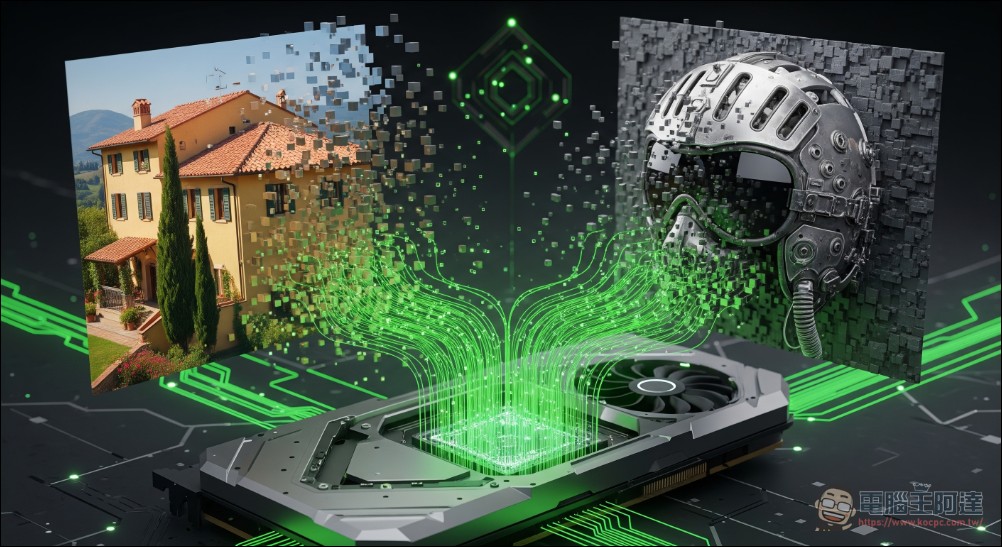
NVIDIA’s cutting-edge neural texture compression technology NTC unveiled
In fact, NTC technology didn’t emerge out of nowhere. As early as 2023, NVIDIA had initially revealed related research concepts, and it wasn’t until early 2026 that it was officially released to the industry through a Software Development Kit (SDK). Although there are currently no commercially released games officially adopting NTC technology, the impressive data and cross-platform compatibility it has demonstrated have already attracted significant attention from developers and console manufacturers worldwide. There’s even reports suggesting that Sony’s next-generation console, PlayStation 6 (PS6), will very likely list this technology as one of its core specifications.
Technical principle: Not generative AI, but rather “deterministic” machine learning decompression
In recent years, AI rendering technologies (such as DLSS or Frame Generation) have been mostly associated with the term “generation,” but NVIDIA emphasizes that the core principle of NTC is not generative AI, but rather machine learning-based “Deterministic Texture Decompression.” This means that during the decompression process, the image output from each set of input data is fixed and precise, unlike the random artifacts or variations that may occur in images produced by conventional generative AI technologies, which is crucial for game scenes that demand precise image quality.
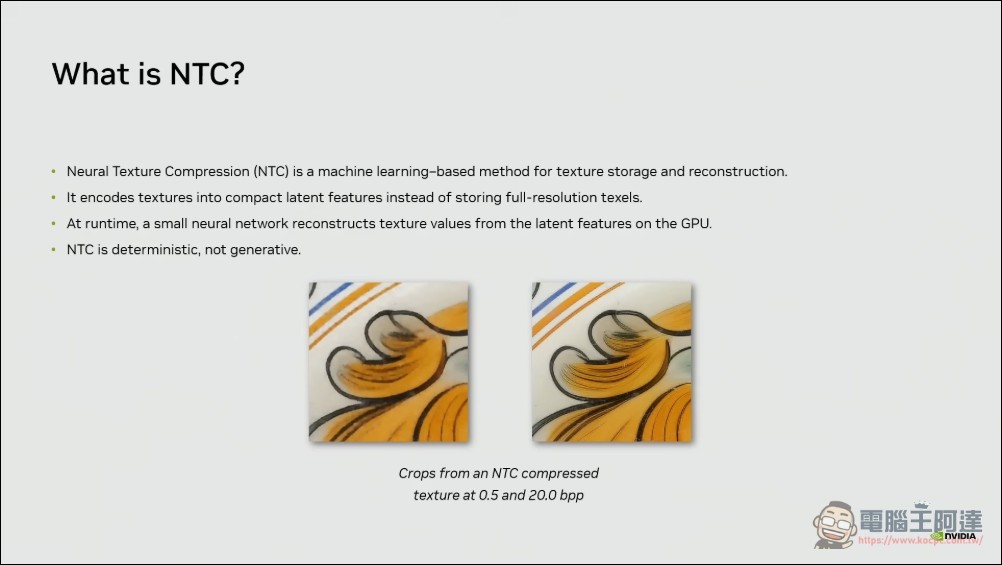
NTC’s operational architecture comprises two key components: first, “Latent Texture,” which transforms traditional texture elements into feature vectors describing material properties and stores them in an extremely compact format; second, “Positional Encoding,” which injects high-frequency spatial information before UV coordinates are passed to the decoder, helping the neural network recover sharp details and repetitive patterns during reconstruction. During training, NTC employs a standard Neural Optimization Loop, continuously converging through a precise Reconstruction Loss Function to ultimately achieve high-fidelity quality approaching the original material.
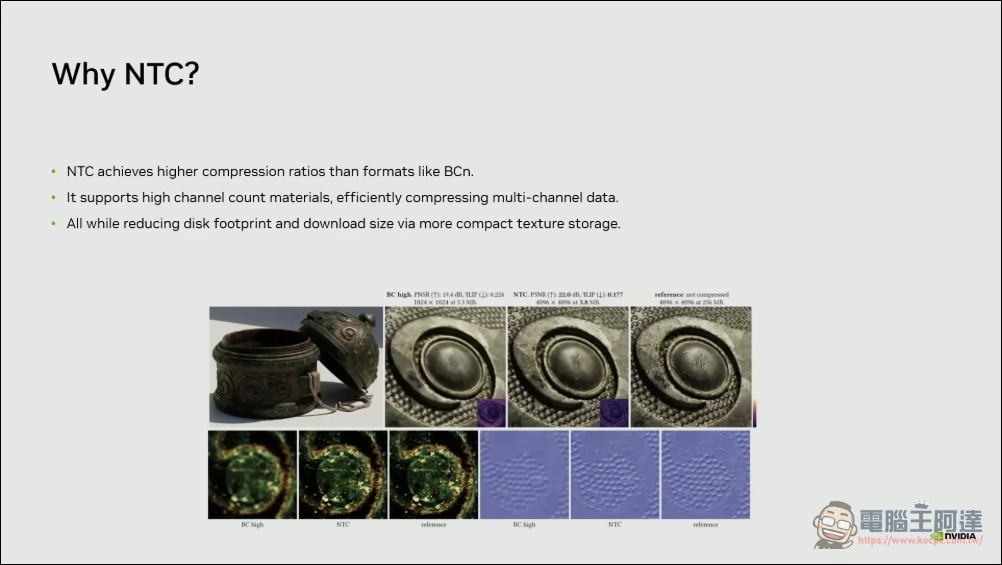
Benchmark Showdown: VRAM Usage Drops 85%, Shattering Block Compression Limits
In traditional GPU technology, texture compression relies heavily on block compression formats like BCn (BC5, BC6, BC7). While these formats have been in use for years and offer excellent compatibility, they often produce noticeable compression artifacts when dealing with high dynamic range (HDR) content or 8K textures, and their compression ratios have reached their physical limits. According to real-world test cases demonstrated by NVIDIA at GTC 2026, NTC technology delivers unprecedented efficiency gains without any loss in image quality.
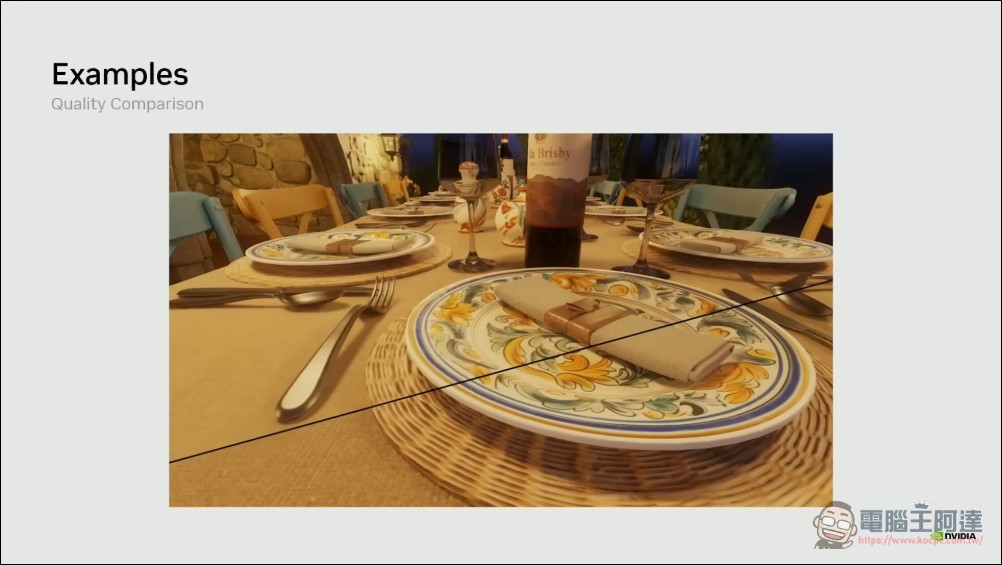
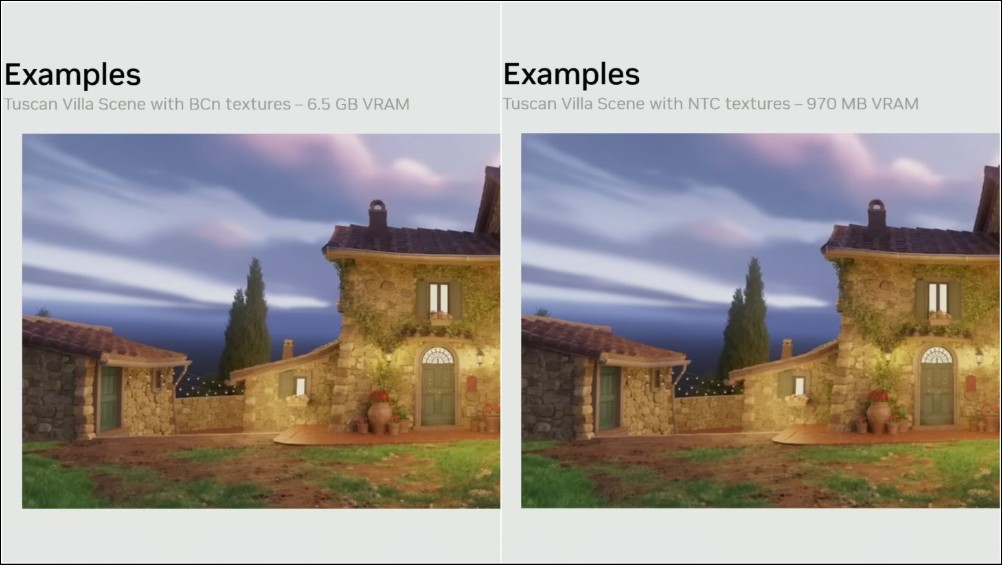
Using the complex “Tuscan Villa” scene as an example, using the traditional BCn format, high-quality assets require approximately 6.5GB of VRAM, which nearly consumes the entire memory of a mid-range graphics card. However, after switching to NTC technology, the same visual result requires only 970MB of VRAM, achieving an 85% reduction. Another demonstration case called “Flight Helmet” is even more impressive: the original uncompressed texture was as large as 272MB, but after NTC processing, it can be displayed with only 11.37MB, achieving a compression ratio of approximately 24x, with detail quality even superior to traditional BCn compression formats.
| Scene/Item | Traditional BCn / Uncompressed size | NTC Dosage |
|---|---|---|
| Tuscan Villa | 6.5 GB (BCn) | 970 MB (saving 85%) |
| Flight Helmet | 272 MB (uncompressed) | 11.37 MB (approximately 24x compression) |
For those interested in detailed technical details, check out NVIDIA’s official explanation video—playback starts directly with the NTC introduction.
Industry Impact: Cross-Brand Support and the Mysterious Force Behind PS6
Although NTC was led by NVIDIA in development, this technology is not exclusive to the green team. In its technical documentation, NVIDIA states that NTC utilizes “Cooperative Vectors” technology under Microsoft’s DirectX standardized architecture. This means that as long as the hardware architecture complies with the standard, AMD and Intel GPUs can also support NTC technology. In fact, Intel has already demonstrated related technical demos, and AMD also mentioned a similar machine learning texture compression concept in 2024, showing that the industry has reached a consensus that this will be the standard technology path for the next generation.
Furthermore, NTC not only solves the issue of insufficient graphics card memory, but also makes a huge contribution to reducing game installation sizes. Since texture files typically account for more than half of a game’s file size, if high-ratio compression can be achieved through NTC, future AAA titles could see their installation sizes reduced from easily 200GB to under 50GB. Industry sources indicate that Sony is closely collaborating with the technology provider to introduce NTC in the next-generation PlayStation 6 console, paired with a 1TB high-speed SSD. This would not only allow players to download games faster, but also enable execution of unprecedented ultra-high-quality content within the console’s limited memory.
Conclusion: From “Computing Power Competition” to “Efficiency Revolution”
The official release of NVIDIA’s Neural Texture Compression technology marks a shift in graphics technology from pure “brute force” approaches of stacking VRAM capacity and chip compute power to an “intelligent revolution” leveraging machine learning to improve hardware efficiency. For gamers, this means that even if your graphics card’s VRAM specs are no longer top-tier, you may still be able to experience next-generation extreme visual quality in the future through driver and software optimizations.
Although developers still need some integration time to formally implement NTC, with the widespread adoption of SDKs and support from the DirectX framework, we can expect to see the first “neurally optimized” games emerge by late 2026 or 2027. At that point, graphics card memory capacity may no longer be the only bottleneck for players when making purchasing decisions, and neural processing unit performance will become the new benchmark for defining graphics card strength.
Source: KOCPC Chinese