


How expensive is Claude AI’s output really? In terms of cost-to-performance, Claude Opus 4.6 charges a staggering $25 per million tokens (approximately NT$810), which explains why developers have been calling it “more expensive than gold.” However, a group of tech enthusiasts has managed to cut token consumption in half or even more through custom Skills and optimization techniques—with some claiming a 65% reduction using a “token-saving Skill.” This article compiles 10 battle-tested token-saving tips to help developers significantly slash AI costs without compromising output quality.

Why Is Claude ‘More Expensive Than Gold’? Understanding the Billing Model First
Before exploring ways to save money, you need to understand Claude’s billing logic. Tokens are the basic units that AI models use to process text. To put it simply: 1 token is approximately 0.75 English words, or 0.5 Chinese characters. The main reason is that Chinese is relatively more “expensive”: for the same number of characters, Chinese consumes nearly twice the number of tokens as English.
Claude adoptionInput Tokens + Output Tokens Bidirectional billing model. Below is the Anthropic Claude 4.6 series officially announced in March 2026.Official pricing :
| model | Input Price (per million Tokens) | Output Price (per million Tokens) | context window |
|---|---|---|---|
| Claude Opus 4.6 | $5.00 | $25.00 | 200K (standard), 1M (Beta) |
| Claude Sonnet 4.6 | $3.00 | $15.00 | 200K (Standard), 1M (Beta) |
| Claude Haiku 4.5 | $1.00 | $5.00 | 200K |
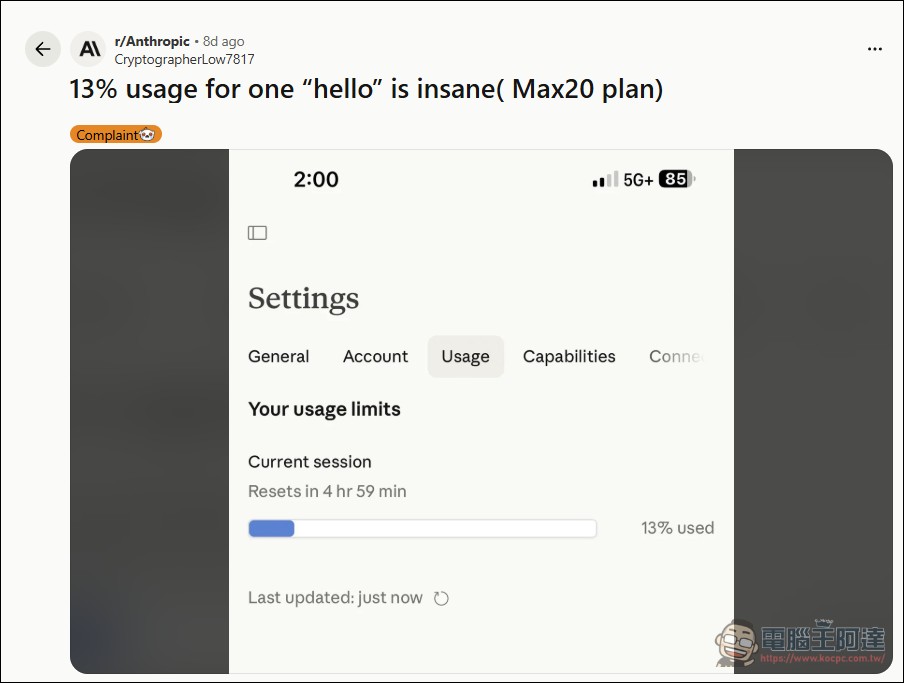
Taking Claude Opus 4.6 as an example, output costs $25 per million tokens, approximately 810 New Taiwan Dollars. Compared to today’s gold price of about NT$2,800 per gram, these two seem hard to compare on the surface. But when a deep reasoning task consumes hundreds of thousands of output tokens, the cost per API call is indeed quite substantial. No wonder people in the community joke that “using Claude Opus to write code will make your wallet cry.” There are even cases where just saying “Hello” consumed 13% of the token usage on the Max $20 subscription plan.Exaggerated case。
Typical Use Case: How Costs Silently Spiral Out of Control
After understanding the billing mechanism, let’s look at two common scenarios of cost overruns.
Scenario 1: Code Review (500 lines of code)
Without optimization:
- Input: Full code (1,500 tokens) + Detailed instructions (300 tokens) + Conversation history (2,000 tokens) = 3,800 tokens
- Output: Detailed Report = 800 tokens
- Per-query cost (Sonnet tier): approximately $0.0234 (about NT$0.76)
After optimization:
- Input: Streamlined code (1,500 tokens) + Concise instructions (50 tokens) + Clear history (0 tokens) = 1,550 tokens
- Output: Structured Report = 600 tokens
- Cost per use: approximately $0.0136 (approximately NT$0.44)
- Save: 42%
Scene 2: Writing Assistant (Continuous Conversation)
Without optimization, accumulated over 10 rounds of conversation, each round requires loading the entire history. The 10th round input instantly balloons to 9,100 tokens, driving the total cost up to about $0.15 (approximately NT$4.9).
After optimization, with periodic history clearing and Skill solidification commands, the 10th round input was compressed to 600 tokens, reducing the total cost to approximately $0.045 (about NT$1.5).Save up to 70% 。
The key is: the longer the conversation, the cost willExponential growthBecause each request loads accumulated conversation history.
10 Practical Tips Everyone Uses—From Beginner to Pro
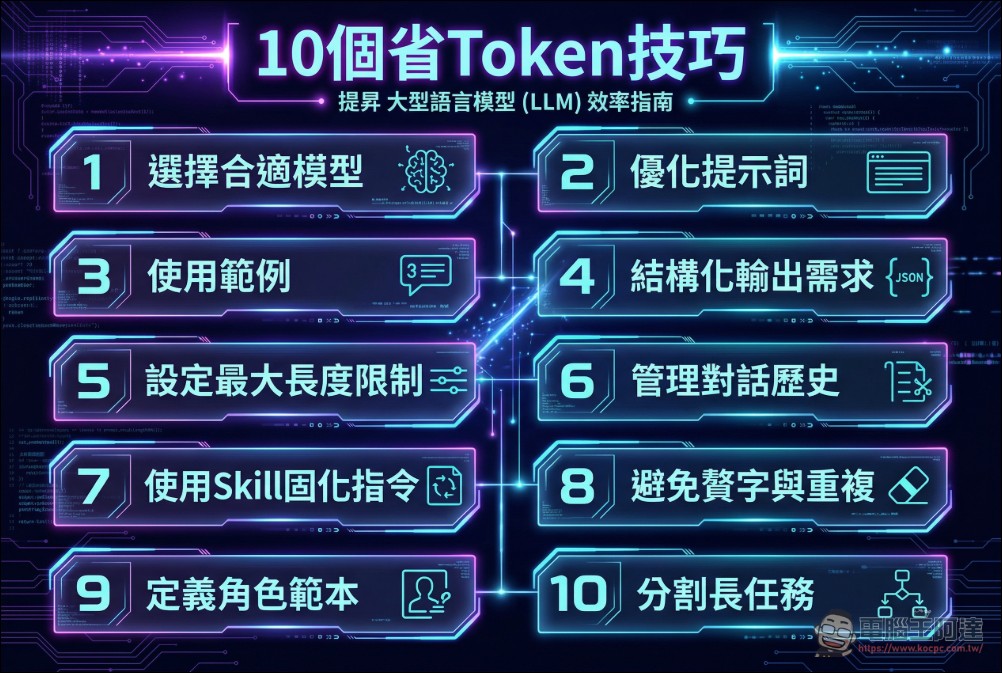
Here’s a collection of 10 token-saving techniques validated through real-world testing by the developer community. Some techniques can be stacked for even more impressive results.
Tip 1: Choose the Right Model
Not every task requires Opus. Choosing the right model based on task difficulty is the most basic and effective way to save money:
| model | Use cases | cost | Quality |
|---|---|---|---|
| Haiku | Simple tasks, data extraction, format conversion | lowest | Medium |
| Sonnet | Daily development, code review, content creation | moderate | Excellent |
| Opus | Complex reasoning, architecture design, high-quality creation | highest | Top-tier |
For simple tasks, use Haiku—input costs just $1 per million tokens and output costs just $5, saving 80% on output costs compared to Opus.
Tip 2: Optimize Prompt Structure
Verbose system prompts are hidden cost killers. Suggestions:
- Remove redundant explanations
- Combine multiple requests into a single clear instruction
- Use bullet points instead of long paragraphs
- Avoid repeating the same context information in each request
Tip 3: Use Skills to Lock in Frequently Used Commands
The so-called “token-saving skill” refers to encapsulating frequently used complex instructions into reusable Skills. CC Academy’s test datadisplay For the same verification code task, a lazy engineer can only take 3 hours, while an engineer who makes good use of Skill can comfortably use the whole day: a difference of up to 7 times.
In Claude Code, Skills let you load a set of highly repetitive instructions—system prompts, relevant file paths, and output format specifications—once and reuse them multiple times, significantly reducing Token consumption per conversation.
Tip 4: Managing Conversation History
CC Academy particularly emphasizes the importance of the ‘/clear habit’
實測資料:經過 200+ 小時的編程實測,合理使用 MCP 並保持良好的 /clear 習慣,7 美金可以用 2 小時。按一天開發 10 小時計算,也只需約 35 美金(約新台幣 1,135 元)。
Not clearing the history of long-running conversations will cause input tokens for each request to continuously inflate. Suggestions:
- After completing each milestone, run /clear to start a fresh conversation
- Manually save important conversation conclusions; do not rely on historical context.
- Use /compact to proactively compress history, keeping key information and removing redundant content

Tip 5: Use batch processing instead of multiple queries
Combining multiple related requests into a single batch process can significantly reduce overall consumption. For example, instead of asking “What does this function do?” followed by “What optimization opportunities does it have?”, ask directly: “Please explain what this function does and provide specific optimization suggestions.”
Get two answers with one request. Two uses from one input-output saves tokens in the end.
Tip 6: Make Good Use of MCP Tools
Model Context Protocol (MCP) tools are a double-edged sword: used right, it saves money; used wrong, it burns through cash faster. Here’s what CC Academy recommends:
關閉不必要的 MCP Server。每個啟用的 MCP 工具都會消耗系統資源與 Tokens,務必定期檢查並移除閒置的工具。
Only keep the MCP tools that are actually needed for the current task, and disable all others.
Tip 7: Optimize Project File Management
Don’t dump the entire codebase into every conversation. Suggestion:
- Only load files directly related to the current task
- Manually split a large file into multiple small modules and process them one by one.
- Use CLAUDE.md to define clear project scope and reduce model comprehension overhead
Tip 8: Using Prompt Caching
Prompt Caching is the most important cost optimization feature for the Claude API in 2026. Anthropic offers for cache hits90% off Special offer:
| Model | Cache write price | Cache read (hit) price |
|---|---|---|
| Opus 4.6 | $6.25/M | $0.50/mo (was $5.00, save 90%) |
| Sonnet 4.6 | $3.75/M | $0.30/month (was $3.00, save 90%) |
| Haiku 4.5 | $1.25/M | $0.10/M (was $1.00, save 90%) |
For developers who need to repeatedly load large amounts of context, this feature can help you save nearly 90% on costs.
Tip 9: Avoid Ineffective Conversations
Common ineffective dialogue patterns include:
- Vague open-ended questions
- Constantly correcting off-topic conversations
- Asking about the next step before confirming the previous result
Each ineffective round-trip avoided saves approximately 100-500 tokens, equivalent to about NT$3-15.
Tip 10: Using API for Fine-Grained Control
API parameter settings can be used to further optimize costs:
- Settings
max_tokensSet a maximum limit on single-output length to prevent the model from rambling - Use
temperatureFor controlling randomness, 0.5-0.7 is usually sufficient for general tasks. - Enable Batch API to process non-urgent tasks for better pricing
Real-world Case: Someone Reduced Consumption by 65% with Skill
Back to the “token-saving skill” mentioned in the article title: this isn’t baseless hearsay. According to discussions in the developer community, some users have packaged complete development workflows using custom Skills, compressing tasks that previously required dozens of back-and-forth conversations down to just 3-5 precise calls, reducing token consumption by 65%.
The core concept of “省 token.skill” is:Not about making AI do less, but about making how AI works more efficient。
Summary: The key to saving money is “awareness”
Although Claude’s token billing may seem complex, by mastering the following core principles, you can effectively control costs:
- Choose the right modelDon’t waste Opus on problems Haiku can solve.
- Clear HistoryMake /clear a habit – don’t let conversations quietly grow out of control
- Apply Skills FlexiblyPackage common workflows, define once and reuse multiple times
- Make good use of cachePrompt Caching can save up to 90% on repeated loading costs
- Batch thinkingAsk clearly in one go; don’t ask in multiple parts repeatedly.
The value of AI tools isn’t about “the more you use, the better”—it’s about “the more precisely you use them, the better the cost-to-performance ratio.” In today’s AI development landscape, learning to manage token costs will be an essential skill for every software engineer.
Source: KOCPC Chinese