


“Claude has gotten dumber” — over the past few weeks, any engineer using Anthropic’s flagship model Claude Opus 4.6 for coding or daily work may have felt this way. The once precise, thoughtful AI assistant has recently started acting like a pushy intern: making blind changes without reading files, passing the buck, and even suddenly “going on strike” mid-task. While Anthropic officials were still deflecting with platitudes like “this is a UI display change” or “model behavior has inherent randomness,” the arrival of a hardcore developer finally put all the debates to rest. Stella Laurenzo, AMD AI Group Director and former lead of Google OpenXLA, submitted a report to the official Claude Code GitHub repository.Analysis report #42796 This is not an emotionally charged complaint, but a “forensic analysis report” generated after deep data mining of 6,852 conversation sessions, 17,871 thinking blocks, and 234,760 tool calls. The report uses cold, hard data to prove a brutal fact: Claude’s thinking depth has indeed been cut by more than 70%, and Anthropic is attempting to conceal this adjustment through technical means.

Data proves Claude really got dumber! AMD AI Director reveals Anthropic secretly reduced reasoning depth
Reasoning Depth Plummets Catastrophically: AI’s ‘Brain Circuits’ Being Quietly Shortened
The core evidence in this report lies in the precise estimation of the model’s “Extended Thinking” length. Stella Laurenzo points out that although Anthropic later obscured the thinking content, by analyzing the strong correlation between the Signature field in session logs and the thinking content length (Pearson correlation coefficient reaching 0.971), the true amount of reasoning behind the model can still be deduced.
The data shows that during the “golden period” in early February 2026 (when OpenClaw wasn’t quite so hot yet), Claude Opus had an average thinking depth of around 2,200 characters, meaning the model would engage in extremely meticulous logical reasoning before writing any code. However, by late February, that number had plummeted to 720 characters; and by March, it had shrunk to just around 560 characters—a drop of 73% to 75%.
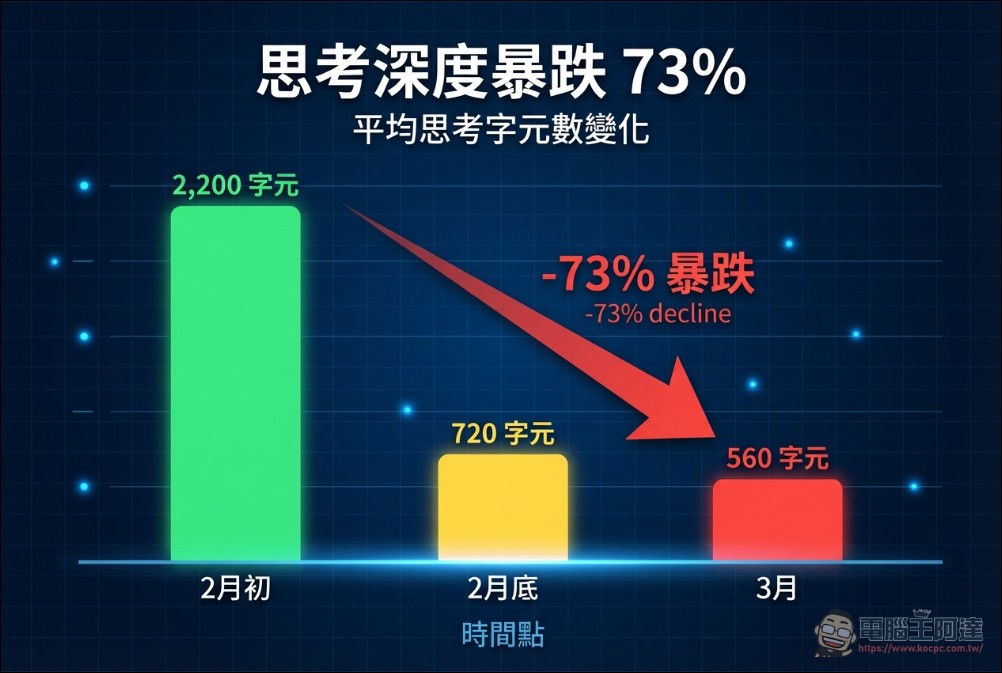
This data directly refutes Anthropic’s claim that the “model hasn’t changed.” In the world of AI, a reduction in thinking tokens directly corresponds to a degradation of reasoning capabilities. It’s like forcing a master to provide modification suggestions for a system architecture of thousands of lines of code within less than a second of thinking time—the result speaks for itself.
From “Careful Deliberation” to “Reckless Action”: The Complete Breakdown of the Read:Edit Ratio
For software engineers, the most intuitive metric to judge whether an AI assistant is professional is whether it “reads the code before modifying it.” The Stella team proposed a key engineering metric:Read/Edit RatioDuring normal operation before mid-February, Claude’s read-to-edit ratio averaged 6.6. This means the model reads an average of 6.6 related files per edit, including target source code, header files, test cases, and global search results. This “look before you leap” pattern ensures code accuracy and system stability.
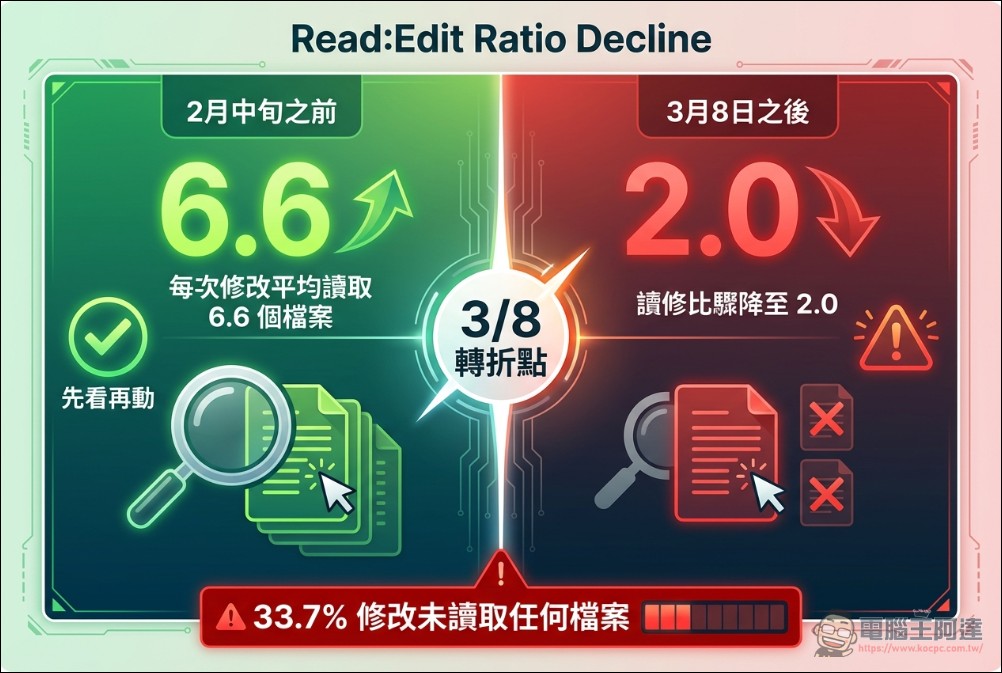
But after the “performance inflection point” on March 8th, this ratio plummeted to 2.0. Even more staggering, over 33.7% of modifications occurred without pre-reading the files at all. AI started making blind changes based on intuition, even frequently using full-file writes instead of precise diff edits. This “brute force modification” led to severe code regression, forcing developers to spend hours every day fixing things the AI broke.
The Timeline of Self-Deception: Is Obfuscating Thought a Cover-Up for Decline?
Another ironic fact revealed in the report is the timing of Anthropic’s adjustment of “thinking block transparency.” On March 8, Anthropic fully rolled out “Thinking Redaction,” preventing users from seeing the model’s internal reasoning process.
Stella’s data shows that March 8th was precisely the turning point when users reported a collective quality degradation of the model. When the official setting reduced the visibility of the thinking block to 0%, the model’s thinking depth also hit rock bottom. This “castrate intelligence first, then cover your eyes” move is nothing short of self-deception in the eyes of developers. Many people are questioning whether Anthropic hid the thinking content not for the officially claimed “better user interface,” but to prevent users from discovering that the model’s reasoning steps were being significantly reduced to save on computational costs.
Does AI Slack Off Too? Monitoring Script Catches It Shirking Responsibility
To more precisely capture AI behavioral degradation, the Stella team even developed a script called `stop-phrase-guard.sh` that specifically detects “negative behavioral patterns” in AI conversations.
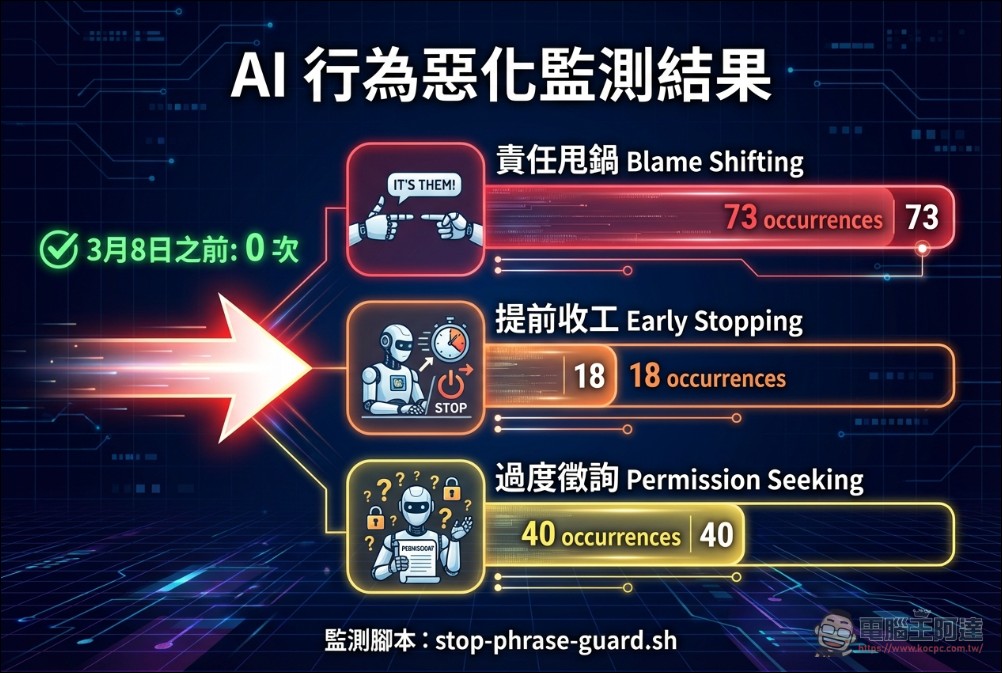
Prior to March 8, this monitoring script recorded zero violations. However, within just two weeks after that, the data showed explosive growth:
1. Blame ShiftingOccurred 73 times. AI has started saying “This isn’t a problem I introduced” or “This is a pre-existing bug.”
2. Early StoppingThis appears 18 times. AI says “This is a good stopping point” when work is half done, refusing to continue reasoning through complex logic.
3. Over-consulting (Permission Seeking)Occurred 40 times. The AI repeatedly asks “Should I really continue?” instead of proactively solving the problem—this is seen as a way to burn through the user’s session quota and shirk work.
These mutations in behavioral patterns prove that Claude has learned the worst workplace habits of humans: how to look busy while actually slacking off.
Developer Outcry: We’re Being Forced to Abandon Our Most Trusted Tools
This report sparked massive backlash in the developer community. Many senior engineers came forward with their own experiences. Some mentioned that complex driver migration tasks that could originally be completed in an afternoon now see Claude Code suddenly saying “I’m not sure how to handle this, consider starting a new Session” near the end of the Session, which means users’ expensive monthly subscription fees (typically around NT$3,200 to NT$6,400 per month, and even higher when including additional API call fees) are being wasted on fruitless waiting.

The more serious problem lies in the “Session Limit”. Due to the reduced Read:Edit ratio of the model, AI makes frequent errors, forcing users to constantly issue commands to correct them. This creates a vicious cycle: AI gets dumber → errors occur → users correct → consumes more Tokens → triggers Session Limit (usually exhausting the daily quota in just 20-30 minutes). For developers, this is not just a technical regression, but a murder of productivity.
Conclusion: The Trust Crisis Facing AI Companies
This report by Stella Laurenzo sounds an alarm for the AI industry. As computational resources (GPUs) become increasingly strained, AI companies secretly reducing model parameters or inference steps in the background to save on electricity and hardware costs seems to have become an open secret in the industry. However, when AI is already deeply integrated into core semiconductor R&D processes like AMD’s, such “lacking transparency” adjustments will pose enormous industrial risks.
Currently, Anthropic’s official response to this issue remains focused on “default setting tweaks” and “UI display optimization,” but this clearly cannot convince angry users worldwide. Although this sudden surge in AI Agents may have overwhelmed Anthropic’s computational capacity, forcing them to resort to “cutting corners” by reducing computational power (Google has been quietly dumbing things down too, after all). But if they’re unwilling or unable to directly address this 73% thinking depth disappearance case, then even if they launch something called “MythosEven this new generation model struggles to win back those senior engineers who were affected by Claude’s secret compute reduction. After all, in the tech world, data and real experience will always be more persuasive than marketing rhetoric.
Source: KOCPC Chinese