


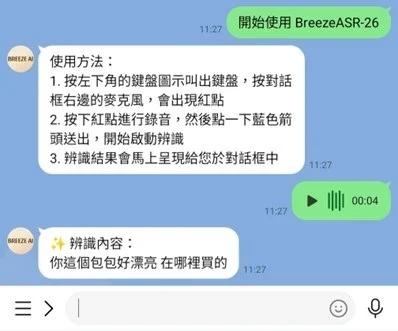
Previous ASR (Automatic Speech Recognition) systems could generally only recognize Mandarin. If you said: “你這個 kha-bang 有夠媠(包包有夠漂亮),在哪裡買的” — a sentence mixing Mandarin and Taiwanese Hokkien as is common in daily conversation — past speech recognition systems were almost completely unable to understand it correctly. MediaTek Research recently unveiled the Breeze 3 series models, with the most notable being Breeze-ASR-26, Taiwan’s first open-source speech recognition model specifically designed for Taiwanese Hokkien, capable of handling real-world conversational scenarios where Mandarin and Hokkien are mixed. This is not only a technological breakthrough but also demonstrates how Taiwan’s local AI teams are making substantive contributions to mother tongue preservation and digital equality.
From “What’s the Peanut?” to Understanding Taiwanese: The Evolution of the Breeze Series
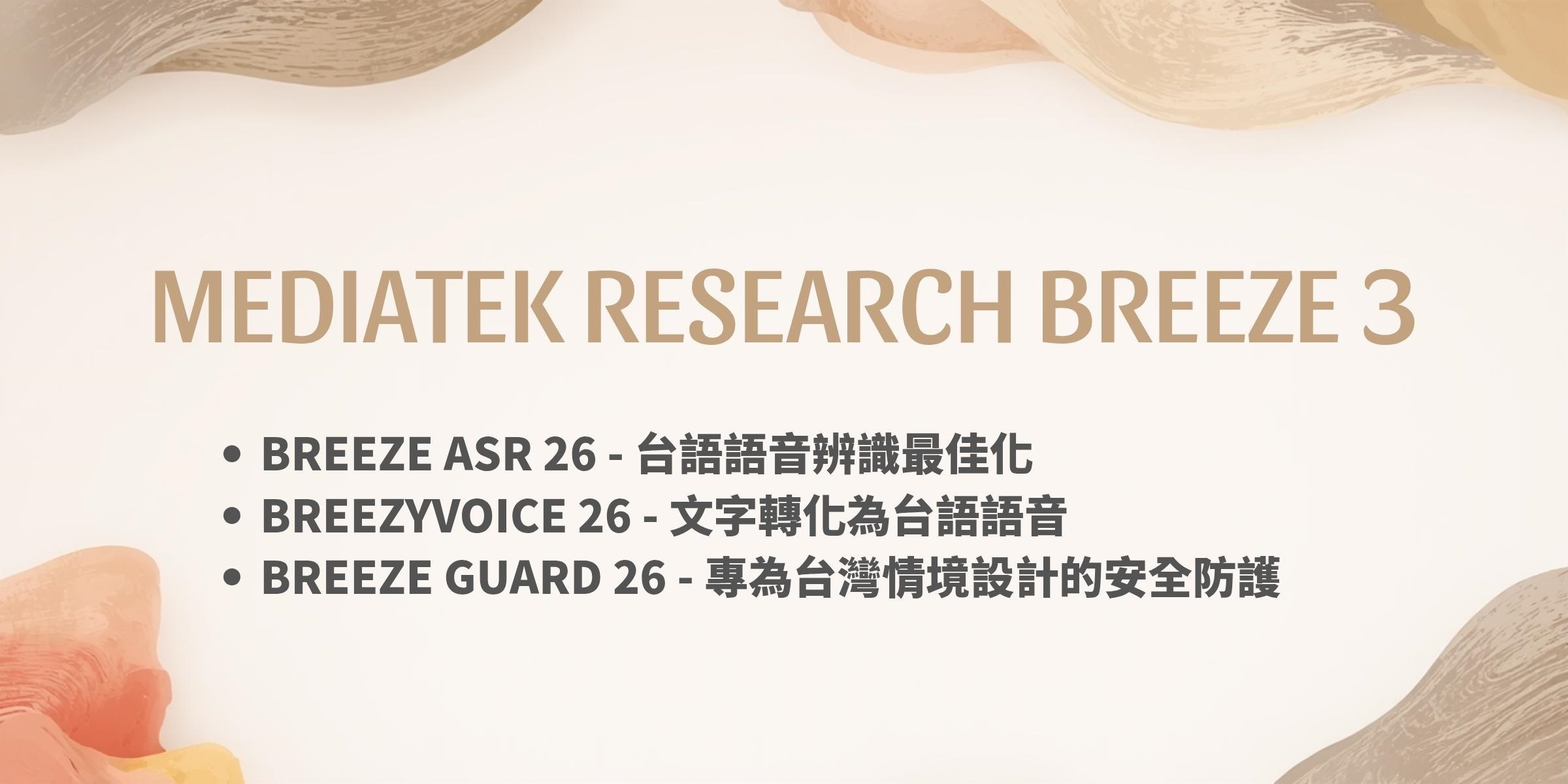
In 2025, MediaTek Innovation Hub launched Breeze-ASR-25, a speech recognition model built on the OpenAI Whisper architecture, specifically optimized for Taiwanese Mandarin accents and vocabulary. It addressed a persistent pain point for Taiwanese users: international speech recognition systems frequently misheard “fa sheng shen me shi” (發生什麼事, “what happened”) as “hua sheng shen me shi” (花生什麼事, “peanut what”). The model improved local speech recognition accuracy by approximately 10%, with code-switching recognition capabilities—handling mixed Mandarin, Taiwanese Hokkien, and English—surging by 56%.
However, ASR-25 only supports Taiwanese Mandarin, and its recognition capability for Taiwanese remains limited: in Taiwanese tests, the Character Error Rate (CER) is as high as 49.99%, meaning approximately one in every two characters is wrong. Breeze-ASR-26, released this time, was precisely created to address this issue.
Breeze-ASR-26 Technical Architecture and Training Methodology
Breeze-ASR-26 is also fine-tuned based on OpenAI’s Whisper large-v2 architecture, with 2 billion (2B) parameters, stored in Safetensors format, and released as open source under the Apache 2.0 license.
For the training data, the research team used approximately 10,000 hours of synthetic Taiwanese Hokkien speech for training. This synthetic data covers diverse speakers, speaking styles, acoustic environments, and Mandarin-Taiwanese mixed conversational scenarios. Notably, the training data was deliberately designed in natural conversational mode rather than formal reading materials, to capture the authentic usage patterns of Taiwanese Hokkien in daily life.
The model’s output uses Mandarin Chinese characters rather than Taiwanese Hokkien etymological characters (such as the official Taiwanese Hokkien orthography established by the Ministry of Education). The research team points out in their paper that since there is no one-to-one correspondence between Taiwanese Hokkien and Mandarin, even perfect Taiwanese Hokkien recognition would not achieve a 0% character error rate when presented in Mandarin Chinese characters. Therefore, CER values are more suitable for relative comparisons between different systems.
Performance: Outperforming Commercial Systems and Gemini 3 Flash
To enable fair evaluation of Taiwanese speech recognition performance, MediaTek Innovation Hub has simultaneously established the “Breeze Taigi Benchmark” standardized evaluation benchmark, consisting of 30 selected Mandarin-Taiwanese paired audio clips from Executive Yuan public service announcement videos, each approximately 30 seconds long, covering diverse domains such as transportation, labor, and judiciary.
In this benchmark, Breeze-ASR-26 achieved the best result with a 30.13% average Character Error Rate (CER), outperforming several well-known systems on the market:
| system | Average CER (%) |
|---|---|
| Breeze-ASR-26 (MediaTek Innovation Hub) | 30.13% |
| Ministry of Education Taiwanese Input Method | 30.70% |
| Yating’s Verbatim Transcript | 32.11% |
| Google Gemini 3 Flash | 32.52% |
| Breeze-ASR-25 (predecessor, Mandarin only) | 49.99% |
Compared to the previous generation ASR-25’s 49.99% error rate in Taiwanese testing, ASR-26 significantly reduced it by nearly 20 percentage points, fully demonstrating the importance of dedicated fine-tuning for Taiwanese. However, the model’s performance still varies across different corpora, with the best sample achieving a CER of 14.49% while the most challenging sample reaches 52.78%.
Not Just Understanding, But Speaking: BreezyVoice-26 Taiwanese Speech Synthesis
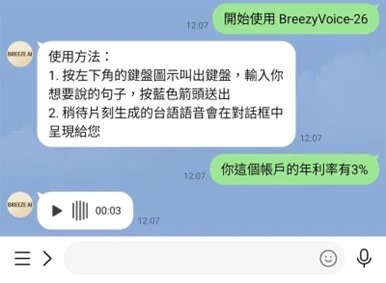
The Breeze 3 series not only enables AI to understand Taiwanese, but also allows AI to speak authentic Taiwanese. Simultaneously announced, BreezyVoice-26 is a Taiwanese text-to-speech (TTS) model built on the CosyVoice 2 architecture. In human evaluations, BreezyVoice-26 achieved a perfect MOS (Mean Opinion Score) of 5.0, with evaluators noting that its generated Taiwanese speech is nearly indistinguishable from real human speech in terms of tone and prosody, making it particularly convenient for elderly people who don’t understand Mandarin.
Breeze Guard 26: AI Safety Guardrails Tailored for Taiwan
The third member of the Breeze 3 series is Breeze Guard 26, a content safety model specifically designed for Taiwan’s social context. Built on the Breeze 2 8B base model, it was fine-tuned with over 12,000 training samples targeting Taiwan-specific risk scenarios, capable of detecting inappropriate language, scam tactics, misinformation, discriminatory speech, and political manipulation. MediaTek Innovation Hub also released TS-Bench, a Taiwan safety benchmark, establishing a standardized evaluation framework for AI safety in Taiwan.

Open Source Release and Future Outlook
Breeze-ASR-26 and Breeze Guard 26 are both released as open source, and the models can be HuggingFace They are available for free download. Additionally, the three models have been integrated into Breeze AI’s LINE official account, allowing users to directly experience Hokkien speech recognition, speech synthesis, and content safety detection features through LINE. Those interested can visit the LINE official account (Click hereGive it a try.
The research team emphasized in their paper published on arXiv that the Breeze Taigi framework provides standardized evaluation protocols, diverse training datasets, and open-source baseline models, establishing a reproducible methodology that not only applies to Taiwanese but can also be extended to speech technology development for other low-resource languages.
From ASR-25 in 2025, which enables AI to understand Taiwanese Mandarin, to ASR-26 in 2026, which enables AI to understand Taiwanese Hokkien, MediaTek’s Innovation Hub is progressively closing the gap in AI technology for Taiwan’s local languages. For Taiwanese Hokkien speakers, this means that applications like intelligent customer service, meeting transcriptions, and accessibility captions will no longer be limited to Mandarin.
Source: KOCPC Chinese