


Recently, the U.S. Federal Court officially approved Anthropic’s payment of a copyright settlement of US$1.5 billion (approximately NT$48.7 billion), setting a record for the largest copyright litigation settlement in U.S. history. The case stemmed from Anthropic’s downloading of more than 7 million books from pirated websites when training its Claude AI model. It also spent millions of dollars purchasing physical books, dismantling them, scanning them, and then destroying the original books. The details in the court ruling are shocking: a company with “AI safety” as its brand core still chose to retain all files even though it knew that the source of the books was pirated.
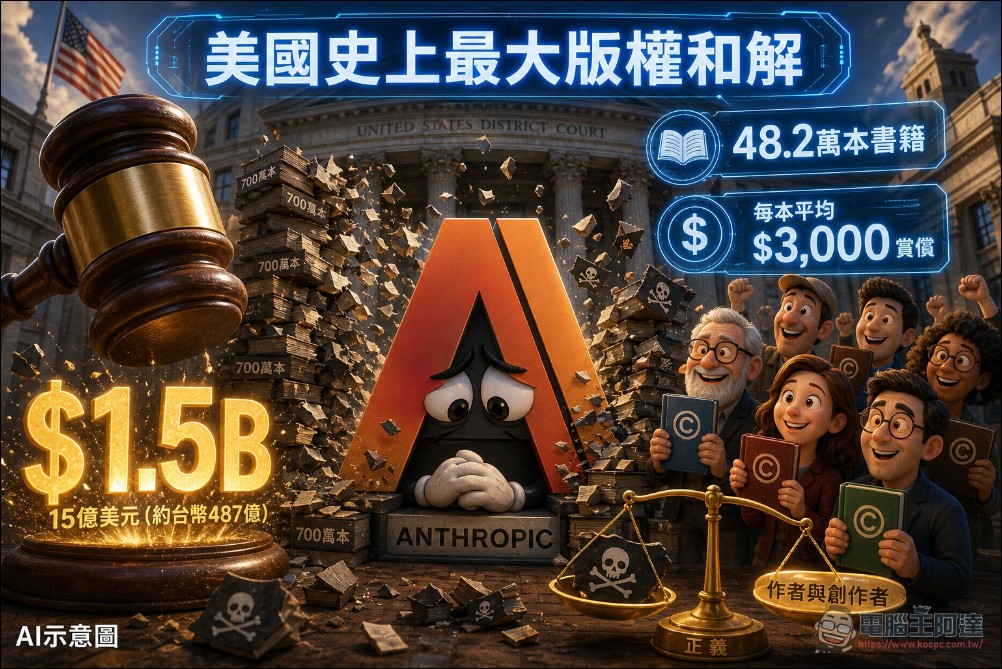
Anthropic downloads 7 million pirated books for training Claude
The court ruling revealed the complete path Anthropic used to obtain training materials. In early 2021, co-founder Ben Mann personally downloaded the Books3 data set, which contained 196,640 unauthorized books. In June of the same year, he downloaded at least 5 million books from the well-known piracy website Library Genesis (LibGen). In July 2022, Anthropic downloaded at least 2 million copies from another piracy website, Pirate Library Mirror (PiLiMi). A total of more than 7 million books have come from pirated channels, and both Ben Mann and Anthropic know that all of them are pirated.
Judge William Alsup directly wrote in the ruling that Anthropic clearly had many legal channels to obtain the books, but “preferred to steal them” because it could avoid what Dario Amodei said was legal, practical and commercial trouble. The cumulative number of pirated books downloaded exceeds 7 million, covering an astonishingly wide range.
Buy books, open books, scan them, destroy them
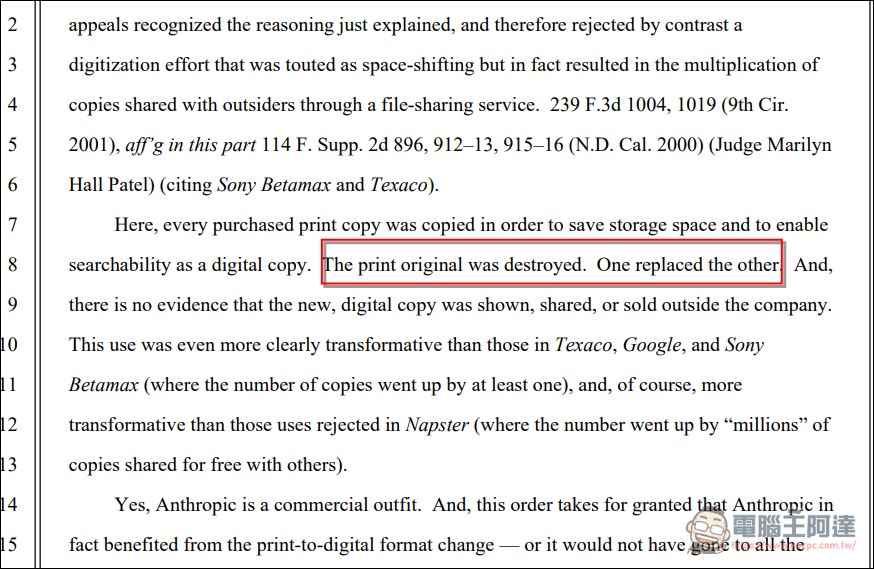
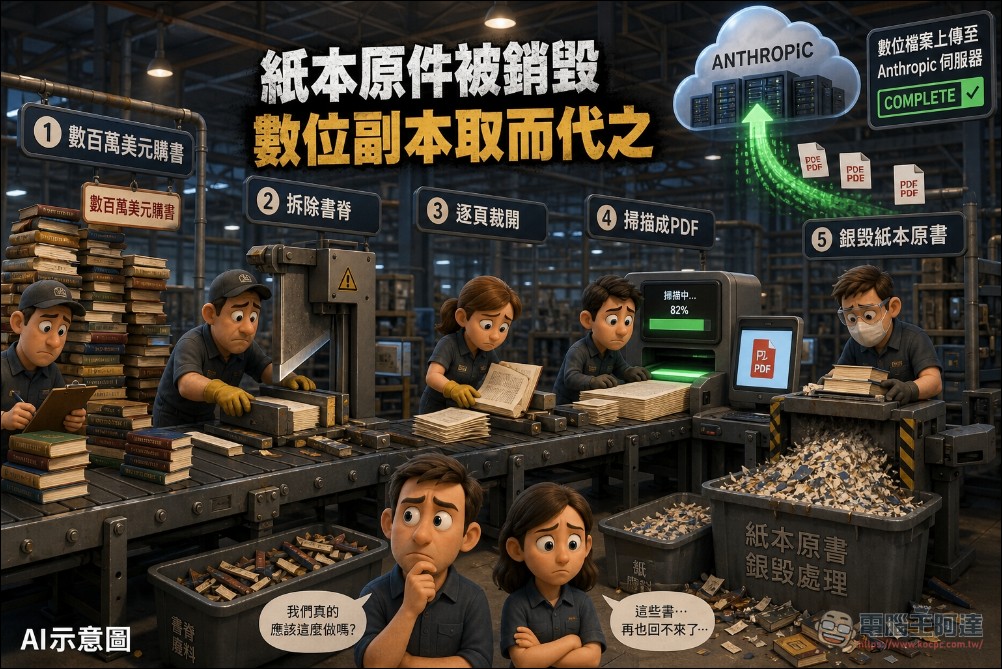
In addition to downloading pirated books, Anthropic has another way to obtain training materials that is even more shocking. The company spends millions of dollars to buy physical books in bulk, then hires people to remove the spines, cut them page by page, scan them into searchable digital PDF files, and then throw away the original paper books. The judge’s description in the verdict was: “The print original was destroyed. One replaced the other.” (The original paper copy was destroyed and replaced by a digital copy.)
In 2024, Anthropic hired Tom Turvey, the former co-lead of Google’s book scanning project, with the task of acquiring “all the books in the world.” He emailed several major publishers asking about licensing AI training. The court held that it was possible to reach a licensing agreement if the negotiations continued, but Anthropic executives stopped the copyright negotiations directly on the grounds that negotiating copyright was too troublesome and it was easier to buy books in bulk, unpack them, and scan them.
The verdict revealed that Anthropic was later aware of the legal risks and had concerns about continuing to use pirated books to train models because of “legal issues.” But the judge then wrote a key sentence: “It kept them anyway.” Even though it knew there was a problem, Anthropic still kept all the pirated book files.
What is even more concerning is that Anthropic will put all the books it acquires into a permanent “universal central library”, intending to keep them “forever”. Even if you’ve determined that certain books will never be used for training again, keep saving them. The court noted that hundreds of engineers had access to the pirated book files and made copies for other purposes. The judge even criticized Anthropic for evading discovery and trying to conceal the full extent of its inner workings.
The line between fair use and infringement
On June 23, 2025, Judge Alsup made the first judicial judgment in the United States on the “fair use” of generative AI, dividing the case into two levels. First, using books to train AI models is considered fair use because it is “highly transformative.” The judge wrote that the purpose of large-scale language models is to produce new content, just like readers who aspire to become writers learn while reading, and there is no intention to copy or replace the original work. Legally purchasing a physical book and then digitizing and destroying the original book is also considered fair use.
Second, downloading more than 7 million books from pirated websites and establishing a central library for permanent storage does not constitute fair use. The judge believed that the pirated book archives functioned as “substitutes for paid copies” and were not transformative. Anthropic later purchased a book that had been previously stolen from the Internet, which does not absolve it of its previous piracy liability.
Elements of $1.5 billion settlement
After Alsup retired, the case was assigned to Judge Araceli Martinez-Olguin. On July 20, 2026, she formally approved Anthropic’s $1.5 billion settlement with the author group. The settlement covers more than 482,000 books, about 91% of which have been claimed by authors or publishers, with an average compensation of about US$3,000 (approximately NT$97,000) per book. This is the largest copyright lawsuit settlement in U.S. history and the first major settlement among dozens of AI copyright lawsuits.
Under the agreement, Anthropic will destroy the original pirated archives and any copies, but the company will retain rights to the legally purchased and scanned books. 14,087 works of British publishing house Bloomsbury (publisher of the Harry Potter series) are covered by the settlement. After deducting about 10% of attorney fees and related expenses, the compensation will be divided equally between the publisher and the affected authors.
The moral ambivalence of AI security companies
The most ironic thing about this case is that Anthropic has always positioned itself as a “more responsible and safety-focused” AI company. The company promotes the importance of AI safety to the world every day, but it has chosen the most unethical path in obtaining training data. Anthropic doesn’t pirate because it doesn’t know the copyright rules. It knows where the formal authorization channels are, it also knows that the books are pirated, and it also knows that there are legal risks in continuing to use them. It just feels like it’s too cumbersome to follow the formal process.
This ruling also draws an important line for the AI industry: training AI with legally obtained books is fair use, but obtaining books from pirated websites must bear legal consequences. Currently, OpenAI, Microsoft, Meta and other companies are facing similar copyright lawsuits, and the verdict of the Anthropic case will become an important reference indicator for subsequent cases.